
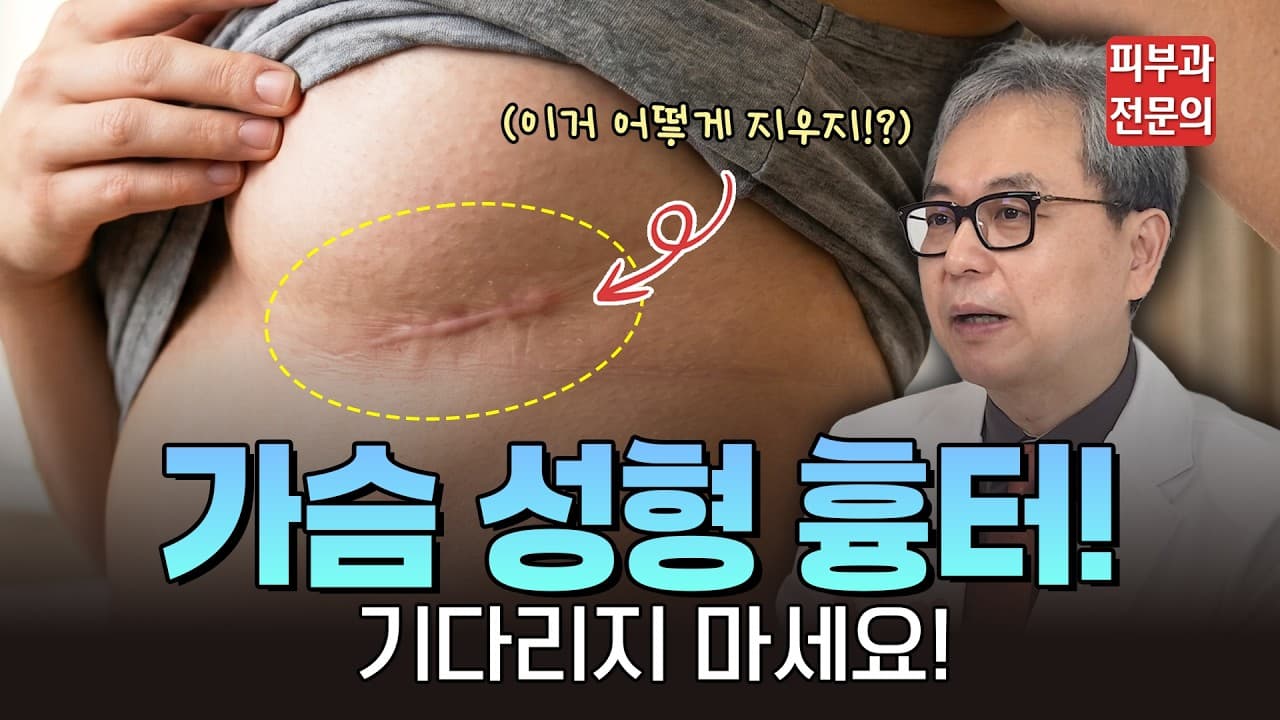
Breast augmentation is a surgery chosen by many, with nearly 15,000 cases annually in Korea. However, since skin damage occurs during the incision process for implant insertion, it is not entirely free from the possibility of post-surgical scarring. Today, we will provide detailed information on how to effectively eliminate and prevent scars that may occur after breast augmentation.
Why do scars form after breast augmentation?
When performing breast augmentation, the incision site is often chosen from the armpit, inframammary fold, or areola to make the scar less noticeable. For breast augmentation surgery, incisions are usually made in the armpit or inframammary fold, while for breast reduction surgery, incisions are often made around the areola. Young women, in particular, often undergo surgery using the armpit or inframammary incision method, which can result in red or white linear scars in these areas.
Scars are more likely to form in areas where the skin is under a lot of tension or experiences frequent movement.
- Armpit: As an area with frequent movement, there is a possibility of scar formation.
- Inframammary fold: During breast augmentation, the skin is pulled downwards, creating tension, which often leads to scarring.
Characteristics of scars by area and considerations for prevention
Generally, the armpit area is reported to be slightly more advantageous than the inframammary incision in terms of scarring. However, plastic surgeons who insert implants choose the most appropriate method for each patient, so it is difficult to definitively state that one area is always correct. Nevertheless, from a scar prevention perspective, if a choice between the two areas is possible, selecting the armpit area may be helpful. If the breasts are augmented to a size significantly larger than their original size, the skin will be stretched considerably, making it difficult to completely avoid scars.
When should breast augmentation scars be treated?
Scars respond better to early treatment, so it is advisable to start treatment as soon as possible. In dermatology, we recommend laser treatment starting 1-2 weeks after stitch removal, when the scar is still in its early, reddish stage. The initial stage, right after the wound has healed and stitches are removed, is the golden time for scar treatment.
In the past, there was a perception that waiting 6 months was the standard, but the latest medical trends are different. Recent studies have shown that starting fractional laser treatment in the early stage after surgery can reduce side effects and effectively prevent scars safely.
Even old breast scars can be treated. While 100% removal is not possible, if the goal is to achieve 50-70% or more improvement from the current state, treatment can certainly be attempted.
How are various breast augmentation scars treated?
There are various treatment methods depending on the shape, size, and height of the scar.
- Red linear scars: Vascular lasers help improve the reddish color.
- Raised or widely spread scars: Laser treatment can significantly improve these. Especially for raised or reddish keloid-like scars, good effects can be expected.
- Scars with straight incision lines or uneven lines: The Pinhole Technique can be used to transform straight incision lines into tiny dots, making them less noticeable, or to soften hardened scar tissue, helping the line settle naturally. The Pinhole Technique, first reported and established in academia in 2005, is used to precisely identify the depth and strength of the scar and create microscopic holes to improve the tissue.
- White, raised, or depressed scars after nose surgery or philtrum reduction: These require very precise leveling of the skin. Using Ultrapulse Alpha, known as an advanced fractional laser among existing ones, it is possible to minimize damage to surrounding healthy skin and selectively refine only the scar tissue. This can significantly reduce post-treatment redness and recovery time, helping patients receive treatment without disrupting their daily lives.
In the past, there were no special methods other than injection therapy, but recently, a combination of laser and injection therapy has shown good results.
Daily efforts for scar prevention and management
If breast augmentation is necessary, there are several ways to minimize scarring.
- Early laser treatment: As mentioned earlier, early laser treatment starting 1-2 weeks after stitch removal is effective in preventing scars.
- Scar ointment: Consistently applying scar ointment at home can be helpful. Ointments are reported to have a scar improvement effect of about 5%.
- Taping: Distributing tension, one of the main causes of scar formation, is very important. Taping areas under high tension to distribute the force can be much more effective than ointment.
What patients want is 'natural recovery'
With over 12,900 posts related to cosmetic surgery scars online in the past month, many people are concerned about scars. The keywords that patients were most anxious about were 'sagging' and 'blunt', while the overwhelmingly positive keywords they wanted to achieve through treatment were 'natural', 'soft', and 'fast recovery'. This indicates that patients desire natural improvement, close to their original skin, without the risk of reoperation and without obvious signs of surgery.
If, even a year after surgery, the line is uneven like a sausage, it is likely not swelling but rather hardened scar tissue where the internal skin tissues have tangled. If the line is re-excised in this state to lower it, it will further damage already compromised tissue, increasing the risk of the skin texture becoming harder and more unnatural.
It is important to choose scientific treatment proven by data and research rather than vague information or aimless waiting. We recommend consulting with a dermatologist to establish an appropriate treatment plan so that your skin can become healthy and natural again.