
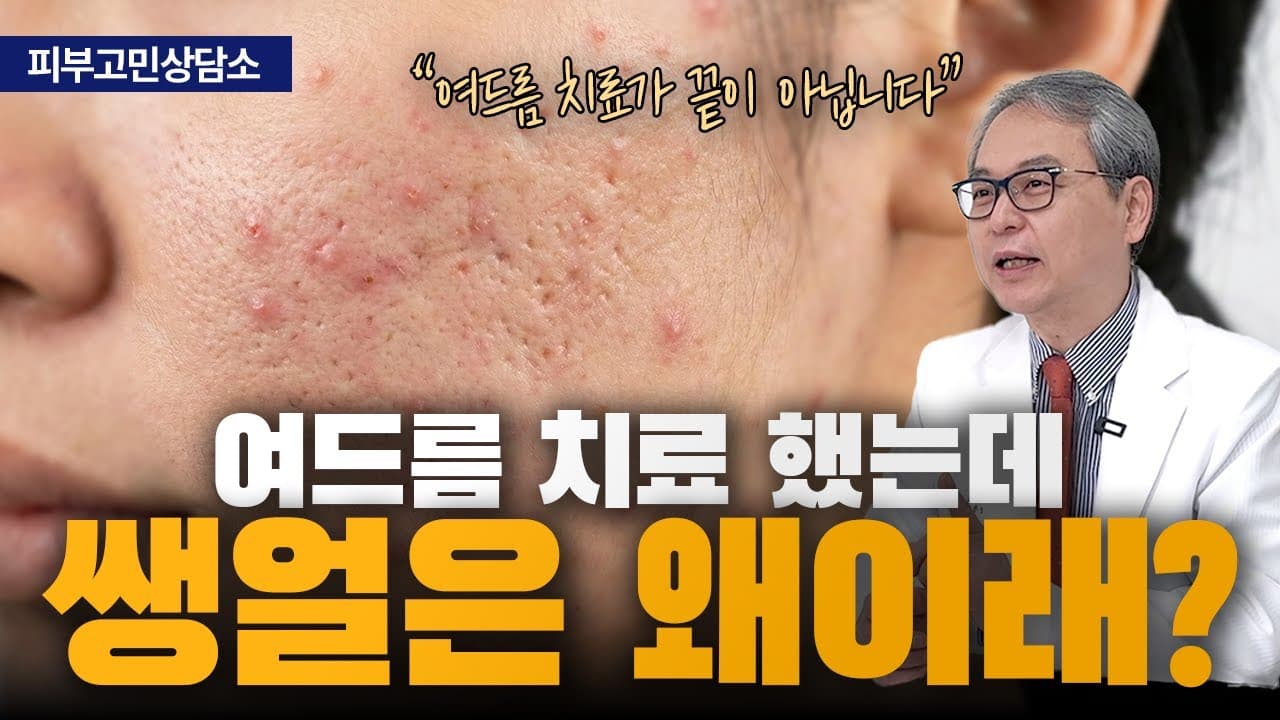
Even after acne has cleared, if you look in the mirror and your skin appears messier, it's because the scars from the battle remain. If you have red scars and enlarged pores on your face, it's difficult to look clean. After acne, three issues often arise: red scars, enlarged pores, and raised scars. Since their causes differ, the treatments must also differ.
We examine the three types of marks left after acne
- Red scars are a state where blood vessels, enlarged from fighting inflammation, have failed to contract.
- Enlarged pores are the result of weakened support structures, leading to larger openings and reduced elasticity.
- Raised scars can include keloids on the jawline or papular scars on the nose or chin.
Since all three causes are different, it is difficult to resolve them with a single method.
Red scars are a vascular problem, not a pigment problem
Red scars sometimes disappear within six months, but often persist for over a year. Many people mistake them for pigmentation, but they are actually a problem of blood vessels that have enlarged and failed to contract.
Only a vascular laser that targets redness can help erase the dysfunctional blood vessels.
The yellow laser beam mostly passes through healthy skin, but when it encounters red blood vessels, the red blood cells inside react and coagulate the vessels. As a result, unnecessary blood vessels disappear, and a reduction in redness can be expected immediately after the procedure.
Enlarged pores need to be filled from within and tightened from without
It is reasonable to view enlarged pores after acne as widened pathways where sebum was excessively secreted. Once widened, these pathways do not shrink on their own and often become larger with age.
In such cases, treatments like Potenza or Fraxel DUAL lasers are used to precisely tighten the area around the enlarged pores. The dermal structure needs to be rebuilt, filled from within, and tightened from without, to make enlarged pores firm and taut again.
Raised scars cannot be squeezed out
Some people mistake raised scars for comedones and keep trying to squeeze them, but they won't come out. Raised scars are divided into two types. Large, red bumps on the jawline are often keloid scars, while rough, cobblestone-like bumps around the chin are papular acne scars.
Papular scars are known to be difficult to treat. A paper published by Dr. Lee Sang-joo includes a key passage stating that the Pinhole Technique, which creates microscopic holes with a laser, regenerates the tightly tangled collagen bundles within the scar and rearranges them smoothly. Actual case studies in the paper confirmed that long-standing, bumpy, cobblestone-like chins subsided and blended with the surrounding skin after Pinhole Technique treatment.
Treating only depressed scars is not the end
Treating only depressed scars is not the end of acne scar treatment. You will only hear that your skin looks clean when the red tone is corrected and the skin texture is refined. Addressing each type of mark with its specific method will harmonize the overall appearance.
Yonsei Star Dermatology will provide the solution to the persistent aftermath of acne.
Results may vary by individual, and accurate diagnosis and treatment are determined after consultation.
Written by Lee Sang-joo (Yonsei Star Dermatology) · Medical Staff Introduction · Last reviewed 2026-06-04