
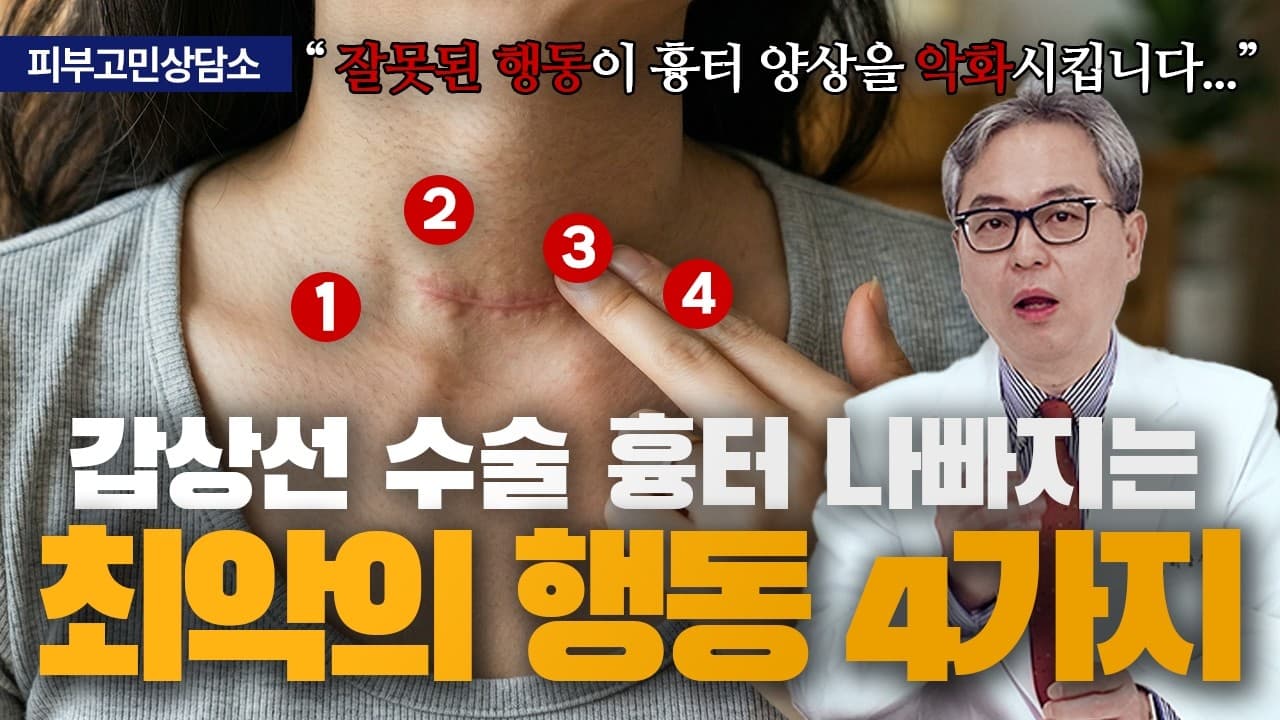
Thyroid surgery scars are often a greater concern due to their location. Thyroid surgery frequently involves incising the skin on the front of the neck to precisely remove a tumor, followed by suturing. Even with various surgical methods available to conceal scars, traditional incision is sometimes still chosen for its safety and accuracy. Therefore, managing scars left on the neck is crucial.
The neck is an area where scars are prone to widening
Scars are the result of the body producing collagen to fill in an incised area. The neck is a visually exposed area that is constantly stretched when breathing, speaking, or moving the head.
This continuous pulling force acting on the scar area is called tension. Because the neck experiences significant tension, scars can easily widen or swell.
Basic care immediately after suture removal is most important
Early management is key to minimizing scar deformation. After sutures are removed, it is fundamental to follow a routine to prevent the scar from widening:
- Using tape to hold the scar together and prevent widening
- Silicone sheets or silicone gel ointments to physically block external friction
- If necessary, combining with vascular laser or Botulinum Toxin to prevent scar enlargement
Combining these treatments from the early stages of wound healing can help prevent scars from becoming larger.
Scars appear shiny due to differences in texture
Even with consistent application of ointment, scars often appear shiny and prominent. This is not just due to a change in color to white, but also because the texture has changed.
Normal skin has pores, which scatter light in all directions, maintaining a slightly matte finish. In contrast, scars lack pores and have a smooth surface, causing light to reflect in one direction, making them appear glossy, like light reflecting off a window. Over-the-counter ointments and general methods can help to slightly lighten the color, but they have limitations in restoring lost skin texture.
Even old, hardened scars can have their texture restored
Even scars that have hardened over time can be treated. Old scars are caused by tough, tangled fibrous tissue deep within the skin.
Our frequently used method involves creating microscopic, pore-like channels deep within the scar to physically loosen the hardened fibrous tissue and induce new collagen. As new skin fills in these channels, the lost texture of neck wrinkles can be restored, and the glossy scar can blend with the surrounding skin, returning to a matte-like texture.
Four habits that worsen scars
Sometimes, well-intentioned care can actually worsen scars. It is best to avoid the following habits:
- Repeatedly over-stretching the neck to prevent adhesion
- Constantly touching and rubbing the scar area to try and soften it
- Excessively applying alcohol or disinfectants to a fully healed scar when there is no infection
- Arbitrarily using unverified products or cosmetics claimed to be good for scars
Repeated irritation can add tension to the skin, widening the scar area, and secondary inflammation can lead to pigmentation or thickening.
The goal of scar treatment is skin texture continuity
The core of scar treatment is to reconnect the broken skin texture. The goal of medical intervention is to restore the shiny texture to match the surrounding skin, helping patients no longer be conscious of their scars in daily life.
Results may vary by individual, and accurate diagnosis and treatment are determined after consultation.
If you are deeply concerned about scars on your neck, we recommend seeking a consultation to find the right approach for your scar type, rather than relying solely on self-care.
Written by. Dr. Lee Sang-Joo, Chief Director (Yonsei Star Dermatology) · Medical Staff Introduction · Last reviewed 2026-06-04