
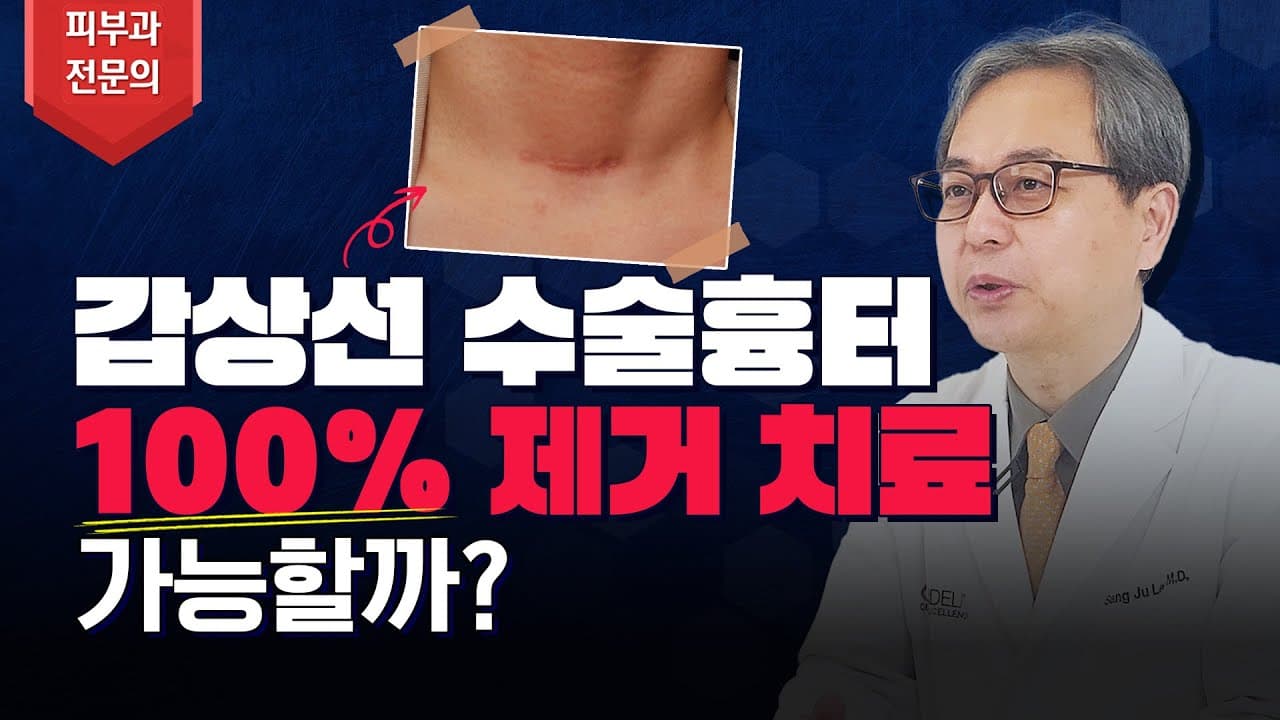
Hello, I am Dr. Sang-Ju Lee, a board-certified dermatologist. According to national cancer registration statistics, thyroid cancer has been the most common cancer among Koreans for the past 10 years. In particular, thyroid surgery involves an incision in the lower part of the neck, so if a scar remains, it is easily visible to others, and many people wish to have it removed. Today, we will learn about management methods to prevent scars after thyroid surgery and effective ways to improve existing scars.
Importance of Early Treatment
Scar treatment is best started within 1 to 2 weeks after removing the stitches. It is important to start treatment as early as possible to prevent the scar from deepening or widening.
Thyroid Surgery Scar Prevention Management Methods
Methods to prevent thyroid scars can be broadly divided into three categories:
- Use of Ointments and Patches: Applying silicone-based patches or onion extract-based ointments available on the market can be helpful. However, ointments alone may not provide sufficient effect.
- Concomitant Laser Treatment: Laser treatment is known to have a scar prevention effect of over 50%. It can be received with little disruption to daily life, helping to minimize scar formation.
- Consideration of Injection Treatment: If the wound does not heal quickly or the scar swells, injection treatment may be combined.
Why are Thyroid Surgery Scars More Concerning?
Thyroid surgery scars often remain as a straight line in the exposed lower neck area, making them noticeable. Some medical professionals may place the incision line along a wrinkle line to make it appear similar to a wrinkle, but this is not always possible, and a scar may remain regardless of wrinkle lines. Young individuals, in particular, tend to have fewer wrinkles, making scars even more prominent.
Furthermore, the neck area moves more than other parts, so it is common for scars to become red and swollen. In individuals with a keloid constitution, scars are prone to significant swelling. The neck is also an area where scars form more easily than the face, and even if it is not a keloid scar, it often results in a hypertrophic scar that protrudes. Therefore, if there are symptoms of scar swelling in the early stages, it is advisable to visit a hospital quickly for treatment.
How to Treat Existing Thyroid Scars?
Treatment methods to improve existing thyroid scars broadly include reoperation and laser treatment.
Thyroid scars are highly influenced by individual constitution, so even with reoperation, the improvement effect may be minimal. Therefore, for thyroid scars, laser treatment is known to be a much more effective method than reoperation. However, in rare cases of severe adhesion, surgery to release the adhesion may be necessary.
Can Old Thyroid Scars Also Be Treated?
Old thyroid scars can also be treated. Scars can be alleviated through appropriate treatment methods. However, it is important to remember that it requires more effort and time than starting treatment early.
It may be difficult for scars to disappear completely. However, with appropriate treatment and consistent management, thyroid scars can be restored to be as similar as possible to normal skin. Therefore, it is important to set realistic expectations for the treatment effect and remember that consistent effort is necessary.