
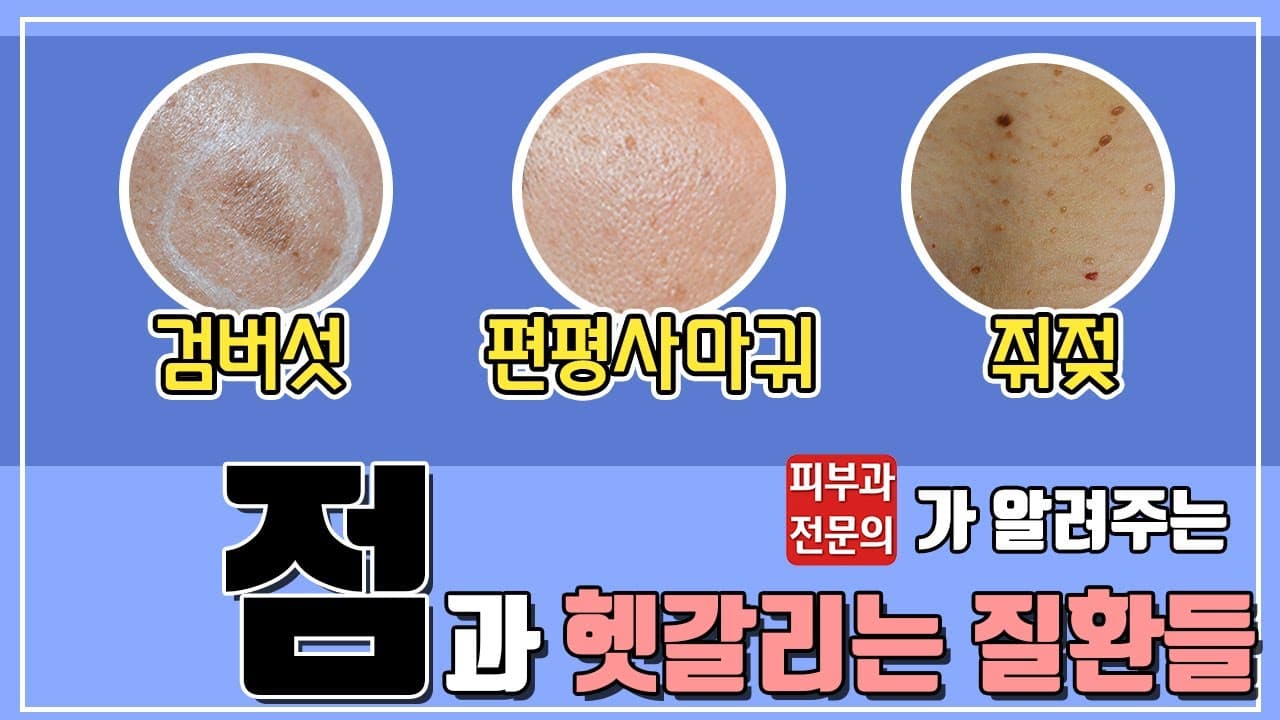
Hello, I am Lee Sang-ju, a dermatologist. Today, we will take some time to learn about skin lesions that we commonly think of as 'moles,' and various skin conditions that can be mistaken for moles.
Moles: Common but Easily Misunderstood Benign Skin Tumors
Moles are common brown or black spots on the face. There are raised moles and flat moles, and their colors also vary from black to skin tone.
Medically, moles can be thought of as a type of benign tumor formed by the aggregation of mole cells. Since they are benign tumors, they rarely cause major problems in the skin, but caution is needed as they can be confused with other conditions.
Generally, moles are treated by cauterization using a laser. However, deep-rooted or very large moles may be difficult to remove in one go and may require several repeated treatments.
Melanoma: A Dangerous Skin Cancer Confused with Moles
The first condition that can be confused with moles is melanoma. While moles are benign tumors, melanoma is classified as a malignant tumor. It is very important to detect and treat it early, as it can grow into surrounding areas or other organs.
If you experience the following symptoms, it is recommended to visit a dermatologist immediately for a precise diagnosis:
- If a mole-like growth suddenly grows significantly.
- If the skin in the affected area becomes ulcerated or bleeds.
- If the color of the mole changes.
One of the conditions that can be mistaken for moles is skin tags. Medically, they are called soft fibromas, and they appear as slightly elongated, protruding skin. They are typically skin-colored rather than black or brown. They mainly occur on the neck or around the eyes.
Skin tags are also benign tumors, so like moles, they disappear when cauterized with a laser.
Flat warts are caused by the Human Papillomavirus (HPV). Unlike moles, they are slightly brownish, slightly raised above the skin surface, and have a flat top.
Flat warts are a viral disease that can spread to surrounding areas or to others, so early treatment is important. Even if completely removed at once, recurrence is common, and re-treatment may be necessary if they reappear within a month.
Treatment methods include using antiviral medications, but due to variations in treatment effectiveness or to ensure complete virus removal, laser treatment is often used. Daily life is possible even after laser treatment, so it is best to receive treatment as early as possible if they appear initially.
Seborrheic Keratosis (Age Spots): Common Skin Changes with Age
Seborrheic keratosis is a condition medically referred to as seborrheic keratosis. Initially, it appears as flat brown lesions, but over time, it rises above the skin surface, becoming slightly larger and resembling a volcano.
The cause of seborrheic keratosis is not clear, but it is closely related to constitution, UV exposure, and aging. People whose parents have many seborrheic keratoses often develop them early, and frequent exposure to sunlight or UV rays often leads to the development and protrusion of seborrheic keratoses.
Seborrheic Keratosis: What is the Latest Laser Treatment?
Treatment for seborrheic keratosis is confined to the epidermis, so laser cauterization is often used. In the past, carbon dioxide lasers were primarily used to burn off the seborrheic keratosis.
However, recently, a treatment method has been developed where high energy is irradiated onto the skin using GentleMax PRO or pigment lasers, causing only the seborrheic keratosis area to form a scab and fall off. This method allows for daily life without applying regenerative tape after the procedure, making treatment more convenient.
Lifestyle Habits for Preventing Seborrheic Keratosis
To prevent seborrheic keratosis, the following efforts are important:
- Consistently paying attention to UV protection
- Maintaining healthy lifestyle habits
Today, we looked at moles and various skin conditions that can be mistaken for moles. If you have any questions, please feel free to contact us via comments or KakaoTalk. Thank you.