
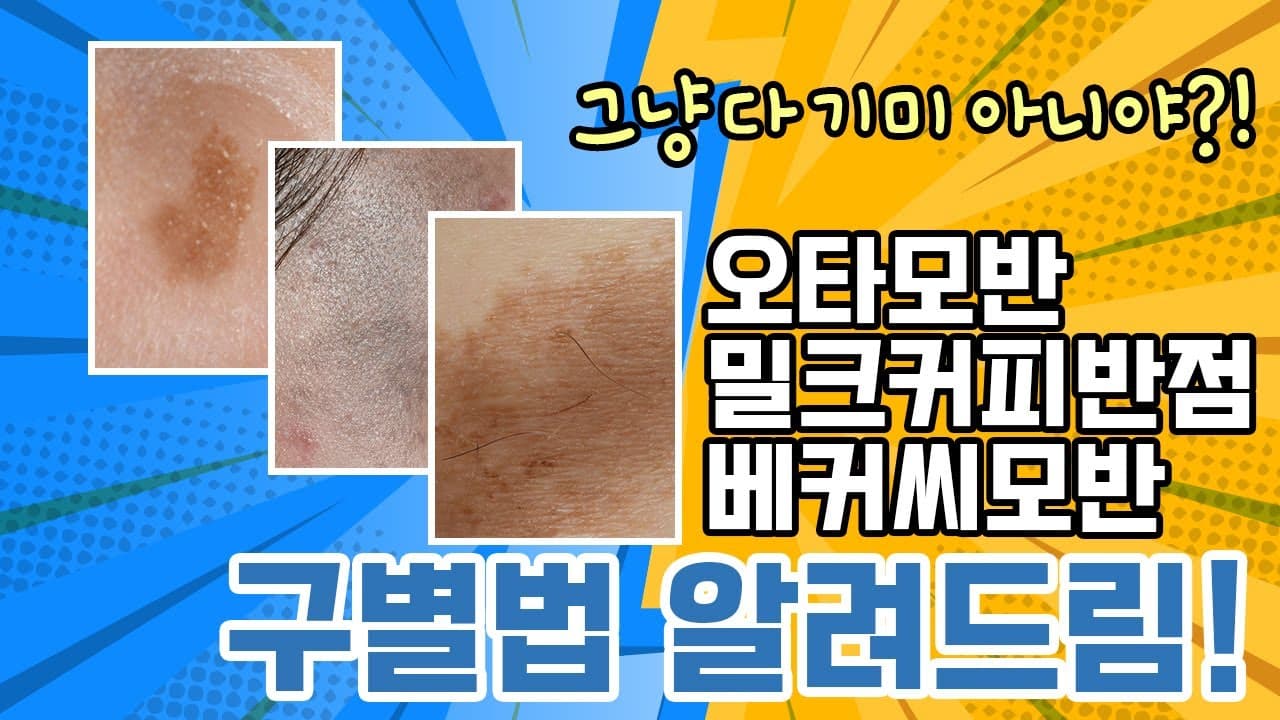
Hello. I am Lee Sang-ju, a dermatologist. Today, we will take a detailed look at three pigmentary disorders that often appear on the face and are easily mistaken for melasma or blemishes: Nevus of Ota, café-au-lait macules, and Becker's nevus. Although these conditions may look similar, their causes and treatments are completely different, so accurate differentiation is important.
Thought it was melasma, but could it be Nevus of Ota?
Nevus of Ota is a nevus that primarily appears as a bluish color around the eyes. Unlike common melasma or blemishes, which are brown, Nevus of Ota is characterized by its bluish tint, much like deep water appears blue, because the pigment cells are located deep within the skin. It usually occurs on one side around the eye and tends to darken gradually during puberty.
In the past, treating Nevus of Ota was very difficult, but with the advancement of pigment lasers, it has now become a treatable condition. It is known that starting treatment early can lead to good results, and it may even be almost completely removed. Therefore, if Nevus of Ota is suspected in a pubescent student or at a young age, it is important to visit a nearby dermatology clinic or a laser-specialized dermatology clinic for early treatment.
Café-au-lait macules, soft brown spots like their name suggests
Café-au-lait macules are also called 'Café-au-lait macule' and are characterized by their light brown color, similar to milk coffee or café au lait. These spots are caused by an excessive proliferation of pigment cells in the skin and the production of a large amount of melanin cells, often appearing one or two at a time on the face or body.
Café-au-lait macules begin to appear immediately after birth or in infancy and tend to darken gradually with age. They can occur anywhere on the body, including the face, arms, legs, and torso.
The treatment results for café-au-lait macules can vary greatly depending on their shape. In particular, cases with irregular, bumpy borders or small sizes tend to respond relatively well to treatment.
Pigment lasers are mainly used for treatment. In the past, treatments often involved removing spots with strong energy, but recently, treatments using low-energy lasers, such as PicoWay Laser, which selectively destroy only melanin cells while minimizing disruption to daily life, are preferred.
However, café-au-lait macules can be associated with systemic diseases, and recurrence is common after treatment. Therefore, it is advisable to consider multiple treatments and manage them consistently rather than ending with a single treatment.
Becker's nevus, a brown nevus accompanied by hair
Becker's nevus is a brown nevus similar to café-au-lait macules, but it is characterized by the presence of hair. It mainly occurs on the edges of the face and shoulder areas.
Becker's nevus can be somewhat more challenging to treat than café-au-lait macules because the nevus cells are often located deeper in the skin. Also, since it is accompanied by hair, it is important to treat it using both hair removal lasers and pigment lasers simultaneously.
Like café-au-lait macules, Becker's nevus also frequently recurs. Therefore, it is advisable to establish a long-term treatment plan and undergo consistent treatment rather than a single treatment. Becker's nevus often appears after puberty rather than at birth and is known to be more common in men than women due to its association with hormones.
How are these three pigmentary disorders treated?
The treatment for Nevus of Ota, café-au-lait macules, and Becker's nevus, as discussed above, primarily involves pigment lasers. However, the type of laser, treatment method, and number of sessions may vary depending on the characteristics of each condition, the depth of the pigment, and accompanying symptoms (such as hair).
- Nevus of Ota: Early treatment shows good prognosis, and complete removal can be expected.
- Café-au-lait macules: Low-energy lasers such as PicoWay Laser are mainly used to destroy melanin cells, and repeated treatments are necessary considering the possibility of recurrence.
- Becker's nevus: Treatment involves combining pigment lasers with hair removal lasers, and a long-term treatment plan is also important here.
Points to remember during treatment
These pigmentary disorders are not merely cosmetic issues; in some cases, they may be associated with other diseases, and consistent management is often required during the treatment process.
- Early diagnosis and treatment: In the case of Nevus of Ota, better results can be achieved by starting treatment early.
- Possibility of recurrence: Café-au-lait macules and Becker's nevus frequently recur, so multiple treatments and long-term management are needed rather than a single treatment.
- Consultation with a specialist: The most suitable treatment method varies depending on the characteristics of each condition and the individual's skin condition, so it is crucial to consult thoroughly with a dermatologist to establish a customized treatment plan.
We hope today's information has been helpful in understanding various pigmentary disorders that are easily mistaken for melasma or blemishes. If you have any questions, we recommend consulting with a dermatologist at any time.