
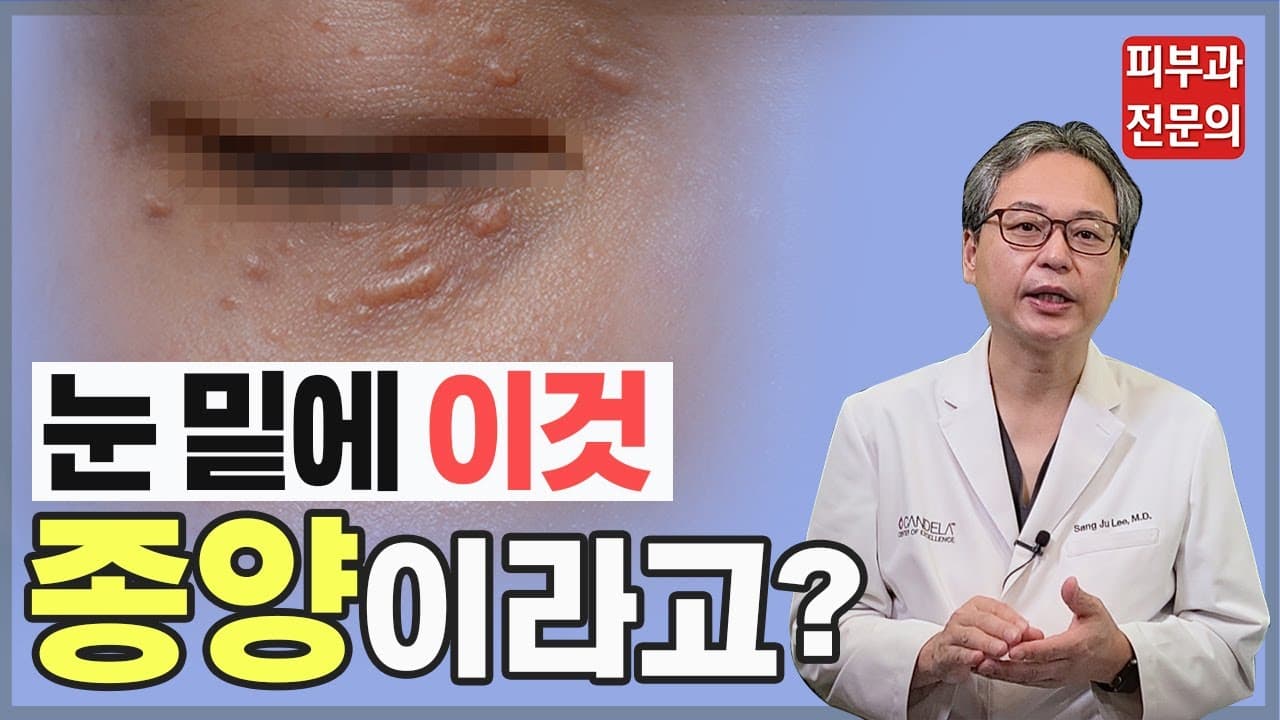
Are you concerned about small, skin-colored or brownish bumps around your eyes? These may not be simple skin troubles but rather syringomas, which are benign tumors. Syringomas are tumors that originate from sweat glands deep within the dermis, and they are particularly common in women, often causing stress as they become more prominent when trying to conceal them with makeup. Today, we will address common questions about syringomas and delve into appropriate treatment methods.
Syringomas: Why Early Diagnosis and Treatment Are Important
Early treatment of syringomas is paramount. If you discover lesions suspected to be syringomas, it is advisable to consult a dermatologist as soon as possible for an accurate diagnosis. This is because the treatment methods for syringomas differ significantly from other similar skin conditions, such as:
- Milia
- Seborrheic Keratosis
- Flat Warts
While milia or flat warts occur in the epidermis and are relatively easy to remove, syringomas have roots embedded deep in the skin, making them difficult to remove easily. Furthermore, if not treated early, the individual lesions can grow larger and merge into a plaque-like form, making treatment much more challenging. Therefore, consulting a dermatologist immediately upon discovery is the best way to achieve optimal treatment results.
Can Eyelid Syringomas Be Treated?
Yes, eyelid syringomas can be treated. However, because the skin on the eyelids is very thin, it is advisable to perform the procedure in multiple sessions, spaced two to three months apart. Since the skin is thinner compared to other areas, there is a possibility of scarring or pigmentation during the procedure. Thus, it is crucial to adjust the laser intensity appropriately and perform the treatment in several divided sessions.
Do Men Also Get Syringomas?
Yes, men can also develop syringomas. Notably, male syringomas often have a family history or genetic factors, making them somewhat more prone to recurrence. Syringomas are generally known to appear in women after puberty, so if they occur in men, we recommend seeking an accurate diagnosis from a dermatologist to confirm that it is not another similar skin condition, such as milia or seborrheic keratosis, as mentioned earlier.
Syringomas: Limitations of Past Treatments and New Approaches
Syringomas are well-known for being difficult to completely remove in one go, as they often appear as multiple millet-seed-sized bumps and have roots deep in the dermis. Past laser treatments often involved repeatedly and deeply shaving off the lesions to their roots, which sometimes led to side effects such as scarring or pigmentation. To address these side effects, Yonsei Star Dermatology has introduced a new treatment method called P.I.N.A.L. (Pinal) Method.
What is the P.I.N.A.L. (Pinal) Method?
The P.I.N.A.L. Method involves creating microscopic holes at 1-3mm intervals and using a high-output carbon dioxide laser to penetrate deep into the roots, selectively destroying the syringomas. It is known as a treatment method that minimizes damage to the surrounding skin through a single hole, thereby improving upon the side effects of conventional syringoma laser treatments.
Syringomas: A Recurrent, Intractable Skin Disease
Syringomas are an intractable skin disease with a tendency to recur. Patients often undergo several laser treatments, and when the lesions appear to have disappeared, they may arbitrarily discontinue treatment. However, because syringomas have deep roots in the skin, there is a very high chance of recurrence if the roots are not completely removed.
Arbitrarily discontinuing treatment without a doctor's instruction can increase the risk of recurrence, so the decision to end treatment must always be discussed with a dermatologist.
However, if syringomas occur due to constitutional or genetic factors, there is still a possibility of recurrence even if the roots have been completely removed.
Do Syringomas Necessarily Need to Be Removed?
Syringomas usually do not cause any particular symptoms, so their removal is not strictly necessary. However, if left untreated, they can spread not only on the face but also to the neck, genital area, and in severe cases, even throughout the body. Furthermore, early treatment can be very effective, so it is advisable to remove them quickly and appropriately if possible.
If you look in the mirror now and find any lesions suspected to be syringomas, we recommend consulting a dermatologist near you for an accurate diagnosis.