
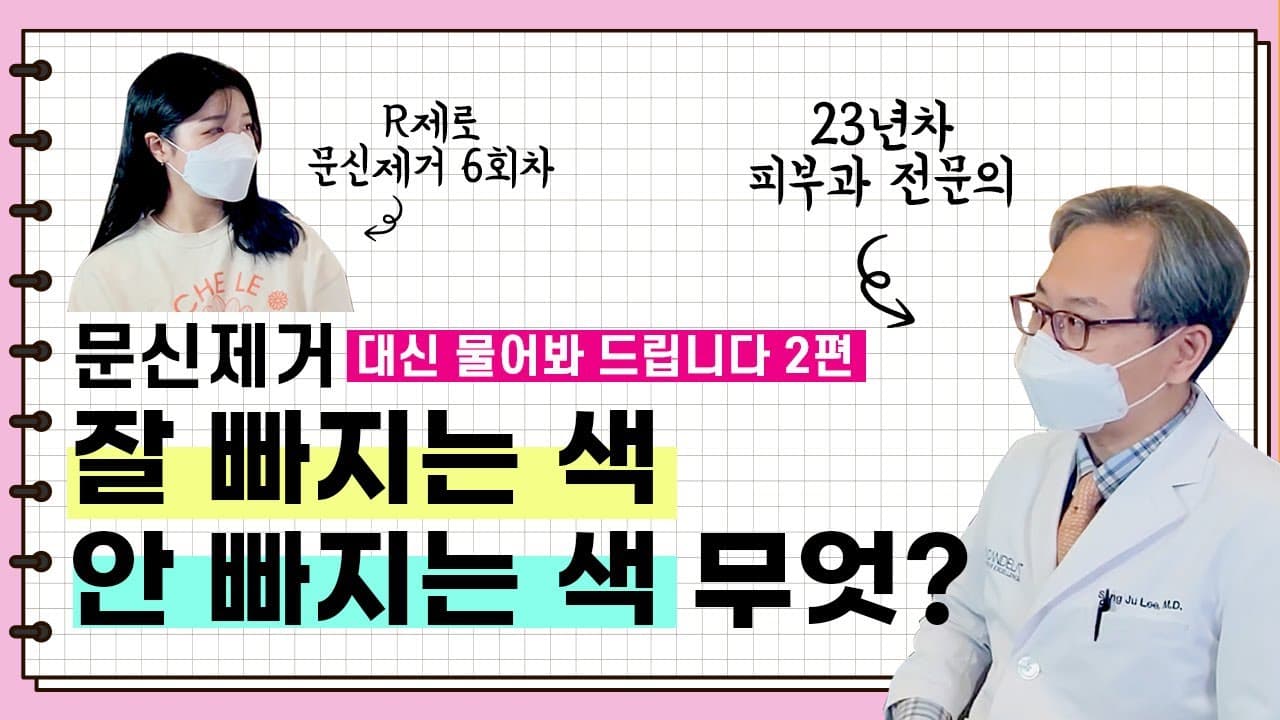
Are you considering tattoo removal? Many people wish to erase their tattoos cleanly, but unexpected questions often arise once treatment begins. Today, let's explore the key information needed to enhance tattoo removal effectiveness.
Color Tattoos: Which Colors Are Removed Best?
The ink used in tattoos varies in composition by color. This difference in composition affects the laser's reaction, leading to variations in removal speed.
-
Colors that are removed well:
- Black, Blue: These primarily contain iron components and tend to be removed relatively well.
- Red: Although previously known to be difficult to remove, it is now classified as a color that can be removed relatively well.
-
Colors that are difficult to remove:
- Yellow: Yellow, similar to skin tone, requires careful approach as excessive absorption of laser energy can damage surrounding skin.
- White: Titanium components are mainly used, and this component is so hard (it's used to create inorganic materials) that it tends not to react well to lasers.
The remaining colors can be effectively removed by using lasers with wavelengths appropriate for each pigment.
What Affects Tattoo Removal Speed?
Tattoo removal speed can vary depending on several factors.
- Type and Amount of Ink: Even with the same energy, the degree of reaction differs depending on the composition of the pigment particles or the amount of ink.
- Skin Thickness and Area: Areas with thicker skin (e.g., back of hands, top of feet) may have deeply penetrated ink, making removal slower, while fleshy areas may be removed relatively quickly.
- Individual Immune Response: After tattoo ink is broken down by a laser, our body's immune cells must engulf and transport these pigments for the color to disappear. The higher the activity of immune cells, the faster the removal speed may be.
What if a Tattoo Removal Leaves a Brown Mark?
After tattoo removal treatment, even if a significant portion of the ink has disappeared, a brownish residual mark may remain. This is most likely post-inflammatory hyperpigmentation.
In East Asians, the breakdown of tattoo pigment can cause inflammation in the surrounding skin, leading to brownish hyperpigmentation.
Such brownish hyperpigmentation tends to fade naturally over time, but laser treatment can shorten the recovery period. However, caution is needed as excessive laser irradiation on areas where ink is already minimal can put an undue burden on the skin.
Tattoo Removal: What is the Appropriate Treatment Cycle?
Tattoo removal involves more than just breaking down ink with a laser; it requires our body's immune cells to process the broken ink.
Initial Treatment
With the advent of the PicoWay Laser, the treatment cycle could be shortened from two-month intervals to one-month intervals. The PicoWay Laser breaks down ink into much finer particles, making it easier for immune cells to process.
Later Treatments
As the number of treatments increases and the pigment lightens, the amount of ink that immune cells need to process decreases, and the reaction speed may also slow down. Therefore, in the later stages, it is advisable to extend the treatment interval to about two months to give immune cells sufficient time to act.
Tattoo Removal Aftercare: These are a Must!
After tattoo removal, proper care is crucial to aid skin recovery.
- Regenerative Cream: Keeping the skin moisturized and using a regenerative cream containing growth factors that aid regeneration can be effective for wound healing. If a regenerative cream is not available, applying a moisturizer can also help.
- Alcohol and Smoking: It is advisable to avoid alcohol for about a month, and smoking is generally detrimental to skin recovery, so it is best to refrain if possible. If your body is fatigued, wound healing may be slower.
- Exercise: It is advisable to avoid strenuous exercise until the tattoo removal area has healed (approximately 3 to 7 days).
Tips for Resolving Questions During Hospital Visits
When visiting a hospital, it's easy to feel nervous or short on time and forget your questions.
- Use Memos: It's a good idea to write down any questions you have beforehand and bring them with you. This allows the medical staff to provide clearer and more detailed answers to your questions.