
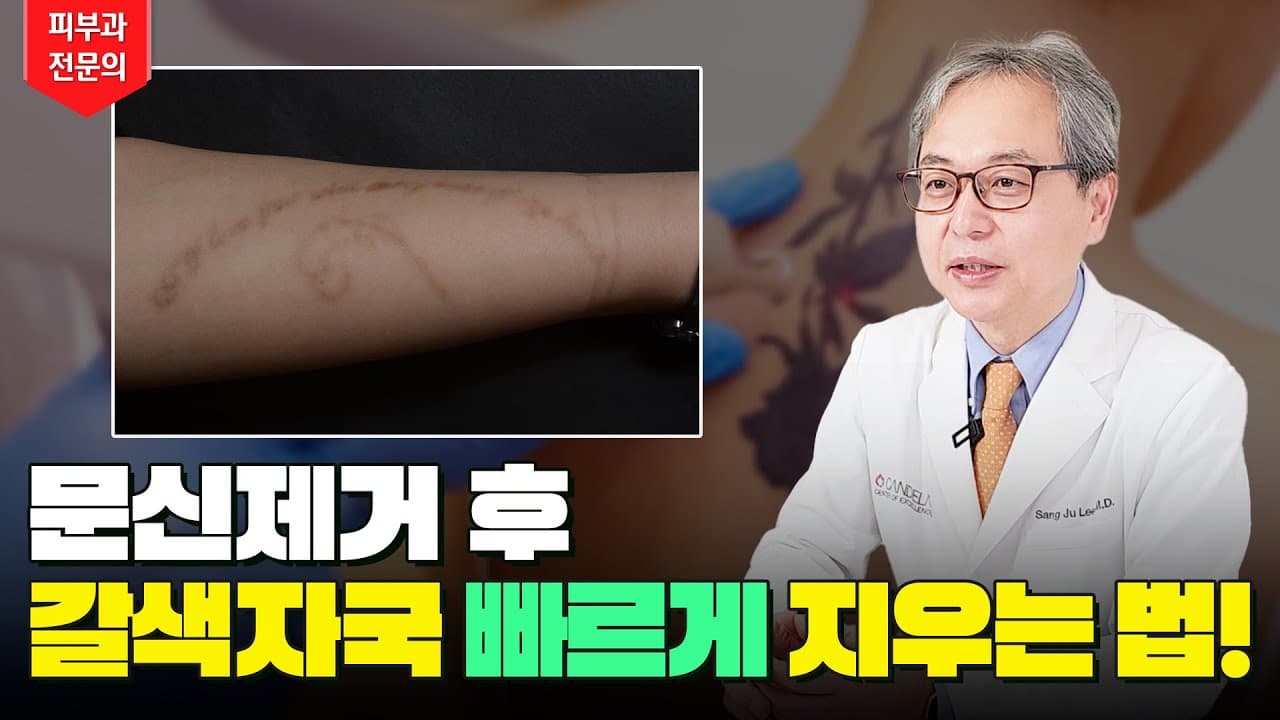
Many people are concerned about unexpected brown marks remaining after tattoo removal, even when they thought the tattoo had been cleanly erased. Why do these brown pigmentations occur, and how can they be improved more quickly? Let's explore questions about brown marks after tattoo removal with Dr. Sang-ju Lee, director of Yonsei Star Dermatology Sinchon.
Why do brown marks appear after tattoo removal?
Tattoo removal lasers cause microscopic irritation to the skin during the process of breaking down tattoo pigments. Immediately after the procedure, the skin may be slightly swollen and red, which gradually turns brown over time. This is the pigmentation phenomenon that appears after tattoo removal.
Tattoo pigment may already be completely removed.
When brown marks remain, many people tend to think that tattoo pigment is still present. However, in many cases, the tattoo pigment has already been almost completely removed. Therefore, it may be a situation where there is no further reaction no matter how strongly the laser is applied, and in fact, tattoo removal procedures may no longer be necessary.
Brown marks fade naturally, but...
Although there may be individual differences, brown marks remaining after tattoo removal tend to fade naturally without separate treatment in most cases. Usually, after about 6 months to 2 years, they often fade to a level that is barely noticeable.
However, tattoo removal itself is a long process, taking anywhere from 6 months to several years. It's natural to be bothered by remaining brown marks and want to remove them quickly.
Is there a way to remove brown pigmentation more quickly?
Fortunately, there are ways to remove brown pigmentation remaining after tattoo removal more quickly. This is a mark removal procedure using a pigment laser.
"You can receive mark removal procedures using a pigment laser at 2 to 3-week intervals."
- Dermatologist Dr. Sang-ju Lee
This procedure can help effectively improve brown marks.
Clean improvement with Laser Toning
Like other pigment treatments, pigmentation such as brown marks can worsen if the laser is applied too strongly, irritating melanin cells. Therefore, it is important to perform repeated treatments with low intensity. Laser Toning is primarily used for this purpose.
- Treatment interval: 2 to 3-week intervals
- Recommended sessions: About 5 to 10 sessions
- Expected effect: It can help brown marks that would gradually fade over a year disappear more cleanly in just a few months.
Laser Toning is effective in improving pigmentation by progressively destroying melanin pigment and promoting its discharge through repeated treatments with low energy, minimizing skin irritation.
Conclusion
Brown marks remaining after tattoo removal may fade naturally, but if you desire faster improvement, you can consider pigment laser procedures such as Laser Toning through consultation with a dermatologist. It is important to establish an appropriate treatment plan based on your current skin condition and the degree of pigmentation.