
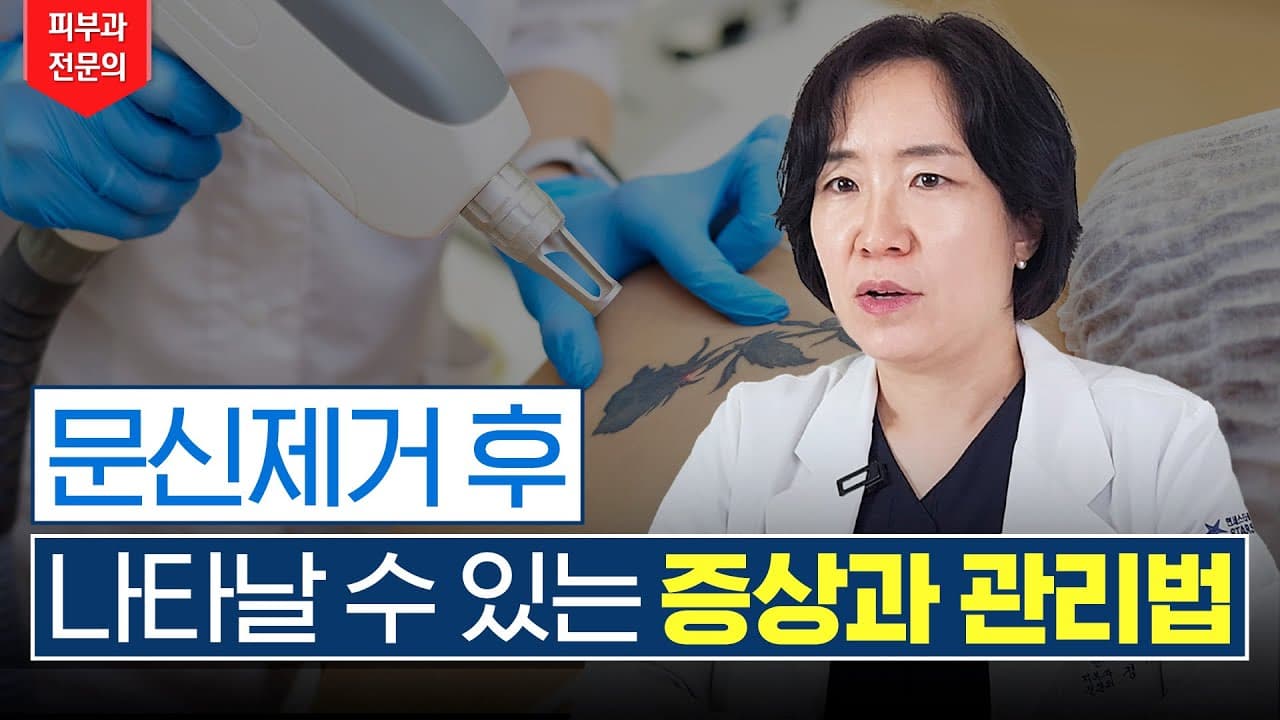
Hello, I'm dermatologist Jin-in Jung. Recently, as more young people choose tattoos as a way to express their individuality, the tattoo population in Korea is approaching 16 million. This accounts for about one-third of the domestic population. However, over time, the number of people who want to remove tattoos on their bodies is also increasing. Today, we will learn more about the various symptoms that can appear after tattoo removal procedures and the correct management methods.
After Tattoo Removal, Remember This! (Immediate Post-Procedure Care)
After a tattoo removal procedure, managing the treated area is very important. Light facial cleansing and showering are possible from the day of the procedure, but for about a week, you should avoid strongly stimulating the treated area.
- Caution with Hydrocolloid Dressings: If you apply a hydrocolloid dressing to the treated area, an allergic reaction may occur depending on the individual, so it is best to avoid applying it and allow the area to ventilate.
- Activities to Avoid for One Week: It is advisable to avoid saunas, jjimjilbangs (Korean bathhouses), swimming, alcohol consumption, smoking, and strenuous exercise that causes sweating for about a week.
- For Semi-Permanent Makeup Tattoo Removal: Avoid applying makeup to the treated area for about a week, and be careful not to rub vigorously when cleansing.
Common Symptoms and Management After Tattoo Removal
After laser tattoo removal, the treated area may temporarily become red, swollen, or itchy. In such cases, applying a cool compress to the area can be helpful.
- Blisters: If blisters have already formed, you should avoid bursting them if possible. If blisters do burst and ooze, you will need to manage the dressing.
- Scabs: If scabs form, the area may be itchy or sting. Scabs themselves act as a barrier to prevent external bacteria or contaminants from entering, so you can apply an antibiotic ointment over them for about 3 to 7 days.
- Other Symptoms: Small rashes may appear around the area, or it may feel dry or slightly cracked.
- Home Care: Applying a regenerative cream to the treated area 2-3 times a day can help with moisturizing and regeneration. Additionally, if exposed to ultraviolet rays, it is highly recommended to apply sunscreen.
Special Precautions for Color Tattoo Removal
During color tattoo removal, the ink may discolor depending on the color, and in the case of red, it may temporarily darken. In some cases, the pigment in the ink may not be 100% removed, only fading.
In particular, white pigment will be almost impossible to remove.
Furthermore, the likelihood of white scars or hypertrophic reactions occurring during color tattoo removal is much higher compared to black tattoos. If scars form, additional scar treatment may be necessary. Pigmentation (hyperpigmentation) is likely to occur during the removal process or after all pigment has been removed. In such cases, there is no need to worry as it is a symptom that naturally disappears after 6 months to 1 year. If necessary, additional laser toning may be performed or a whitening ointment may be prescribed.
Understanding the Process of Tattoo Ink Disappearance
Tattoo ink does not disappear immediately after a tattoo removal procedure. When the ink that has penetrated the body is broken down into tiny particles by a laser, it takes time for our body's macrophages to engulf and excrete it. Therefore, it takes about 4 to 6 weeks after the procedure to see the tattoo ink naturally fade. Multiple repeated procedures may be necessary depending on the amount and depth of the ink.
Don't Worry About Semi-Permanent Eyebrow Tattoo Removal!
In the case of semi-permanent eyebrow tattoos, it is rare for eyebrows to be completely burned by a pico laser. While some singeing may occur, it does not affect the hair follicles, so the eyebrows will grow back over time, so there is no need to worry.
Rare Allergic Reactions That May Occur
In the case of red-colored tattoos, allergic reactions or inflammatory reactions may rarely occur depending on skin immunity. In such cases, you must consult your doctor. Allergic reactions can occur in the early stages of tattooing, but they can also occur as an immune response during the laser removal process that breaks down the ink.
Today, we have learned about the symptoms and management methods that can appear after tattoo removal, as well as important information to be aware of.