
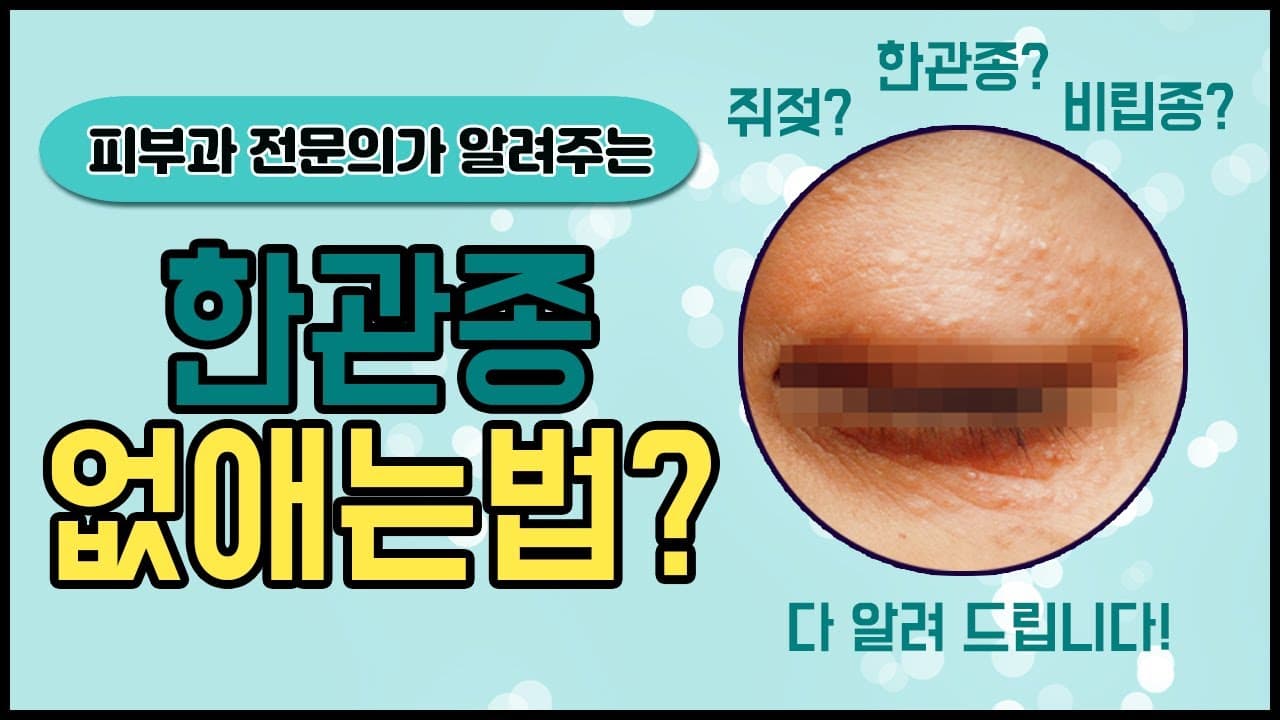
Hello. I am Lee Sang-ju, a dermatologist. Today, we will learn more about syringoma, a disease that appears as small bumps under the eyes of many women.
What is syringoma?
Syringoma is a benign tumor that occurs due to the proliferation of sweat ducts, which are the ducts through which sweat secreted from the sweat glands exits. It mainly occurs in women after puberty, and it is common for it to appear as small bumps under the eyes. However, it is a disease that can also occur on the eyelids, forehead, lips, and in severe cases, throughout the body or on the female external genitalia.
Causes of syringoma
The exact cause of syringoma has not yet been clearly identified. However, it is known as a tumor that grows from the sweat glands, and it is often seen in cases with a family history, suggesting that genetic predisposition plays a role. If left untreated, syringoma can gradually grow larger and coalesce to form large plaques, so early treatment is recommended if possible.
Syringoma is often confused with other similar skin conditions. Let's look at the characteristics of each condition.
- Syringoma: Appears as flesh-colored lesions the size of millet seeds, and while some may experience itching, there are usually no specific symptoms. It often looks like wrinkles under the eyes.
- Milia: Characterized by small, whitish bumps that are slightly whiter than normal skin color, formed by accumulated sebum or skin keratin.
- Skin tags (acrochordon): Appear as elongated growths on the skin and are small in size. They are almost similar to skin color and often occur on the neck as well as under the eyes.
- Flat warts: Appear as flat, attached lesions on the skin, and are slightly darker than normal skin color. They are known to be caused by a virus.
Treatment methods for each condition
The treatment methods for these four conditions differ slightly.
- Milia: Can be treated relatively easily by making a small hole in the lesion and removing the sebum or skin keratin inside.
- Skin tags (acrochordon): Since they are a surface skin problem, they can be easily removed using a laser.
- Flat warts: Can be removed with a laser as they are on the outer layer of the skin, but since they are caused by a virus, they can recur or appear in other areas, so it is important to treat them until they are completely gone.
- Syringoma: Among these conditions, syringoma is the most difficult to treat. Syringoma has deep roots located in the dermal layer, not just the epidermal layer, and because of its considerable depth, complete removal with a single treatment is difficult, often requiring multiple treatments.
Syringoma treatment methods
There are broadly three main treatment methods for syringoma.
-
Surgical method: This method was used in the past when lasers were not available, involving surgical removal of the syringoma area. However, it often left significant scars and could cause atrophy, so it is rarely used today.
-
Radiofrequency (electrocautery): This method uses electricity to burn and remove the syringoma area. This also often results in significant scarring and is not commonly used recently.
-
Laser-based method: This is the most commonly used method today. Carbon dioxide lasers or erbium YAG lasers are used to destroy the syringoma tumor. However, syringoma has deep and multiple roots, and it primarily occurs under the eyes where the skin is delicate, which can lead to disadvantages such as scarring or post-inflammatory hyperpigmentation.
While lasers have fewer side effects compared to traditional methods, side effects can still occur. To compensate for this, the Pinhole Technique or Drilling Method was developed. This method uses a laser to selectively destroy only the syringoma area while minimizing damage to the surrounding skin, thereby reducing the possibility of side effects such as scarring or post-inflammatory hyperpigmentation. Through this method, even deep syringoma can be expected to be treated or improved.
Why is syringoma recurrence common?
The reasons for syringoma recurrence are not yet clearly understood, but they can be explained by three main factors.
- Deep roots: Syringoma originates deep in the dermal layer of the skin compared to other tumors. Therefore, recurrence is common if the roots are not completely removed and remain.
- Constitutional and genetic factors: Syringoma is known to be influenced by constitutional and genetic factors. Even if lesions in a specific area are completely removed, if the constitutional or genetic predisposition does not change, syringoma can recur. In particular, as people age after middle age, hormonal changes can often lead to an increase in syringoma.
- Distribution of sweat glands: Syringoma originates from sweat ducts, and sweat glands exist in almost all skin tissues of our body. Because these sweat glands are affected by constitutional factors, syringoma is known to recur frequently.
Precautions for syringoma treatment
As syringoma is an intractable disease, special care is required during the procedure.
Since syringoma has deep roots and varies in size and location, the rich experience and expertise of the practitioner are more important than uniform treatment.
When treating, it is good to consider the following:
- Practitioner's experience: Syringoma has deep roots, varies in size, and can appear in various locations. Therefore, the practitioner's diverse experience is more important than uniform treatment. Treatment should be tailored to the depth and size of the roots, and if it occurs on areas like the forehead or neck, considering other methods may be advisable.
- Equipment excellence: Generally, carbon dioxide lasers or erbium YAG lasers are widely used, but to effectively remove only the syringoma area while minimizing damage to surrounding tissue, it is advisable to use high-output lasers with minimal collateral damage, such as Ultrapulse Carbon Dioxide Laser.
- Patient's consistent treatment: Syringoma is an intractable disease with deep roots, so consistent treatment from the patient is more important than a single treatment. If residual lesions remain, recurrence can occur, and scars or various complications may appear, so it is important to receive consistent treatment through consultation with medical staff.