
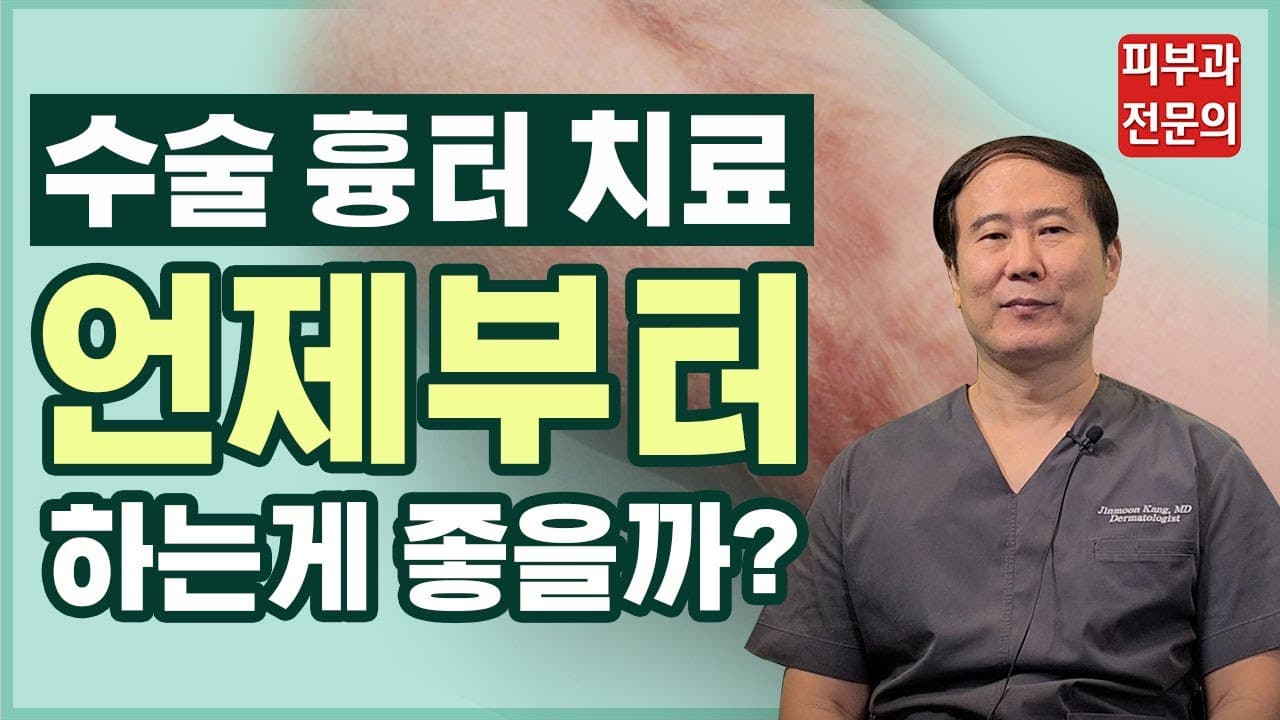
Hello, I am Kang Jin-moon, a dermatologist. Many people undergo minor surgeries for various illnesses at some point in their lives. Unlike general scars, surgical scars often form deep wounds that penetrate the skin and muscle layers, resulting in deep scars. Today, I will address common questions about scar treatment and management, which are very important after surgery.
Why Early Treatment for Surgical Scars is Important
To get straight to the point, just like with general scar treatment, starting surgical scar treatment early can lead to better results. This is because preventive treatment must begin during the Pre-scar stage, before the wound heals and a scar forms, to minimize scarring.
Therefore, for surgical scars, it is recommended to consult a dermatologist about 1-2 weeks after surgery, immediately after stitch removal, to establish an appropriate treatment plan based on the individual's scar condition.
Especially for early red scars caused by surgery, V-Beam Perfecta laser treatment, which suppresses vascular proliferation to prevent excessive scarring, is effective.
Why is Surgical Scar Treatment More Difficult?
Treating surgical scars is much more difficult compared to general scars or burn scars. This is because surgical scars are deeper. The depth of general scars or burn scars usually does not exceed 1 cm, but surgical scars can often be 2-3 cm deep. This makes treatment difficult, prolongs the treatment period, and can lead to lower treatment satisfaction. However, the more severe the scar, the greater the potential for improvement.
How are Various Surgical Scars Treated?
It is important to choose the appropriate treatment method based on the individual's skin condition and scar type.
General Surgical Scars
There is a method of correcting the scar by selecting an appropriate laser tailored to the individual's skin condition and scar type, making the boundary with healthy skin disappear. Since a laser capable of delivering heat deep into the skin layers must be used, treatment should be received from a dermatologist with experience and expertise in scar treatment.
Red and Raised Scars (Keloids)
For keloid scars, where collagen is excessively produced, causing the scar to be wide, red, and swollen, Triamcinolone Scar Injection can reduce the hypertrophic scar caused by the excessive proliferation of abnormally accumulated collagen. The redness can be treated with the vascular laser V-Beam Perfecta, which was introduced earlier. With this approach, keloid scars formed after surgery can be significantly improved.
Depressed Scars
Occasionally, after surgery, the skin at the sutured area may adhere, leading to uneven or depressed scars. For such depressed scars, treatment involves elevating the depressed skin layer and refining the skin surface. A representative treatment method for this is Subcision. Subcision severs the fibrous bands pulling the skin down, allowing the depressed skin to rise. After this, a combination treatment with lasers that aid skin regeneration to make the surface as even as possible is most effective.
Laser Treatment vs. Surgery: Which Method is More Suitable?
It is advisable to choose the method that is more suitable for you, considering the advantages and disadvantages of both surgery and laser treatment.
- Laser Treatment
- Advantages: Can expect significant effects with fewer side effects, and as a non-surgical method, the burden of treatment is relatively low.
- Disadvantages: Requires multiple periodic treatments.
- Surgery
- Advantages: Can reduce the size of the scar in one go.
- Disadvantages: Eventually, the skin tension at the sutured area may widen over time. Since surgery is a one-time procedure, if you have a predisposition to scarring, a new scar may form or an even larger one may appear, so careful consideration and sufficient consultation are necessary.
Surgical Scar Treatment: Realistic Expectations and the Importance of Combination Treatment
Unfortunately, it is impossible to completely remove a scar once it has formed. Therefore, when undergoing surgical scar treatment, one should approach it with the mindset of correcting the scar to be as inconspicuous as possible. Since each person's constitution and skin condition differ, and the scar's appearance changes during treatment, rather than insisting on a single treatment method that is considered effective, the best results can be achieved by receiving combination treatment tailored to the individual, after thorough consultation with a dermatologist, considering the suture condition, skin constitution, and other factors.
We have explored various questions related to surgical scars. When treating surgical scars, rather than trying to achieve improvement in a short period, consistently combining appropriate treatment methods that match the scar's appearance at each stage can certainly lead to improvement.