
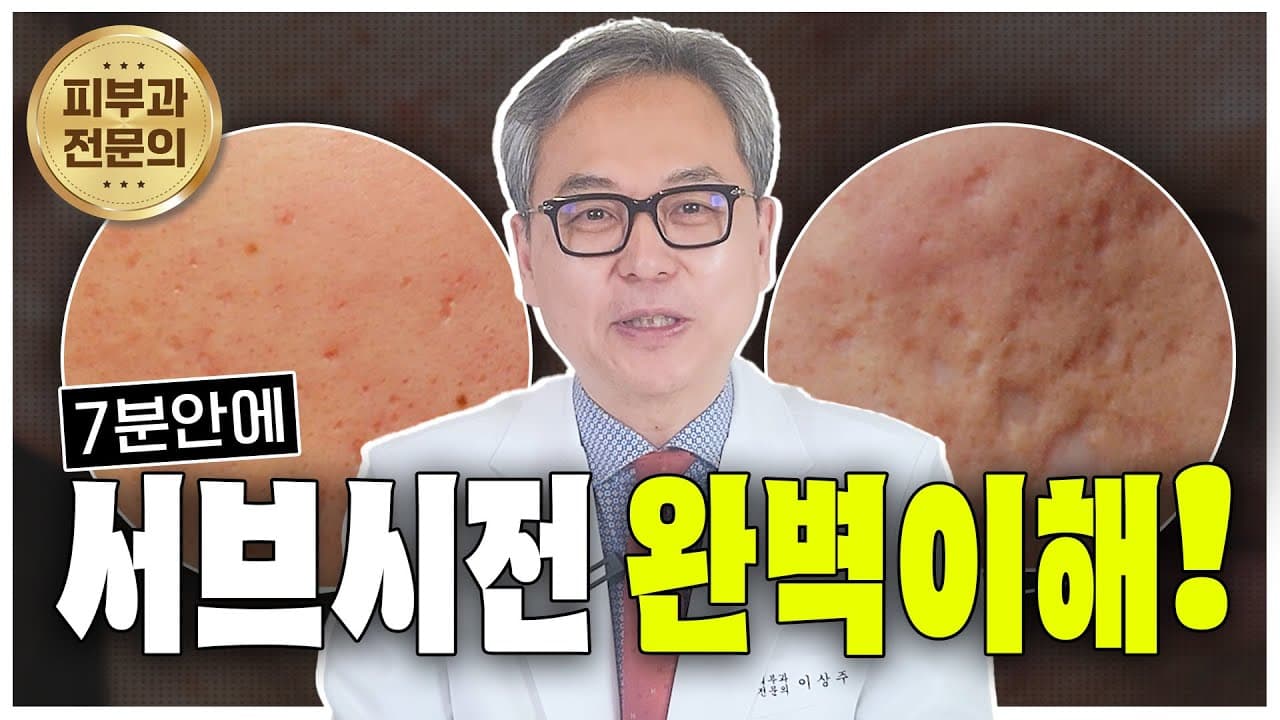
Breaking up adhesions within the skin? This is what Subcision is for depressed acne scars.
Acne scars occur when acne is squeezed by hand or when inflammatory acne repeatedly damages surrounding tissue. In particular, the more severe the inflammation, the more varied the depth and shape of the scars can be. Once formed, acne scars, especially depressed ones, do not disappear naturally over time, often requiring active treatment.
Acne Scars: Why do they form and what types are there?
Causes of Acne Scars
Acne scars primarily form when the dermis is damaged by squeezing acne by hand, or when inflammatory acne is not controlled and repeatedly causes inflammation in surrounding tissues, destroying collagen tissue. The more severe the inflammation, the more severe the scarring tends to be. Occasionally, keloid scars may appear on the chin or bumpy papular scars on the nose, but generally, depressed scars are more common.
Various Types of Acne Scars
Depressed acne scars can be broadly divided into three types based on their shape:
-
Icepick Scars: Deep, pore-shaped scars, usually with a narrow opening of 1-2mm or less, but significant depth.
They are called icepick scars because they resemble marks made by an 'icepick,' a tool used in the West to break large blocks of ice. They are also known as ice pick scars or pore pick scars.
-
Boxcar Scars: Scars with a relatively wide diameter of 2mm or more, clear boundaries, and a rectangular shape.
'Boxcar' originates from the term for a rectangular railway car used to transport goods. The name comes from the scar's rectangular shape, rather than resembling a box itself.
-
Rolling Scars: Scars with gently sloping, wide depressions. They often appear when inflammation is severe and occurs deep within the skin.
These types of acne scars are generally difficult to heal naturally and rarely disappear over time.
Depressed Acne Scars: Natural healing is difficult.
Once formed, acne scars are very difficult to recover naturally due to damage and deformation of the collagen tissue within the skin. Depressed scars, in particular, may remain or even become more prominent over time, making it important to seek improvement through active treatment.
Acne Scar Treatment: A comprehensive approach is crucial.
Depressed acne scars vary in type, and since their shapes and sizes differ, it is difficult to treat them perfectly with a single method. Just as a sculptor uses various carving tools, it is necessary to select appropriate methods according to the shape of the acne scar, thus combination treatment is generally required.
Rather than trying to eliminate scars completely at once, a gradual and repetitive approach is the safest and most effective method.
Representative Acne Scar Treatments: Fractional Laser and Subcision
Fractional Laser for Collagen Regeneration
In the past, mechanical dermabrasion, which involved shaving off the skin with a machine, was primarily used to treat acne scars. In the early 2000s, laser dermabrasion became popular, but it had issues such as long recovery times, erythema, and pigmentation. Currently, fractional lasers or fractional radiofrequency that compensate for these drawbacks are widely used for acne scar treatment.
These fractional lasers induce collagen regeneration, helping the skin to gradually fill in from within. Fractional lasers are divided into ablative and non-ablative types, but the overall principle is to improve acne scars by allowing the depressed areas to fill in.
Subcision to break up adhesions within the skin
Subcision literally means 'to cut below' (sub-cut), and it is a procedure that incises the area beneath the skin. Depressed acne scars often have fibrous bands of scar tissue beneath the skin that pull the skin downwards. Subcision uses a special needle to sever this scar tissue, helping the skin that was being pulled down to rise. This contributes to lifting depressed scars more quickly and effectively.
Subcision: Which scars are particularly effective for?
Subcision shows good results for wide and deep scars, especially those where scar tissue is deeply located and strongly pulls the upper skin downwards. A typical example is a wide, dish-shaped depressed scar, like a chickenpox scar.
Subcision treatment can be expected to have two main effects:
- Adhesion Release: When the underlying scar tissue is cut and softened, the scar rises, much like a rubber band springs back when released. This helps to lift the depressed area.
- Natural Filler Effect: Blood accumulates in the empty space created by severing the adhesive tissue. This blood acts as a kind of 'natural filler' that is naturally absorbed by the body, and over time, it induces collagen to fill the space, helping to push the scar upwards. Thus, two effects can be achieved simultaneously with a single treatment.
Subcision Treatment: The expertise of medical staff is crucial.
Subcision is a procedure for which only basic methods are described in textbooks, and it is not widely known as it is not frequently performed in university hospitals. However, our clinic has been performing Subcision for over 20 years and has accumulated in-depth expertise, including direct training from Dr. Mann, a leading expert in acne scars in Australia.
In particular, we possess the technology to perform precise treatments in about five stages, going beyond a simple single-stage procedure. Through our expertise in performing customized Subcision according to the shape of the scar, we can expect more effective treatment results.