
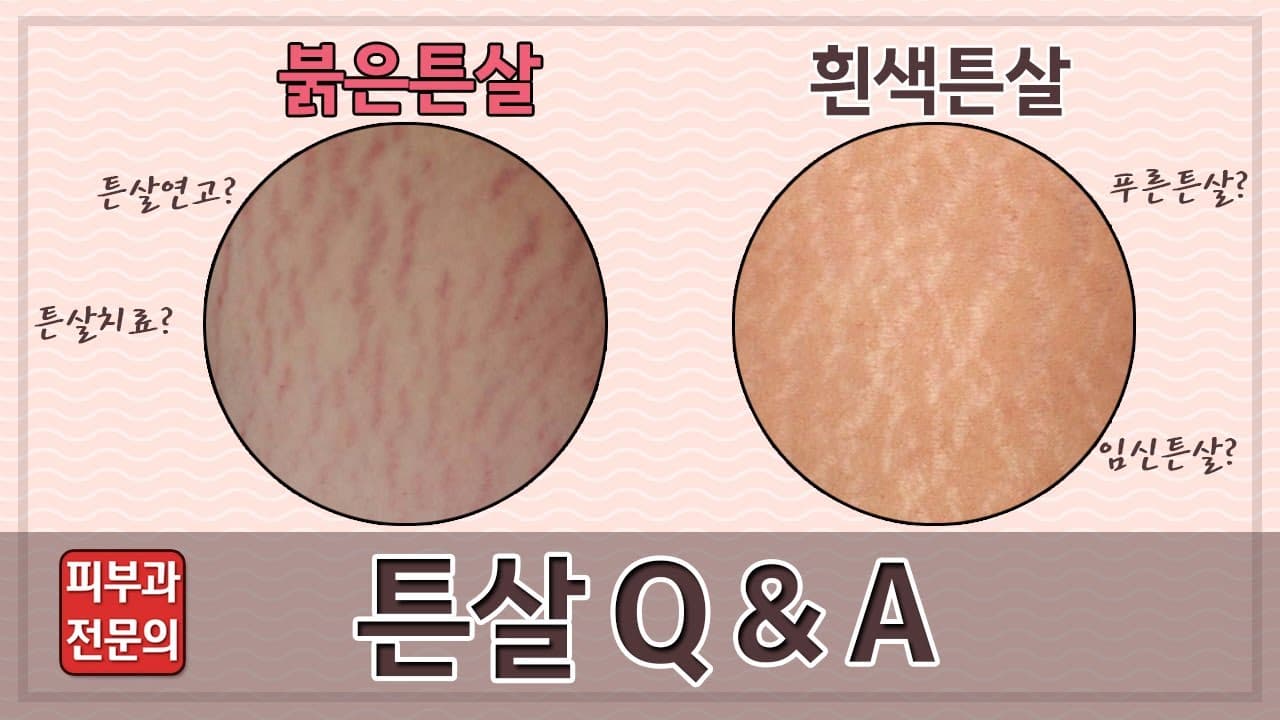
Hello. I am Lee Sang-ju, a dermatologist. Many of you expressed curiosity after my previous explanation of stretch marks, so today I will provide detailed information focusing on Q&A about stretch marks.
Stretch Marks: Similar to Scars, But Strictly Different
Strictly speaking, stretch marks are not scars. However, a closer look at stretch mark tissue reveals damage to collagen and elastin, and their progression is similar to that of scars, leading many to consider them a type of scar.
Red Stretch Marks vs. White Stretch Marks: Why Do They Look Different?
Stretch marks can be broadly categorized into red stretch marks and white stretch marks.
- Red Stretch Marks: In the initial stage, as stretch marks form and the skin thins, the underlying blue blood vessels become visible, giving them a red appearance.
- White Stretch Marks: Over time, the red color fades and turns white or gray.
Occasionally, they may appear black.
Stretch Mark Ointments: How Effective Are They?
There are mainly two types of ointments for stretch mark treatment:
- Commercial Stretch Mark Creams: These primarily help prevent stretch marks to some extent by moisturizing the skin. If there are no special ingredients, using a general moisturizer can also be an option.
- Medically Verified Vitamin A Ointments: Applying these to stretch mark areas can help prevent or treat stretch marks to some extent. However, their effectiveness is very limited compared to laser treatments. Vitamin A ointments require a prescription, so they must be purchased at a pharmacy after a dermatology consultation.
When Do Red Stretch Marks Turn White?
The time it takes for red stretch marks to turn white varies from person to person, but it is generally around 6 months. Some individuals may develop white stretch marks directly without a red stage.
Do Stretch Marks from Dieting or Postpartum Require Different Treatments?
In the case of early red stretch marks, losing weight through dieting may allow them to return to their previous state to some extent. However, if they have become white stretch marks or if the stretch marks are too large, losing weight might make the affected area appear more sunken and thus more prominent. In such cases, it may be difficult to fully return to the initial state.
Postpartum stretch marks are typically wide and severe. Furthermore, collagen denaturation in the surrounding tissue often accompanies the stretch marks themselves, making it difficult to achieve 100% recovery with stretch mark treatment alone. In these cases, combining basic stretch mark treatment with high-frequency treatments like Thermage FLX, which helps regenerate collagen in the surrounding skin, can be beneficial.
Stretch Mark Treatment Varies Depending on Red vs. White Stretch Marks
Stretch mark treatment should be approached differently depending on whether they are red or white stretch marks.
Red Stretch Mark Treatment
Treating red stretch marks has the advantage of preventing them from becoming permanently fixed as white stretch marks and allowing them to return to their previous state to some extent. However, it is important to consider that the effectiveness may decrease if weight gain continues or growth is still in progress.
White Stretch Mark Treatment
In the past, it was thought to be almost untreatable, but recently, with Fractional collagen regeneration, especially the Ultrapulse Alpha, improvement of about 70% is possible. Even a single treatment can show results, but repeated treatments can further promote regeneration for better effects.