
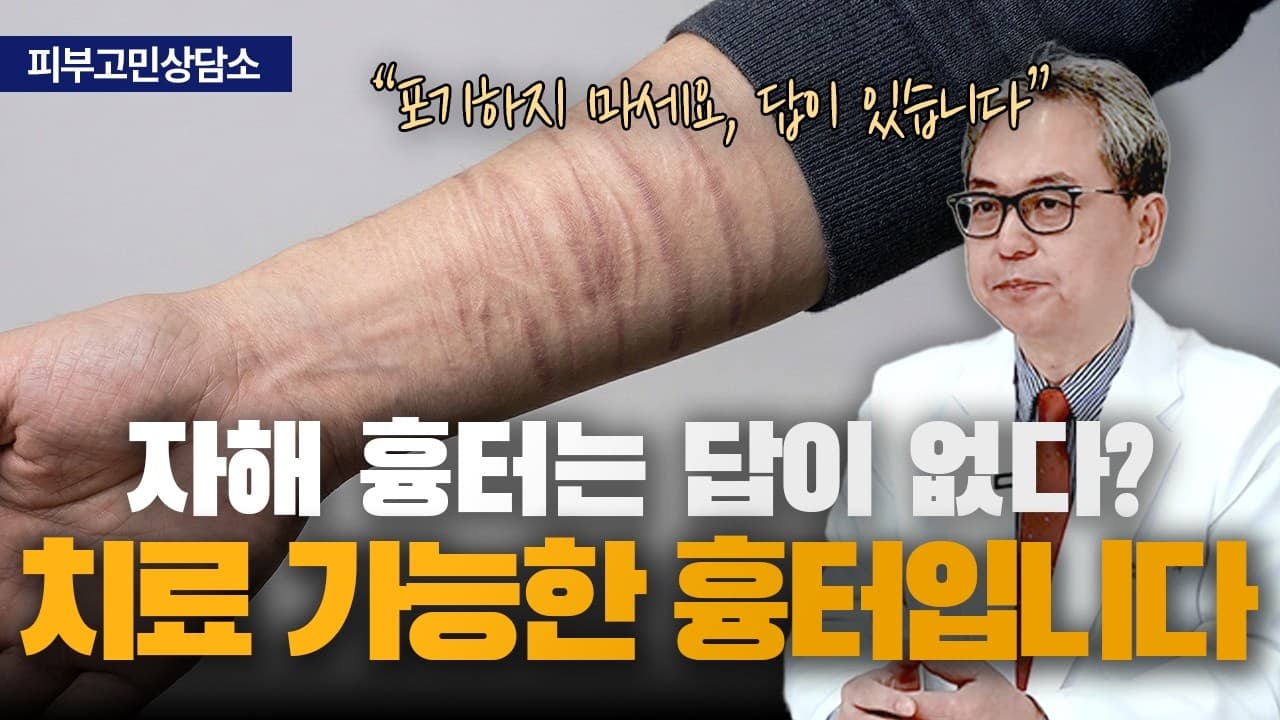
Hesitation marks are scars that can be sufficiently treated. When I meet patients in the examination room, I realize that not only young people but also various age groups are concerned about self-harm scars and hesitation marks. Many experience deep emotional pain during what should be their brightest period, and the traces left on their skin often weigh them down again. Today, I would like to calmly examine hesitation marks from a medical perspective.
What is the difference between accident scars and self-harm scars?
General accident scars and self-harm scars differ in shape, color, and histological form. Accident scars are caused by irregular external forces, so their direction is not consistent, their depth varies, and the tissue tends to be thick and irregular.
In contrast, self-harm scars often appear as linear scars that repeatedly go against the skin's grain. As damage accumulates in a small area, deep changes occur in the underlying skin layers, sometimes appearing whiter and shinier than the surroundings, or conversely, raised.
Why are they called hesitation marks?
When a patient inflicts self-harm, there is a medical pattern of hesitation, which is where the name hesitation marks comes from. Therefore, they are characterized by multiple fine lines overlapping in one area.
Hesitation marks are deeper than they appear; the visible traces on the skin are just the tip of the iceberg, with scar tissue deeply embedded underneath.
Surgery is not always the answer
Surgery is often the first method that comes to mind for scars, but it is often difficult to apply directly to hesitation marks. Surgically excising fine linear scars can actually make the scar longer or wider. Past methods also had clear limitations.
- Skin grafting can leave a large patch-like area that is visually more prominent.
- If general laser dermabrasion is performed, the scarred area may become redder or shinier, leaving the hesitation marks as they are.
Can old white scars also be treated?
Old hesitation marks can also be treated. Scars that have turned white are stabilized, mature scars that have passed the initial stage. Since there is little change over time, a more stable treatment plan can be approached.
In this case, the core of the treatment is to rearrange the scar tissue within the skin using powerful high-output lasers and restore it to a texture similar to the surrounding matte normal skin. Dealing with deeply embedded tissue makes a difference in the results.
It wasn't that there was no answer, but that there were few places to provide one.
Many people give up on self-harm scars, believing there is no solution, but that is not true. The areas where hesitation marks occur have thin skin, and improper treatment can worsen them, making it a challenging area even among doctors. There are not many places that specialize in treating them, and there is little related clinical data, so the situation of losing hope after bravely deciding to seek treatment, only to find nowhere to go, repeats itself.
Results may vary by individual, and accurate diagnosis and treatment are determined after consultation.
Self-harm scars are not just traces of injury but records of a fierce time. However, if those records are holding you back today, we recommend starting anew with experienced medical professionals. We will help you create a more comfortable tomorrow than today.
Written by Lee Sang-joo (Yonsei Star Dermatology) · Medical Staff Introduction · Last reviewed 2026-06-04