
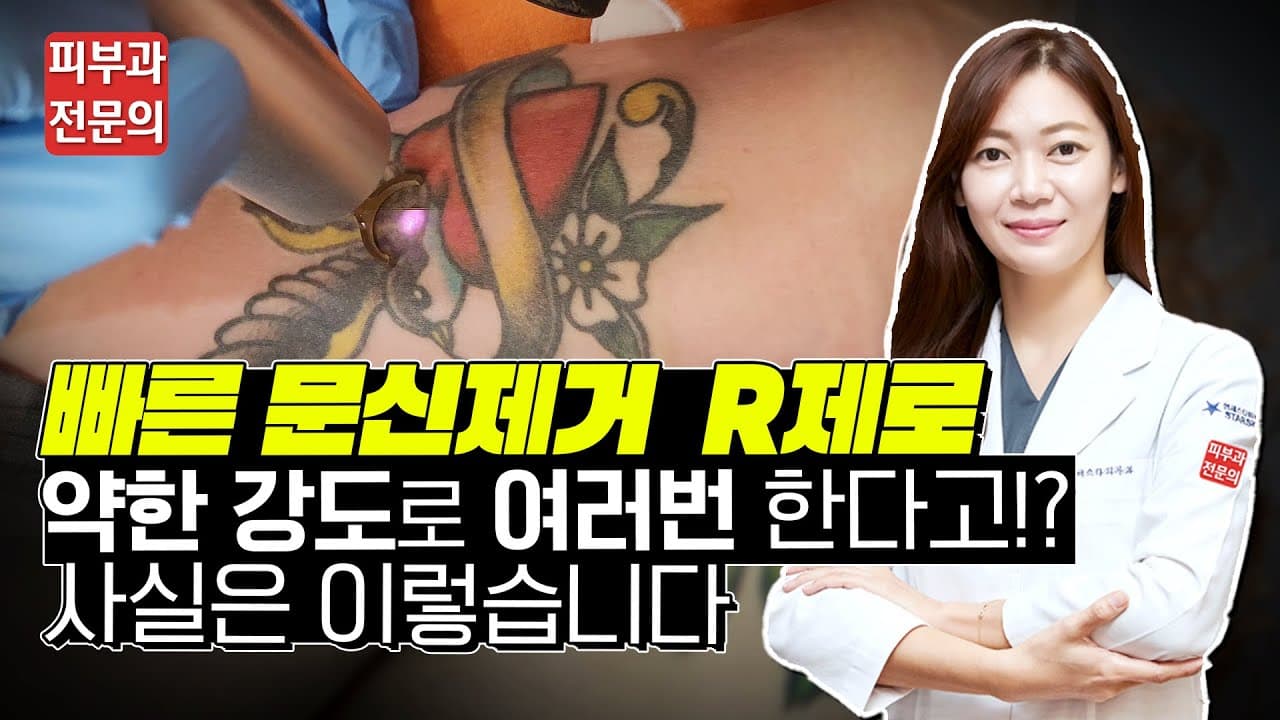
R-Zero Tattoo Removal: How to Understand and Manage It Correctly
Hello, I am Dr. Lee Haeng, a board-certified dermatologist. While the experience and expertise of the medical staff are important for tattoo removal procedures, it is crucial for patients to correctly understand and manage the procedure. Today, we will learn more about the R-Zero Tattoo Removal procedure at Yonsei Star Dermatology Sinchon.
What makes R-Zero Tattoo Removal different?
Our R-Zero Technique at Yonsei Star Dermatology Sinchon uses a special medication called PFD. While conventional laser tattoo removal procedures allowed only one laser pass per session, the R-Zero Technique, thanks to PFD medication, allows up to four laser passes in a single session. This significantly shortens the number of treatment sessions compared to other tattoo removal methods.
Is R-Zero Tattoo Removal performed with weak output multiple times?
Some people misunderstand that since the R-Zero Technique allows up to four laser passes, it must involve multiple treatments with weak output. However, this is not the case. It is true that strong laser output breaks down pigment particles more effectively than weak intensity. However, if the procedure is performed with excessively strong intensity without considering the skin condition, side effects may occur, and the treatment effect may even decrease. This is because excessively strong laser irradiation can damage the skin and lymph, leading to scarring, and may also prevent the tattoo pigment from being properly expelled from the body.
Therefore, when performing R-Zero Tattoo Removal, our clinic comprehensively considers the individual's skin condition, scar minimization, and treatment effectiveness to find the optimal output for the procedure. This is our clinic's unique expertise.
If blisters don't form after the procedure, does it mean it's ineffective?
Patients sometimes worry that if blisters don't form after the procedure, it might mean it's ineffective. Most patients who receive treatment at our clinic either do not develop blisters or develop very small ones. This is because the formation of blisters indicates a higher likelihood of scarring. Yonsei Star Dermatology Sinchon applies a scar prevention treatment method that minimizes blistering. Therefore, we maintain an appropriate laser intensity and reduce the probability of blister formation, so you do not need to worry too much if blisters do not appear.
How often should I get tattoo removal?
Generally, complete pigment removal is difficult with a single tattoo removal session, so repeated treatments are essential. Therefore, we recommend a minimum of 10 or more tattoo removal sessions. However, the number of sessions may be fewer or more depending on the size of the tattoo or the amount of pigment.
- Factors influencing the number of tattoo removal sessions:
- Size of the tattoo
- Amount and depth of pigment
- Type of tattoo (e.g., outline, lettering tattoo)
Outline and lettering tattoos, in particular, tend to have a large amount of pigment deeply injected into a small area by tattoo artists to make the color appear dark and uniform. This may require more treatment sessions compared to other tattoos.
What is the interval between tattoo removal sessions?
We recommend the following treatment intervals:
- First 5 sessions: 4-week intervals
- From the 6th session onwards: 8-week intervals
If a brown mark remains after tattoo removal, does it mean it wasn't properly removed?
If the practitioner says the tattoo removal procedure is complete but a brown mark remains, you might wonder if the tattoo was not properly removed. The tattoo removal procedure is indeed finished. If the tattoo pigment had not been sufficiently removed, the ink would appear prominent.
The brown mark is pigmentation that accompanies tattoo removal, and it usually resolves slowly over several months. However, for those who wish to remove the mark quickly, Yonsei Star Dermatology has introduced a mark removal safety system to manage post-tattoo removal pigmentation quickly and safely.