
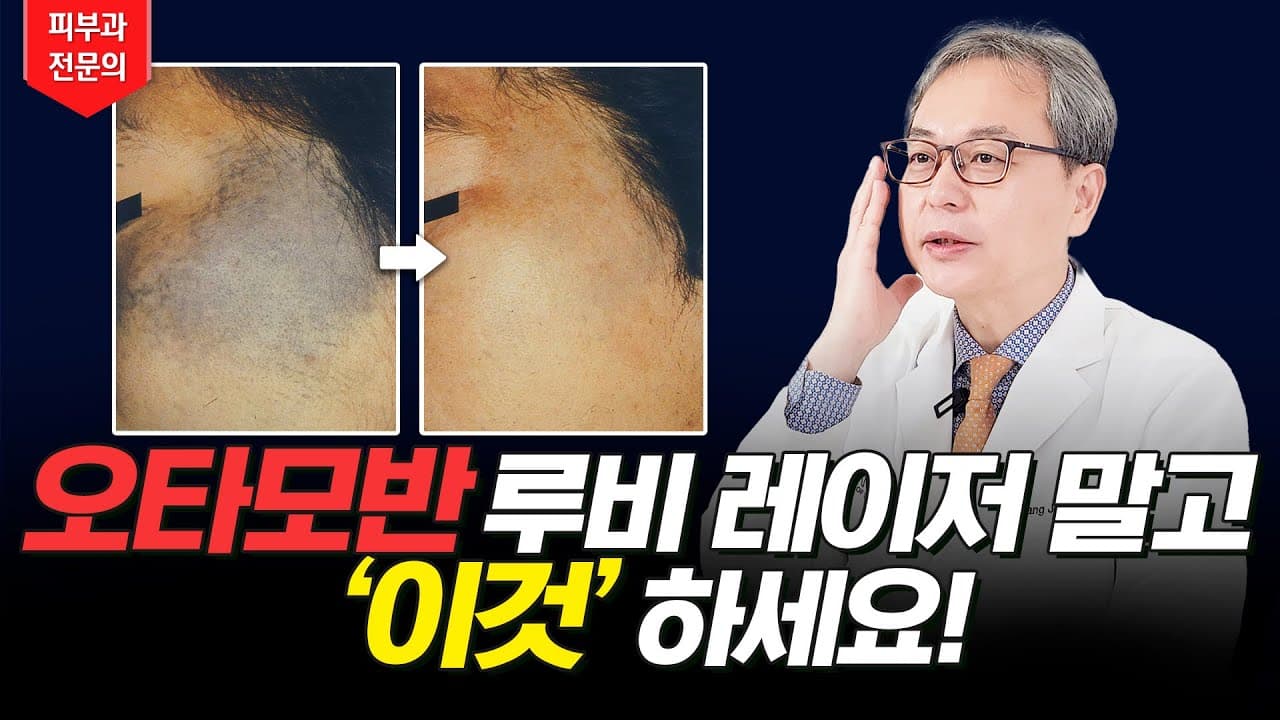
Hello, I am Dr. Sang-ju Lee, a dermatologist. Among the various spots that appear on our face or body, Ota nevus is particularly noticeable. It mainly occurs around the eyes, such as on the forehead, temples, and cheekbones, and unlike common brown spots, it is characterized by a bluish or grayish tint. Today, we will learn in detail about what Ota nevus is, how it differs from other spots, and effective treatment methods.
Why is Ota nevus bluish?
Ota nevus is a phenomenon that occurs when there is an abnormally large number of melanin cells in the deep dermal layer of the skin. Unlike melasma and other spots where melanin cells are mainly present in the epidermal layer, Ota nevus is located in the deep layers of the skin, which gives it a bluish or grayish color. You can easily understand this by thinking of it as the same principle that shallow water appears less blue than deep water.
What are the characteristics of Ota nevus?
Ota nevus usually appears on one side of the face, but in about 5-10% of cases, it can appear on both sides. Congenital Ota nevus, which appears immediately after birth, mainly occurs in infants and is known as a common skin disease affecting about 0.5% of the total population. In particular, it is reported that women have about 5 times higher incidence than men.
How is it different from café au lait spots and Becker's nevus?
Ota nevus is often confused with café au lait spots or Becker's nevus. The characteristics of each spot are as follows:
- Café au lait spots: Brown spots similar to the color of milk coffee appear on the skin.
- Becker's nevus: It is characterized by hair growing together in the spot area of the same color as café au lait spots.
- Ota nevus: Refers to spots that are gray or bluish rather than brown.
How has Ota nevus treatment evolved?
About 30-40 years ago, before laser treatment was developed, Ota nevus was treated with cryotherapy or skin surgery. However, with the development of laser treatment about 30 years ago, treatment methods have greatly advanced. In the past, Q-switched ruby laser was mainly used for Ota nevus treatment, but recently, PicoWay Laser has emerged and is known to show even better effects. Currently, PicoWay Laser is considered the most standard treatment for Ota nevus.
How many PicoWay Laser treatments are needed?
There are individual differences in the color of Ota nevus and the degree of laser response. Generally, treatment is received 5 to 10 or more times at intervals of 4 to 8 weeks. It is important to determine the exact number and interval of treatments through consultation with a specialist.
Why it is better to treat Ota nevus at a young age
It is recommended to start Ota nevus treatment as early as possible. Treating at a young age has the following advantages:
- The treatment effect may be faster.
- The child can be freed from psychological stress that may be experienced as they grow.
- The overall treatment results may be better.
Laser treatment is generally safe, so it is recommended to consider treatment from a young age if possible.
Ota nevus treatment can bring about life changes
As a dermatologist, Ota nevus is one of the diseases that brings great satisfaction. In the past, many people lived with Ota nevus throughout their lives and experienced psychological stress. However, with the advancement of laser treatment today, Ota nevus is often improved by more than 80-90%, so it can be said that it is a treatment that can positively change the lives of patients.
If you actively receive treatment, it is difficult for a doctor to use the term 'complete cure', but it is known as a disease for which 'treatment close to complete cure' can be expected.
So far, we have learned about the characteristics of Ota nevus and effective treatment methods. If you have any questions, please do not hesitate to consult with a dermatologist.