
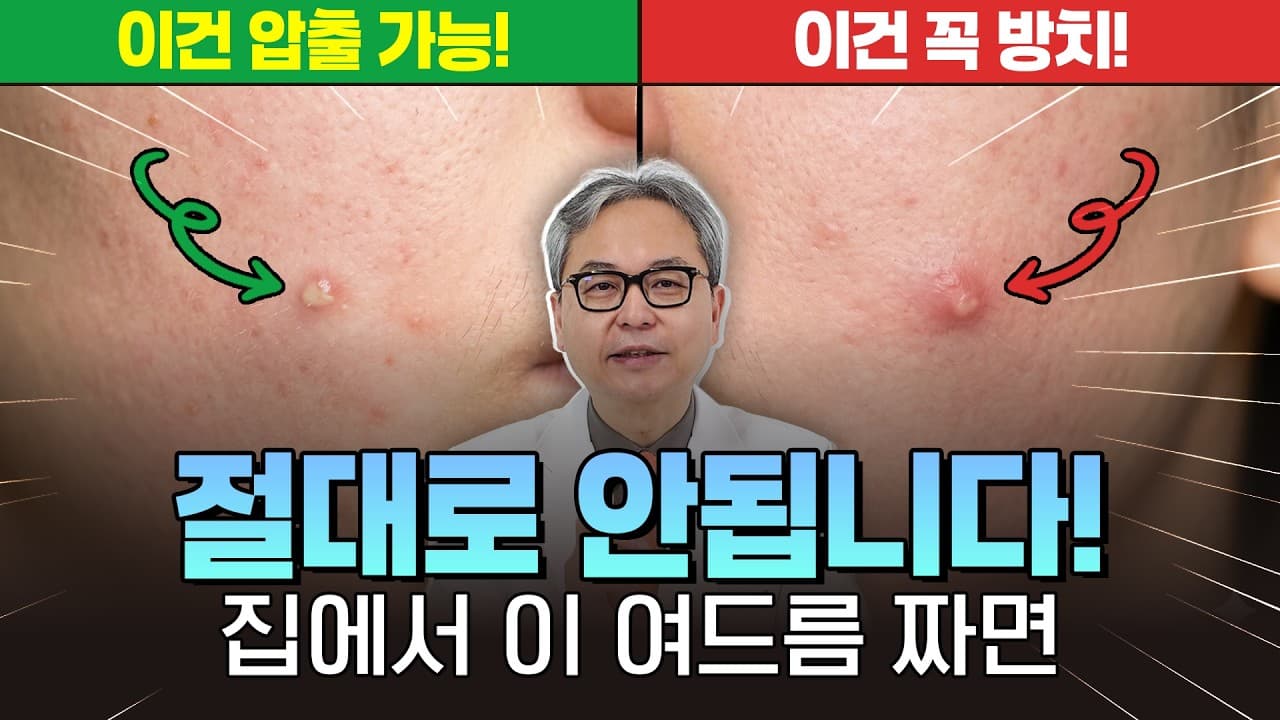
When you look in the mirror and see whiteheads, it's hard to resist the urge, isn't it? The moment you touch it, thinking, 'Just one squeeze will be so satisfying,' your skin could undergo irreversible changes. Many people regret squeezing acne with their hands, only to find it swells up even larger a few days later or leaves a permanent scar, leading them to seek help at the clinic. Today, we'll clearly explain three types of acne that can lead to undesirable results if touched. Hello. I'm Lee Sang-ju, a dermatologist at the Skin Concern Counseling Center.
1. Nodular Acne: Absolutely Do Not Squeeze!
The first type is nodular acne, also known as 'underground acne'. It is characterized by being red, hard, and without visible sebum. It often occurs along the jawline, and these types of acne should never be squeezed. Since the inflammation is deep within the skin, no matter how much you squeeze, sebum will not come out; only pus or blood may appear.
Forcibly squeezing it can cause the inflammatory sac inside to rupture, spreading inflammation to the surrounding area, which can lead to much deeper depressed scars.
2. Red Acne: Risk of Inflammation Spreading
The second type is red acne. Red acne is a sign of inflammation around the sebaceous glands. If you touch and squeeze it, the inflammation can spread to the surrounding area, and acne bacteria can also proliferate. This can lead to secondary bacterial infections and cause bigger problems.
If inflammation spreads to the surrounding area, it is easy for deep depressed scars or ice pick scars to remain in that area. Therefore, it is important to manage this type of acne quickly.
3. Thought it was Milia, but is it another condition?
The third point is that if you thought it was milia but it keeps spreading, you might need to suspect another skin condition rather than acne. For example, flat warts can appear as small bumps and look like acne.
However, since this is a viral disease, squeezing or scratching it with your hands can further spread the virus to the surrounding area. In such cases, acne creams or medications may have no effect at all and could even irritate the skin, so it is best to visit a dermatologist for an accurate diagnosis.
4. Acne that can be squeezed and the correct extraction method
Acne can be broadly divided into inflammatory acne and non-inflammatory acne. Acne that meets the following criteria can be attempted for extraction:
- Acne that is not red
- Acne from which sebum naturally emerges when squeezed
However, there are still precautions to take:
Applying too much pressure when squeezing acne can damage the surrounding skin wall. Therefore, it is important to squeeze gently, without excessive force.
5. Incorrect extraction can lead to costly scar treatments
Please remember that one incorrectly squeezed pimple can lead to scar treatments that incur significant costs.
In the next video, we will tell you about the Golden-Time Care method to prevent acne scars from forming.