
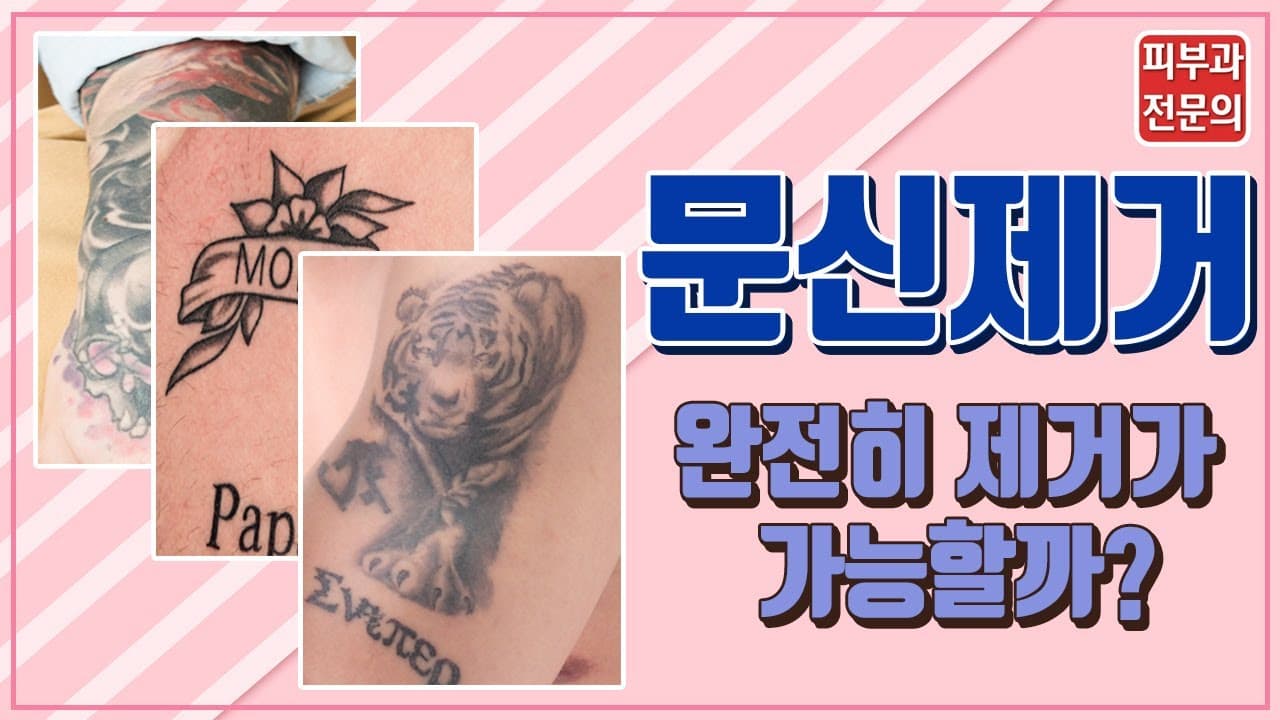
Everything You Need to Know About Tattoo Removal (with a Dermatology Specialist)
Hello, I am Lee Sang-ju, a dermatology specialist. Recently, not only celebrities and athletes but also the general public are getting tattoos. In the past, eyebrow and eyeliner tattoos were common, but nowadays, many people are getting various tattoos on their bodies. Today, we will learn more about how to remove tattoos with lasers and precautions before and after treatment.
What is a Tattoo?
Tattooing is a procedure that creates tiny wounds on the skin with a fine needle and injects dye deep into the skin through that needle. Generally, if the dye particles are small, they may be naturally removed by our body's scavenger cells, but if the dye particles are large, they settle in the skin. These remaining dyes appear in the form of a tattoo.
Occasionally, depending on one's constitution, there may be an allergic reaction to the dye, or bacteria may penetrate when the skin is wounded, causing inflammation in the tattooed area. Therefore, it is important to receive tattoo procedures in a sufficiently sterilized and clean environment.
How are Tattoos Removed?
In the past, methods such as skin peeling or using chemicals were used to remove tattoos, but these methods can leave large scars on the skin and are rarely used today. The most commonly used method for tattoo removal nowadays is laser treatment.
When the laser selectively destroys dye particles in the skin, our body's scavenger cells remove these destroyed dye fragments, and the tattoo gradually fades. Therefore, a tattoo does not disappear immediately after one laser treatment; repeated treatments are necessary as the dye is slowly removed.
Types of Lasers Used for Tattoo Removal
Tattoo removal lasers can be broadly divided into two types:
- Q-switched laser: This laser was widely used in the past. However, it had the disadvantage of leaving scars after treatment or not completely removing tattoos cleanly.
- Picosecond laser: This is a recently developed laser, characterized by increased effectiveness and reduced side effects compared to Q-switched lasers. Picosecond lasers have the advantage of leaving fewer scars after tattoo removal and can relatively well remove tattoos of various colors.
Although good results are being achieved with various lasers such as picosecond lasers, in many cases, tattoos are still not 100% completely removed. Therefore, it is advisable to fully consider that a tattoo may not be completely removed before deciding on a tattoo procedure.
Considerations Before Tattoo Removal
Tattoo removal results can vary depending on several factors:
- Type of tattoo: Professional tattoos may be more difficult to remove than amateur tattoos.
- Laser device used: PicoWay and PicoSure picosecond lasers are known to show excellent results.
- Operator's experience: The operator's experience in finding the appropriate energy and wavelength for tattoo treatment greatly influences the outcome.
Phenomena and Management Methods After Tattoo Removal
After tattoo removal, the treated area may swell and become red, and occasionally bleeding may occur. In the case of eyebrow tattoos, there may also be a side effect of temporary singeing of the eyebrows. However, these phenomena are mostly temporary and gradually improve over time.
After a tattoo procedure, it is recommended to manage it in the following ways:
- Apply a cool cold compress to the treated area to soothe it.
- If there is a wound, apply ointment or attach tape to help the wound heal quickly and minimize side effects.
Traces That May Remain After Tattoo Removal
Traces may remain after tattoo removal in the following cases:
- If you have a constitution prone to scarring, such as a keloid constitution or hypertrophic scar constitution.
- If the tattoo was too dark or applied too deeply.
- If repeated treatments are received.
- If there is an existing scar in the tattooed area (in this case, the likelihood of scarring remaining after laser treatment is higher than for others).
Today, we looked at the principles of tattoos and tattoo treatment methods. We hope this information is helpful to those considering tattoo removal.