
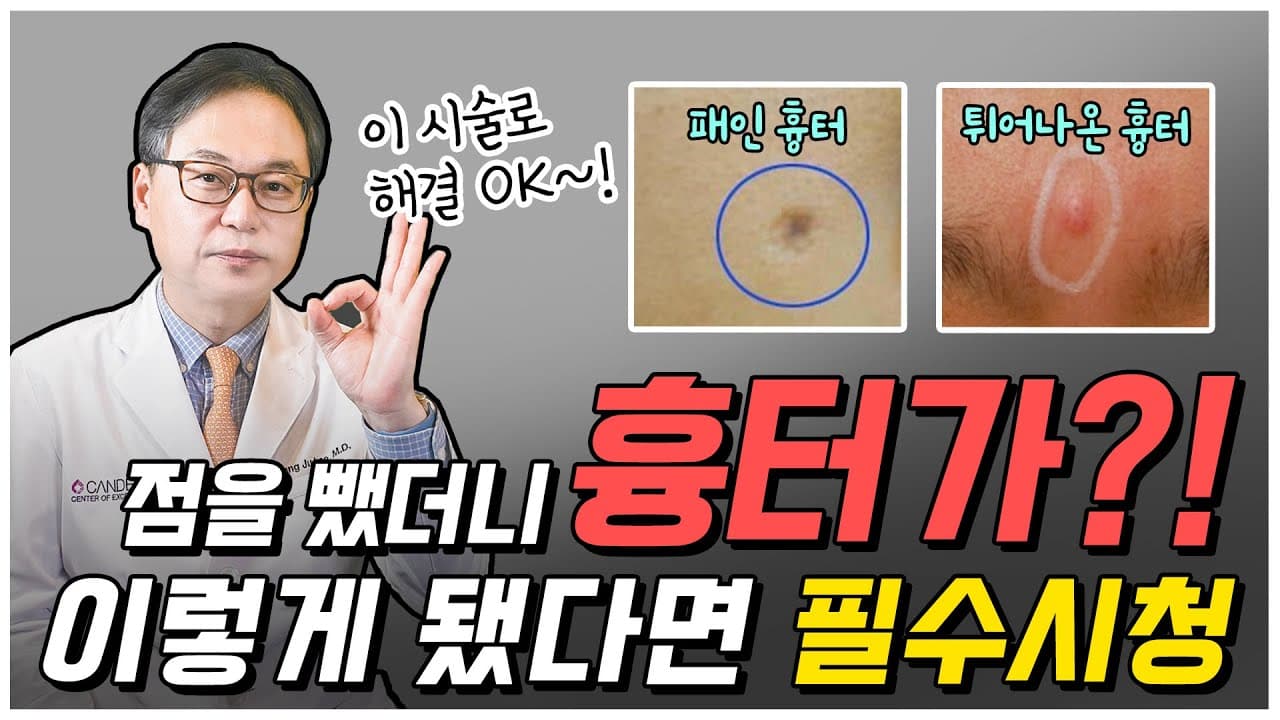
Many people worry about scars remaining after mole removal. There's a strong perception that moles can be easily removed with lasers, leading many to seek out low-cost clinics, only to end up with scars due to improper procedures. In particular, many patients visit our dermatology clinic concerned about scars left after mole removal, which makes us realize that worries about mole removal scars are more common than expected. Today, we will thoroughly address various concerns such as red marks, depressed scars, and raised scars that can remain after mole removal.
Why do scars form after mole removal?
The main cause of scarring during mole removal is an incorrect procedure. If the laser is used to dig too deeply regardless of the pigment's location, or if there's an attempt to remove a large, deep mole in one go, skin cells can be damaged, leading to scarring. Also, the type of laser used can make a difference in the likelihood of scarring.
At Yonsei Star Dermatology, we primarily use the Ultrapulse Encore laser for mole removal to minimize side effects such as scarring or hyperpigmentation. High-spec lasers like the Ultrapulse Encore have a very short pulse duration, which minimizes damage to surrounding skin during mole removal, unlike lower-cost lasers. This allows for clean mole removal with a significantly reduced chance of scarring.
Proper regenerative care after mole removal is the first step to preventing scars
After mole removal, you must apply a regenerative tape, such as DuoDERM, to protect the skin and aid regeneration for at least one week. The effectiveness of scar prevention can vary greatly depending on how the regenerative tape is managed, so the following should definitely be avoided:
- Changing the regenerative tape too frequently or removing it when exudate appears.
- Forcibly removing scabs that form later.
These actions can cause new skin to peel off along with the scab, leading to hyperpigmentation or scarring, so they should never be done.
How long should I wait for red marks and depressed scars after mole removal?
Around 3-4 weeks after mole removal, the scab will naturally fall off, and the treated area may still appear red and depressed. At this point, many people worry greatly that a scar will remain, but we can tell you that it's not yet the stage to worry about scarring.
While skin regeneration varies from person to person, it generally takes about 1 month, or up to 3-6 months, for the skin to fully regenerate to its previous state. After that, it can take 6 months to even a year for the red marks to disappear in some individuals.
However, if red marks persist after one year, it may lead to scarring. In such cases, the latest Vbeam Prima vascular laser can be used for effective improvement.
If a depressed scar remains, treatment that promotes powerful skin regeneration is necessary. At our dermatology clinic, we induce powerful regenerative effects in depressed areas using the Pinhole Technique with the Ultrapulse Encore laser, achieving satisfactory results. In addition, procedures such as the following may be performed depending on the nature of the scar:
- Subcision: Using a specially designed medical needle, the fibrous bands pulling the skin down are released, allowing the skin to return to its normal height.
- Punch: The depressed area is lifted using a punch device and then secured with medical glue.
If you're anxious, prevent it in advance! Scar prevention treatment after mole removal
Waiting 1-3 months for a red, depressed, or more noticeable area to regenerate after mole removal can be unsettling and difficult. Here's how to minimize scarring.
First, as explained earlier, you should keep the regenerative tape on for at least one week. Then, from the second week, you can consider scar prevention treatment with the Vbeam Prima laser. Vbeam Prima not only effectively improves redness but also has a preventive effect, stopping the scar from progressing further. If you are anxious about scarring during this period or have a history of easily forming scars, we recommend consulting with a dermatologist before undergoing the procedure.
Characteristics of moles prone to scarring and treatment for raised scars
Moles can range from junctional nevi that occur in the epidermis to dermal nevi that occur deep in the dermis. In particular, moles that are blue or gray, significantly raised above the skin surface, have hair growing from them, or were present at birth often have a very deep root. These types of moles have a relatively higher chance of scarring.
If two or three months have passed since mole removal and the area is still depressed or raised above the skin surface, similar to immediately after the procedure, it is likely to lead to scarring. When regenerative tape is applied after mole removal, scabs may not form, or if they do, they are tiny and not easily visible. Both scabs and regenerative tape serve the same protective role for the skin, so don't worry too much if a scab doesn't form, and we recommend keeping the regenerative tape on for a sufficient amount of time.
How are raised scars treated?
When mole removal involves excessive damage to skin tissue due to an incorrect laser procedure, abnormally arranged collagen can proliferate excessively, leading to raised scars. In such cases, it is most effective to first perform injection treatment to break down the excessively proliferated collagen and reduce its height, and then use a laser to precisely adjust the remaining height.
However, for the treatment of raised scars after mole removal, the know-how to improve the scar to be as similar as possible to the surrounding skin, by appropriately using lasers or injections depending on the degree of the scar, is more important than just the method. Therefore, we strongly recommend receiving treatment at a specialized scar clinic.