
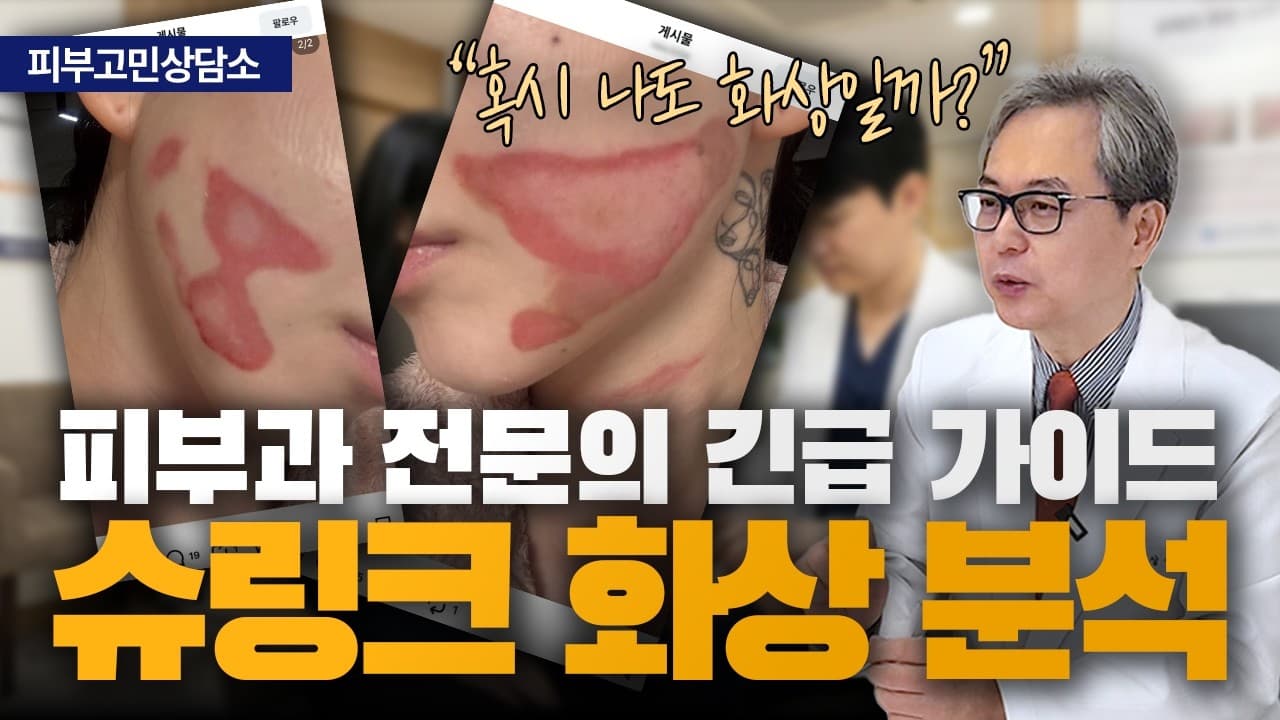
Understanding the principles behind why burns can occur during a procedure can help alleviate vague fears. Many people have been anxious due to recent news of a celebrity's burn injury. While burns after dermatological treatment are quite rare, it can be helpful to know under what circumstances they occur and how to reverse them if they do. Today, we will summarize safe treatment standards and burn scar recovery methods based on facts.
Why Do Burns Occur?
The causes of burns after a procedure can be broadly divided into three categories:
- Device malfunction
- The practitioner using excessive energy for a tightening effect
- Patient factors, i.e., thin skin making it vulnerable to burns
Especially if the skin is thin and delicate, it may be more susceptible to burns. If there are many liquid components inside from previous procedures like fillers, heat may concentrate in those areas. However, these are not common occurrences.
Sedation Anesthesia Can Be More Dangerous
Even with topical anesthetic cream on the face, if pain severe enough to cause a burn occurs, the body instinctively recoils. However, if sedation anesthesia is used to avoid pain, this defensive reaction cannot function.
It is safer to receive lifting or tightening procedures with topical anesthetic cream rather than sedation anesthesia, even if it is somewhat painful.
How to Distinguish Between Simple Redness and Burns
Depending on the type of laser, redness may persist for one to two hours or up to a week, but it generally subsides over time, and pain also decreases. Burns, on the other hand, are classified as first, second, or third degree.
If blisters appear during lifting or tightening, it can be considered a second-degree burn or higher. The signs are increasing pain and blistering over one or two days. While it is said that scars may remain with second-degree burns or higher, they do not necessarily always form, and with appropriate early intervention, recovery without scarring is possible.
Why Lifting Burns Are More Challenging
Most burn scars left after procedures occur on the face. Since scars appear on previously clear tissue, they are more noticeable and challenging. Additionally, lifting and tightening devices deliver heat to the deeper layers of the skin.
While external burns, like from hot water, primarily damage the upper skin, lifting and tightening procedures deliver a lot of heat to the deeper layers, making deep burns more likely. As a result, scars often become thicker and harder, making it crucial to receive active treatment from a specialist in scar management from the early stages.
Reversing Burn Scars with the Pinhole Technique
From the skin's perspective, a burn is like a sudden disaster, prompting it to quickly protect itself with thick scar tissue. This often results in an aesthetically unsatisfactory outcome. The Pinhole Technique involves creating microscopic holes in the firm scar to induce the skin's regenerative response.
- Makes thick burn scars softer and thinner.
- Corrects skin discoloration that is red, pigmented, or whitened.
- Improves texture to be closer to normal skin.
For deep scars, 4mm to 5mm, few lasers can reach that depth, requiring high-end equipment and experience in treating various types of scars. A multi-laser approach, combining several lasers tailored to the depth and problem, is effective. Lifestyle changes, such as reducing smoking and drinking, also aid recovery.
Results may vary by individual, and accurate diagnosis and treatment are determined after consultation.
Treatments like the Pinhole Technique generally do not significantly interfere with daily life, apart from oozing for a day or two, and showering or applying makeup is possible. Even old burn scars from childhood, for which there were no solutions before, now have many avenues for improvement. Therefore, even if a problem arises, we recommend not being too disheartened and seeking appropriate treatment.
Written by Lee Sang-joo (Yonsei Star Dermatology) · Medical Staff Introduction · Last reviewed 2026-06-04