
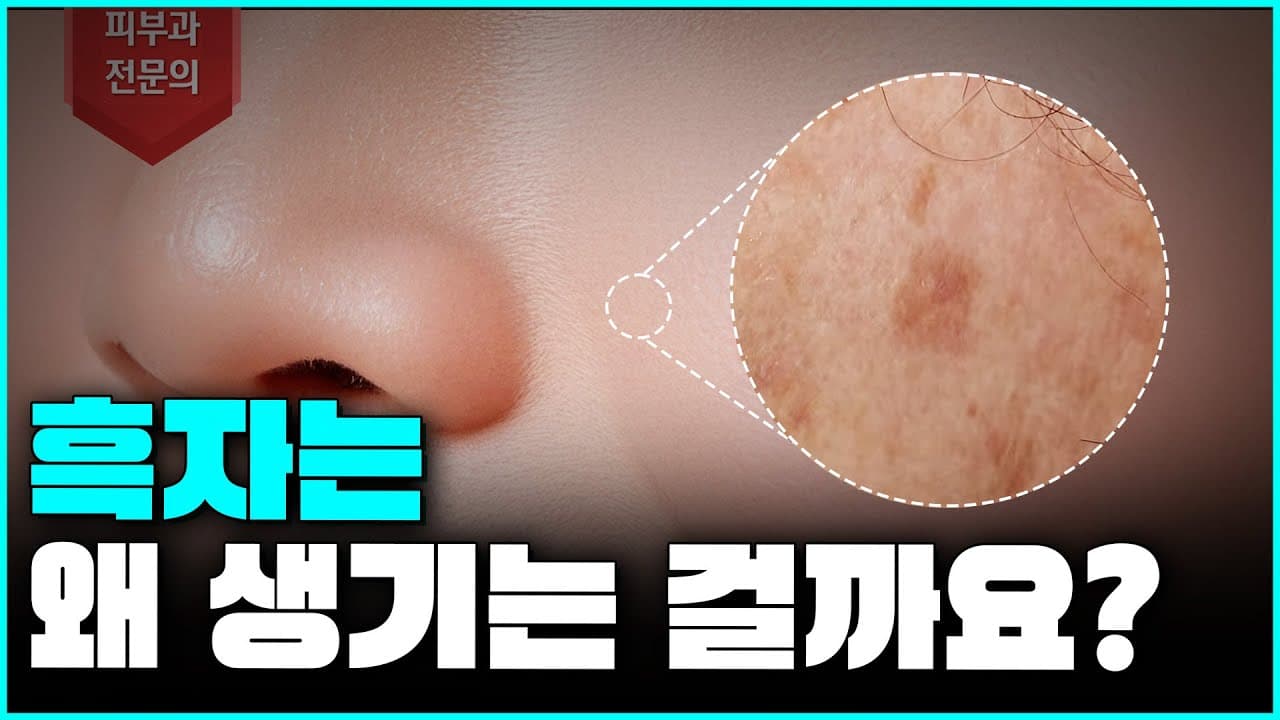
Do you ever worry about the brown spots on your face every time you look in the mirror, wondering if they might be 'lentigines'? Lentigines, which primarily appear on areas frequently exposed to sunlight, are a type of pigmentary disorder that causes stress for many people. Today, we will delve into what lentigines are, why they occur, and what effective treatments are available.
What are lentigines?
Lentigines are pigmentary disorders that primarily occur on sun-exposed areas such as the face, cheekbones, cheeks, back of the hands, and shins. They appear when the number of normal melanin cells in the skin abnormally increases, often appearing brown or gray.
- They exhibit a clear boundary and a flat shape, typically about 1 cm in diameter, but can sometimes appear as coin-sized brown spots measuring 2-3 cm.
Why do lentigines occur?
The main causes of lentigines are known to be sun exposure and aging. While they mostly appear in individuals aged 40 and above, there are rare cases where lentigines develop on the faces of younger individuals in their 20s or 30s.
Before treating lentigines, be sure to check this!
If you are considering lentigo treatment, it is very important to carefully observe the color of the lesion before treatment. What appears to be a typical lentigo may actually be an inflammatory condition.
"Inflammatory lentigo," as this type is called, if treated by strongly crusting the lesion like a conventional lentigo, may result in post-treatment hyperpigmentation or recurrence. Such irritation can prolong the treatment period, thus requiring careful diagnosis and a cautious treatment plan.
How to distinguish lentigines from melasma and seborrheic keratosis?
Lentigines can be easily confused with other pigmentary disorders like melasma or seborrheic keratosis. It is helpful to know the precise distinguishing features.
- Melasma
- Appears symmetrically on both sides and has indistinct borders.
- Pigment may spread like paint along blood vessel distribution or appear reticulated.
- Most melasma is faint and broadly distributed, but small spots under the eyes can be confused with lentigines. In such cases, remembering that lentigines usually appear on one side, while melasma appears on both sides can help with differentiation.
- Seborrheic Keratosis
- The skin feels thick or raised.
- In contrast, lentigines are flat, making them easy to distinguish by touch.
Are there skin types prone to lentigines?
Interestingly, individuals with fair and smooth skin tend to develop lentigines at a younger age. Many people who thought they had good skin in their youth often express distress due to lentigines. This is one of the pigmentary disorders where high satisfaction can be achieved with appropriate treatment.
What are the effective treatment methods for lentigines?
Lentigo treatment primarily uses laser methods. These can be broadly divided into two approaches.
1. Treatment that strongly forms a scab
This method involves strongly stimulating the lentigo on the surface to form a scab. The scab usually falls off naturally after 1-2 weeks as new skin regenerates, removing the lentigo.
- Previously used lasers: CO2 laser, 532nm picosecond laser, 755nm wavelength laser, etc.
- Recently introduced laser: RePott Laser
- This method uses powerful cooling to form a scab on the lentigo while protecting the blood vessels beneath the lentigo from stimulation.
- It is known to help minimize post-inflammatory hyperpigmentation that can occur after treatment.
2. Multiple treatments with low-energy laser
This method involves treating multiple times with weak energy without forming a scab. It has the advantage of a lower risk of side effects, but it may require a relatively high number of treatment sessions, which could lead to slightly lower patient satisfaction.
For lentigo treatment, it is important to choose the most suitable method based on the individual's skin condition and the characteristics of the lentigo. Please consult sufficiently with medical staff to establish a treatment plan that is right for you.