
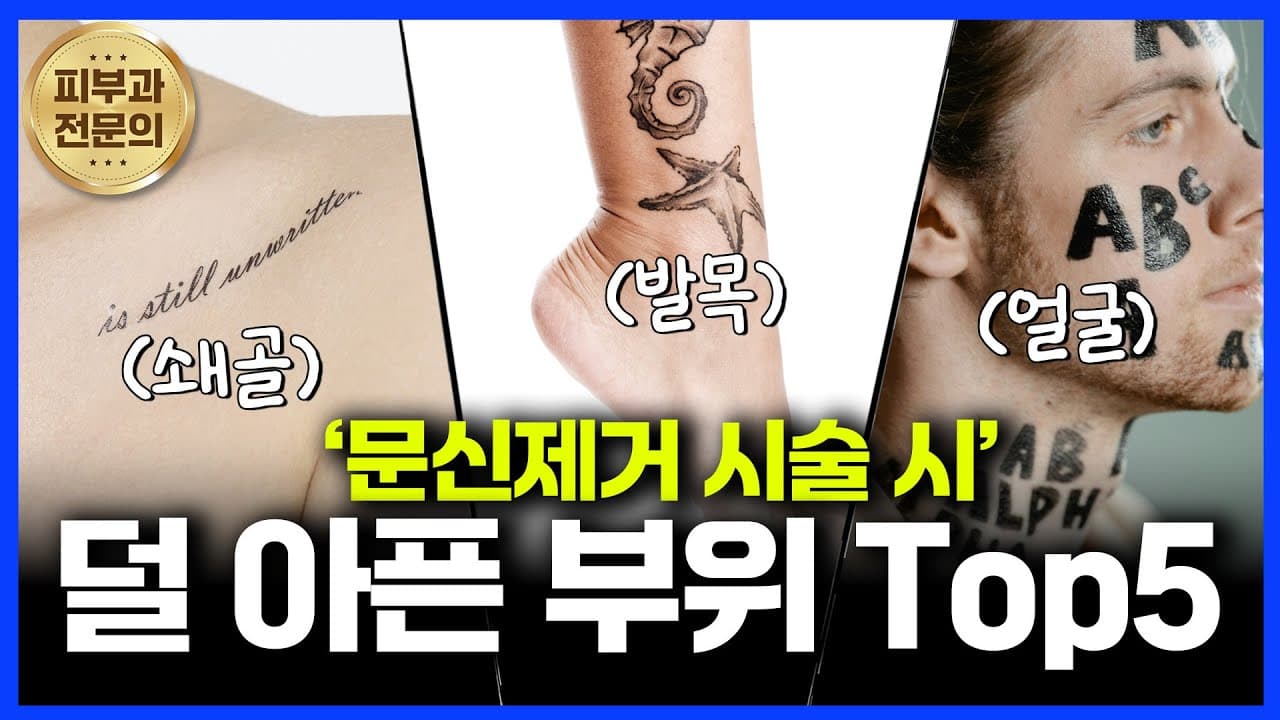
Hello. I am Lee Sang-ju, a dermatologist. One of the most common questions for those considering tattoo removal is, 'Which area hurts the most?' Did you know that the pain during tattoo removal is not just individual variation, but also varies greatly depending on the treatment area? Today, I will explain in detail the various factors influencing tattoo removal pain, the pain ranking by area, and methods for reducing pain.
Why does tattoo removal pain differ by area?
Tattoo removal pain does not simply arise from the laser procedure itself being painful. The degree of pain varies depending on several factors such as skin thickness, nerve distribution density, presence of fat and muscle, and proximity to bone. Generally, areas with many nerve distributions or close to bone tend to experience more severe pain, while areas with more muscle or fat are known to experience relatively less pain.
From the least painful to the most painful areas: Tattoo removal pain ranking
Let's find out the areas with less pain during tattoo removal, in order.
5th place: Forearms and thighs
The forearms and thighs are areas where the skin is thick and fat and muscles are well-developed underneath, making them relatively less painful. Many people get tattoos in these areas, so if you have a tattoo here, you can consider removal without much pain concern.
4th place: Shoulders and calves
The shoulders and calves have less fatty tissue than the forearms or thighs, but there are muscles underneath, so the pain may be felt as a tolerable, momentary sting.
3rd place: Wrists and ankles
The wrists and ankles have fewer nerve distributions compared to the face, but because they are close to the bone, the pain may be felt a little more intensely.
2nd place: Neck, ribs, back of the hand
These areas have thinner skin and more nerve distribution, so the pain may be stronger than in the previously mentioned areas.
1st place: Fingers and toes
Fingers and toes are known to be areas where anesthesia is not very effective and nerves are well-developed, leading to significant pain. However, these areas often have small tattoos, so tattoo removal is sufficiently possible by enduring for a short time.
5 major factors affecting tattoo removal pain
The main factors determining the degree of pain when removing a tattoo with a laser are as follows:
- Patient's pain sensitivity: There is a significant difference in how much pain each individual feels. Some people feel almost no pain, while others complain of greater pain from the same procedure.
- Amount of tattoo particles: The darker the tattoo, the more particles there are, which can cause more pain in the surrounding area when the laser breaks down the particles.
- Tattoo color: Black or blue tattoos tend to cause more pain than red tattoos. This may vary depending on how the tattoo particles are broken down.
- Tattoo removal speed: If the laser is applied slowly, the pain may be less, and if applied quickly, the pain may be felt more. The laser intensity is adjusted to an appropriate level for tattoo removal, so the pain due to the intensity itself may not be significant.
- Tattoo area: As explained earlier, areas with many nerves and close to bone are more painful, while areas with fat or muscle are less painful.
Home care guide for pain relief after tattoo removal
Home care before and after the procedure is also very important in reducing pain during laser tattoo removal.
Pre-treatment care:
- It is advisable to avoid excessive alcohol consumption the day before the procedure and get enough rest to maintain good physical condition.
- Adequate hydration to improve skin condition and moisturizing the skin are also important.
Post-treatment care:
When a tattoo is broken down by a laser, an inflammatory reaction can occur in that area, and quickly reducing this inflammation helps alleviate pain.
It is recommended to apply a cold compress to the treated area for about 24 hours after the procedure. This is effective in reducing inflammation and alleviating pain.
- On the day of the procedure, avoid activities that raise body temperature, such as saunas or excessive exercise, which can dilate blood vessels and worsen inflammation.
- Since the skin is damaged after laser treatment, it is important to use a regenerative ointment to keep the skin moist and healthy.
Various pain control methods provided by the clinic
Clinics use various methods to control pain during tattoo removal. Clinics specializing in tattoo removal can utilize several techniques depending on the patient's pain status.
- Topical Anesthetic Cream: Applied to the treatment area to reduce pain.
- Cooling anesthesia: Cools the treatment area to dull sensation.
- Vibration anesthesia: Uses vibration to disperse pain signals.
- Nitrous oxide anesthesia: Recently, nitrous oxide gas anesthesia is also widely used for pain reduction.
While tattoo removal pain cannot be completely avoided, it can be sufficiently managed by understanding the characteristics of each area and taking appropriate precautions before and after the procedure. If you have any further questions, we recommend consulting with a dermatologist at any time.