
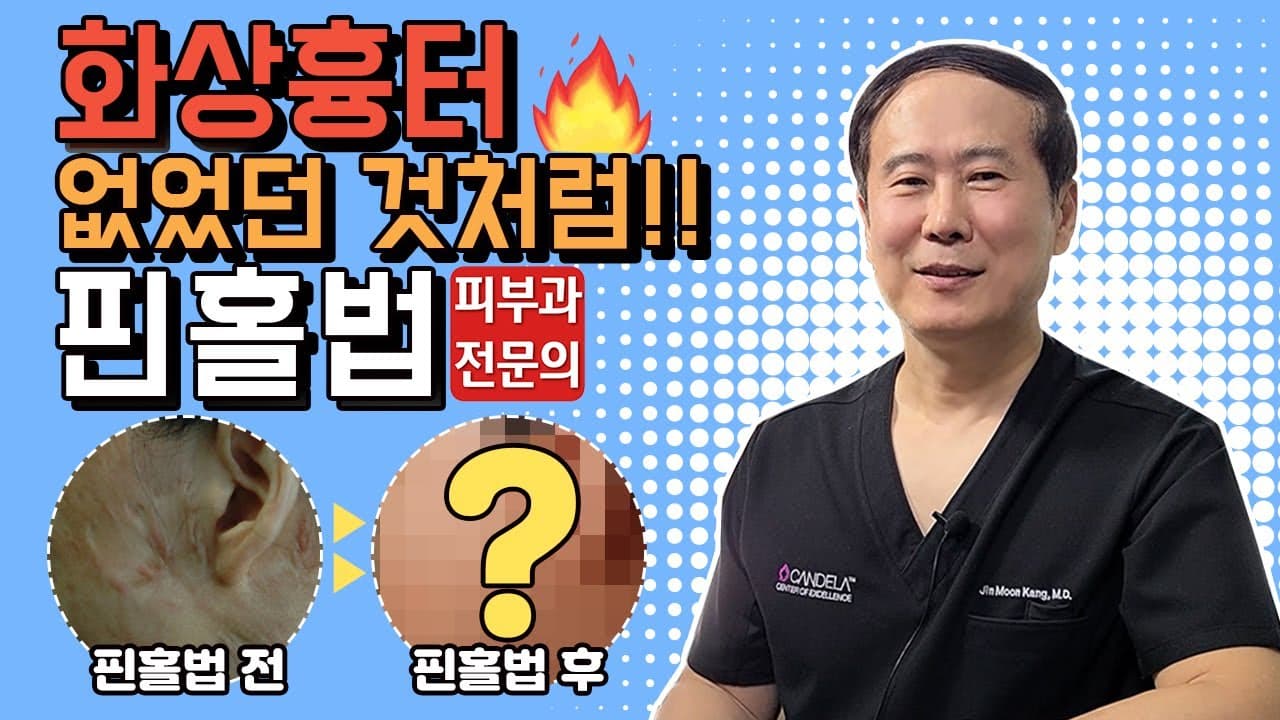
Hello! The number of subscribers to Yonsei Star Dermatology's YouTube channel, "All Skin Q&A in the World," has exceeded 10,000. We sincerely thank everyone who has shown interest in our channel. We ask for your continued support and will work hard to become a useful channel that solves your skin concerns. Today, we'd like to talk in detail about the Pinhole Technique, one of the burn scar treatment methods. If you like the video, please hit the like and subscribe buttons.
Pinhole Technique, How Did It Start?
Pinhole Technique is actually a treatment method inspired by folk remedies used since ancient times. In the past, grandmothers reportedly treated burn scars by pricking them with needles, and this can be seen as a modern application of that method using lasers. While the needle-pricking method had an empirical effect of softening scars, it had the disadvantage of being unhygienic. Based on this experience, hospitals began using more scientific lasers, and because the effects were surprisingly good, it continues to be used today.
To briefly explain the principle, it is a treatment that utilizes the effect of gradually loosening hardened scar tissues by making holes in the scar at regular intervals with a laser.
What's the Difference Between Needles and Lasers?
While traditional needle treatment and the laser-based Pinhole Technique may seem similar, there is a significant difference in how sufficiently they destroy scar tissue and induce regeneration.
- Needle Treatment: Pricking with needles can hardly destroy surrounding tissue, so even if there is an effect, it can be considered minimal.
- Laser Pinhole Technique: Laser holes are not only large, but they also provide invisible stimulation to the surrounding tissue beyond the hole itself, so the regeneration-inducing effect can be considered much greater.
Can Old Burn Scars Also Be Treated?
In reality, burn scars often occur in childhood, so if treatment begins in adulthood, most scars are at least 20-30 years old or more. In fact, the oldest person I treated was in their 80s. Therefore, just because a scar is old does not mean it cannot be treated at all.
Several years ago, an 80-year-old male patient came in. He was quite active and enjoyed exercising. He showed me a scar on his arm, which, in my opinion, was not that severe. However, he insisted on treatment, so I asked if it was really necessary, given his age and the mildness of the scar. His response was as follows:
He said he hadn't told anyone, but it was a lifelong regret that had bothered him for 80 years, and he wanted treatment.
Through this person, I realized that the stress caused by burn scars has no distinction by age or gender, and can even be a lifelong regret for older individuals.
Is Surgery the Only Answer for Burn Scar Treatment?
Surgical methods for treating burn scars have existed for decades. Representative methods include skin grafting, and tissue expansion, which was once popular. Tissue expansion is a treatment method where a water bag is inserted under the skin to stretch it, then the scar area is removed and covered with the stretched skin.
However, recently, these surgical treatments are less common. The reason is that patient satisfaction is not high even after surgery. While 20-30 years ago, many scars were treated with surgery, nowadays, it is much more common to proceed directly with laser treatment rather than surgery.
Evolving Pinhole Technique: Pinhole 4.0
The idea for the Pinhole Technique was conceived about 20 years ago, and through continuous treatment over two decades, the procedure has been gradually upgraded, evolving into the current Pinhole 4.0. While the initial Pinhole Technique only involved making holes with a laser, the recent Pinhole 4.0 method has the following characteristics:
- Deep and strong holes
- Small, invisible holes that can provide more direct stimulation to the skin surface
- Combined application of medication injections to soften scars
Through such combined treatments, the therapeutic effect appears much faster, and the results are further improved compared to the initial Pinhole Technique.
Facial Burn Scar Treatment: Pain and Results?
Treating burn scars on the face can be difficult or not. The challenging aspect is that the face is more sensitive, so pain may be slightly more severe during treatment. However, the final treatment results are generally known to be better for facial areas. Our goal is to achieve an effect that can be covered with light makeup, and most patients can achieve satisfactory results.
It is true that burn scar treatment remains a challenging field. However, consistent treatment can yield satisfactory results. However, the treatment period can be long, so it is important to anticipate and plan for long-term treatment. If you have any additional questions, please leave a comment below or contact our clinic via KakaoTalk. This has been dermatologist Kang Jilmun. Thank you.