
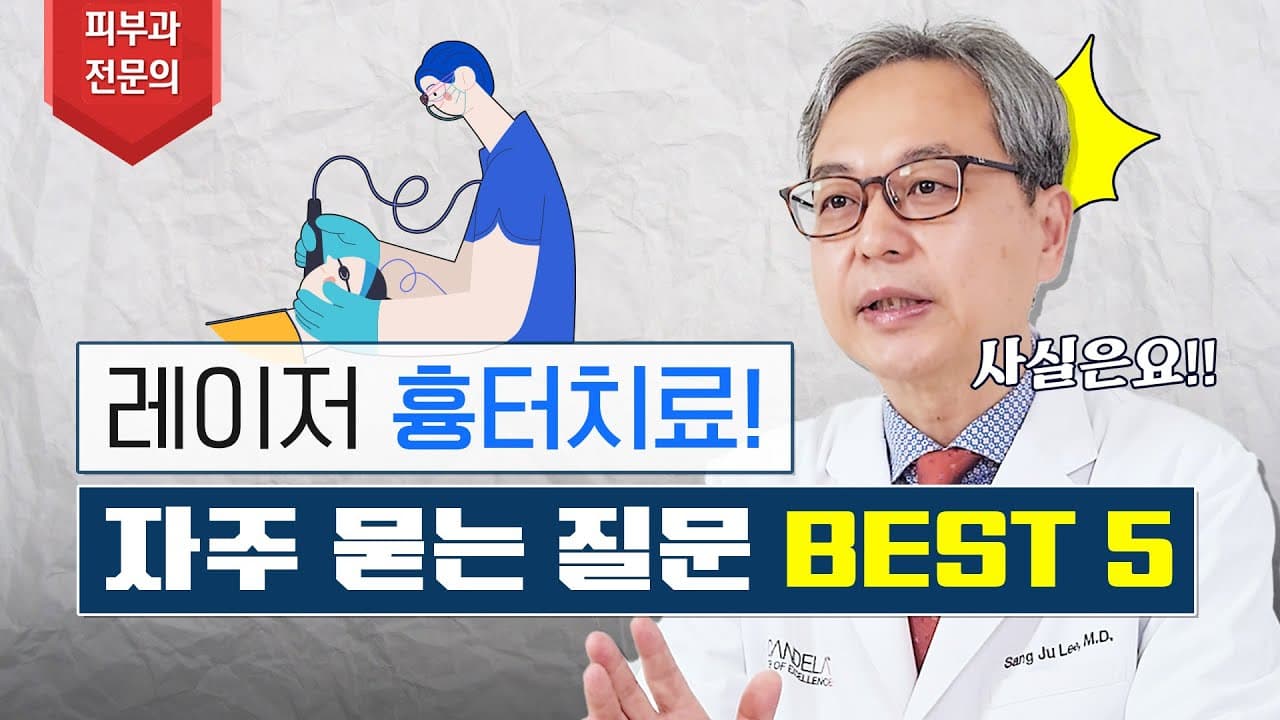
Scars, once formed, rarely disappear, causing concern for many. Especially when considering laser scar treatment, various questions naturally arise, such as 'How much will the scar improve?' or 'Will there be any side effects?' Dr. Sang-ju Lee, director of Yonsei Star Dermatology Sinchon, has been treating scars for over 20 years and aims to answer common questions patients have about scar treatment.
When is the best time to start scar treatment?
There's a term called 'golden time' in scar treatment. It is advisable to start treatment as soon as possible after the wound has healed. In the past, it was recommended to wait about 6 months for the scar to mature, but recent research over the past decade has shown that treating scars as early as possible is more effective. Please remember that if you miss the early treatment period for a scar, the treatment effect may be significantly reduced.
Are old scars harder to treat? Factors determining the difficulty of scar treatment
Many people think that a 30-year-old scar is harder to treat than a 3-year-old scar. However, the difficulty of scar treatment is actually influenced more by the scar's texture, thickness, and area (if it's large), rather than how long it has been there. In other words, it's important to know that the nature of the scar plays a more crucial role in the treatment outcome.
For scar treatment, the quality of the scar (texture, thickness, area) has a greater impact on the treatment outcome than the duration of the scar.
How do fractional lasers improve scars?
In the past, scars were treated with methods like skin dermabrasion, which were time-consuming, interfered with daily life, and had relatively low effectiveness. However, fractional lasers have compensated for these drawbacks, becoming an effective method that enhances treatment efficacy and reduces side effects.
An interesting aspect of fractional lasers is that they can be used for both raised and depressed scars. This is because the skin has a tendency to regenerate and return to its original state.
- Raised scars: Gradually flatten after laser treatment.
- Depressed scars: Gradually fill in after laser treatment, showing an effect.
While not applicable to all scars, effectiveness can be expected for most scars.
Are there other treatments besides fractional lasers?
While fractional lasers are an effective treatment, they do not yield optimal results for all scars. In some cases, such as thick burn scars, fractional lasers alone may not be sufficient.
In such instances, treatments like laser dermabrasion, which allow for various intensity and density adjustments according to the scar's shape, thickness, and texture, may be more effective. Many scars that did not show sufficient improvement with fractional lasers can be improved through laser dermabrasion. This is because it allows for a more precise and in-depth approach tailored to the specific characteristics of the scar.
Symptoms that may occur after laser scar treatment and how to manage them
After laser scar treatment, some temporary symptoms may appear. Typically, redness or, depending on individual constitution, pigmentation may occur. Most of these symptoms are temporary, so you don't need to worry too much.
If redness appears, laser treatment to reduce redness can be combined, and if pigmentation occurs, it can be improved with methods like toning. Therefore, rather than hesitating due to concerns about side effects, it is important to consult with a specialist to find appropriate coping strategies.