
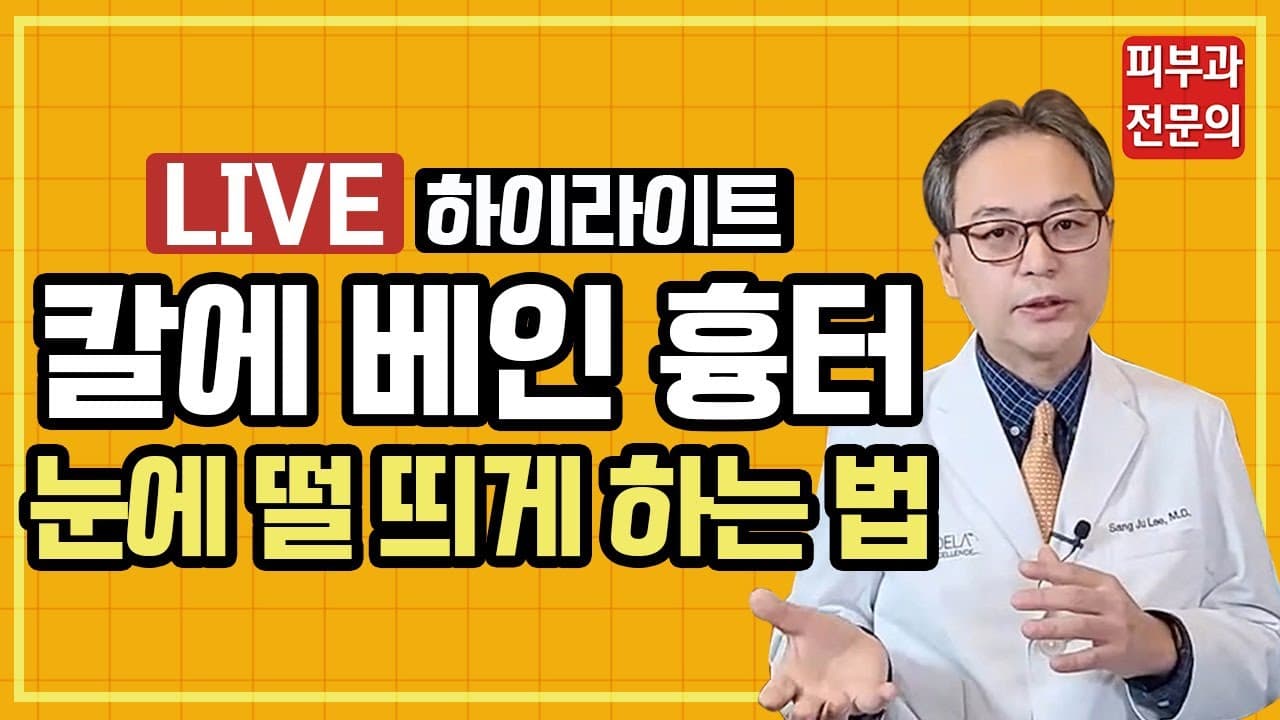
Hello. I am Dr. Lee Sang-ju of Yonsei Star Dermatology. Today, I would like to talk about incised wounds or laceration scars caused by sharp objects like knives. Self-harm scars and surgical scars also fall into this category. I will explain in detail, focusing on the questions many people have about incised wounds.
Initial Wound Care: When Cut by a Sharp Object
Many parents worry about scars when their children are frequently cut or stabbed by sharp objects. Whether a scar will form after an injury largely depends on the depth of the wound and initial care.
- Shallow wounds that do not bleed: This is when only the epidermis, the outermost layer of the skin, is affected. Such wounds leave almost no scars, so light dressing is usually sufficient. However, care to prevent secondary bacterial infection is essential.
- Deep wounds that bleed: If the wound penetrates deep enough to reach blood vessels below the epidermis, bleeding occurs, and the likelihood of scarring increases. If the wound is wide open, it is best to suture it quickly.
Why Does Pain Persist After an Injury?
Sometimes, pain continues even after the wound area has been disinfected. The main reasons are as follows:
- Residual microscopic foreign bodies: Tiny foreign bodies, like glass fragments, that are not easily visible can remain and continue to irritate. If suspected, it is advisable to have them removed at a hospital.
- Secondary bacterial infection: If bacteria penetrate the wound area, it can cause severe pain.
- Skin irritation: The wound area is sensitive, so even if it's not bacteria, irritating substances like soap can cause stinging.
Suturing and Ointment Use for Scar Prevention
Many people worry about scarring if they cut their hand while cooking and the skin separates. If the skin is separated, there is a high chance of scarring.
While the palm tends to scar less even with deep wounds, other areas are prone to scarring. Therefore, if the wound is wide open, it is advisable to visit a hospital and consider suturing.
Ointments applied when cut by a sharp object are to prevent secondary bacterial infection. If the wound area is clean and relatively shallow, ointments like Fucidin may be helpful. When severe inflammation or bacterial infection is suspected, it is advisable to use disinfectants like Betadine.
Incised Wound Treatment: Surgery vs. Laser
Scar treatment methods include surgery and laser, each with its own advantages and disadvantages.
- Surgery:
- Advantages: Effective for narrowing very severe and wide scars. It can generally be completed in a single treatment.
- Disadvantages: Surgery itself can create new scars, and depending on one's constitution, scars may not improve or may even worsen.
- Laser:
- Advantages: Effective for fine scars or when cosmetic improvement is desired. It does not significantly interfere with daily life.
- Disadvantages: It is not a one-time treatment and requires repeated procedures.
Incised wounds on the face require different treatment methods depending on the shape and size of the scar. If the width is 1 cm or more, it is advisable to reduce the width with surgery. If it is around 5 mm, laser improvement may be more effective.
Treating Old Scars and Self-Harm Scars
Old scars from childhood or self-harm scars can also be treated.
- Old scars: Even severe incised scars on the forehead that are over 20 years old or surgical scars that are 40 years old can be treated. Early treatment of scars is more effective, but the treatment effect for old white incised scars is not diminished, so you can comfortably receive treatment. Especially for old linear scars remaining on the face, Pinhole Technique shows good results.
How to Treat Self-Harm Scars?
It is advisable to discuss self-harm scars with parents rather than worrying about them alone.
- Ointment treatment: If the wound is shallow enough not to bleed, ointment may be helpful. However, if it is bleeding, active treatment is necessary.
- Difficulty of surgery: Self-harm scars are often not wide and are fine, making it difficult to create a scar thinner than the existing one even with surgery. If linear scars are sutured in a zigzag pattern, the zigzag shape may become more noticeable, often leading to unsatisfactory results.
- Tattoos are not recommended: It is difficult to completely cover scars with tattoos, and since skin color changes with the seasons, it is virtually impossible for the scar to be completely invisible.
- Best alternative: Laser Pinhole Technique: Currently, the laser Pinhole Technique is known as the best alternative. It can stimulate the growth of new skin in the scar, making it resemble the surrounding skin. It does not significantly interfere with daily life, has good cosmetic improvement effects, and has few side effects.
- Old hesitation marks and deep scars: Old hesitation marks or scars that have deepened due to continuous self-harm for more than 5 years can also be treated. Even deep self-harm scars can be improved to a degree that they are not a major concern, so please do not worry and consult us.
- Pigmentation: For self-harm scars with red or brown pigmentation, combining the Pinhole Technique with pigment laser treatment tailored to the scar condition can yield good results.
Precautions During Self-Harm Scar Treatment
- Treatment period: The time it takes to remove self-harm scars varies depending on the individual's constitution, and the width and length of the scar. Fine scars improve quickly, while thicker scars take longer. If you have a keloid constitution, the treatment period may be longer.
- No self-harm during treatment: If you self-harm again while receiving laser treatment, you will return to the beginning, and it will take longer. It is important to try not to self-harm during treatment. It is best to receive consistent treatment without giving up.
Questions About Laser Treatment
- Laser treatment around the eyes: Lasers use light, so they are closely related to the eyes, but treatment is possible without problems by wearing safety devices to prevent the laser from entering the eyes. Moles on the eyelids or eyelashes can also be removed with a laser.
- Number of treatments: Laser treatment is performed repeatedly, and good results can usually be obtained with 5 to 10 sessions at intervals of one to two months.
- Redness after treatment: It is a normal reaction for the wound or scar area to temporarily become redder after laser treatment. Especially with lasers like the Pinhole Technique, the area becomes red as new skin grows, and this redness usually lasts for about a month before disappearing, leading to scar improvement. If there is excessive redness, it is advisable to contact the clinic where you received the procedure.
Post-Surgery Care and Precautions
- Suture line separation: If the incised wound suture line separates, the response varies depending on the timing.
- Early stage (1-2 weeks): It is best to re-suture quickly to close the wound.
- After some time (1-2 months): Initially, vascular lasers like Vbeam Prima can be used to reduce the scar, and then remaining scars can be treated with the Pinhole Technique or similar methods.
- Protrusion of the surgical site (Keloid): The surgical site may swell slightly initially, but if it continues to rise over time, it is likely a keloid scar, and early treatment is necessary. Hypertrophic scars that are confined to the wound area may sometimes improve over time.
This content was created based on the YouTube live broadcast of Dr. Lee Sang-ju of Yonsei Star Dermatology. Treatment results may vary depending on the individual's condition, so accurate diagnosis and consultation should be obtained by visiting a medical institution.