
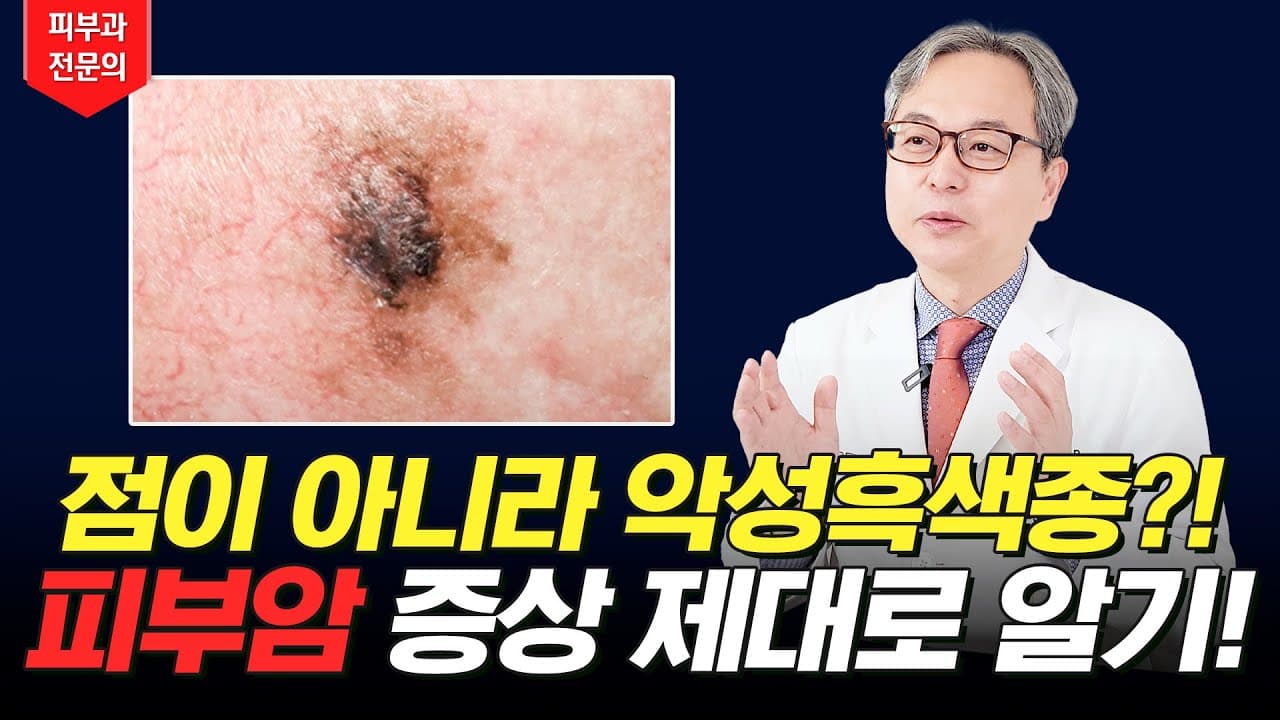
Thought it was a mole, but it's skin cancer?! Watch this video to distinguish skin cancer!
Did you dismiss a mole on your skin as insignificant? However, sometimes a simple mole can be malignant melanoma, a type of skin cancer, requiring attention. With Dr. Sang-ju Lee of Yonsei Star Dermatology Sinchon, we will learn more about the risk factors, symptoms, prevention, and treatment of skin cancer, which is a malignant neoplasm that occurs on the skin. Everyone knows that early detection and prompt treatment are important for any cancer. The same applies to skin cancer.
Thought it was a mole, but it's skin cancer? Why early detection is important
Generally, if a black mole with irregular color and shape appears, malignant melanoma can be suspected. In particular, malignant melanoma tends to occur frequently on the soles of the hands and feet in Koreans, so it is very important to get a dermatological examination if any mole on your hands or feet has an abnormal shape or color.
What are the main risk factors for skin cancer?
The factors affecting skin cancer development are as follows:
UV exposure
The most important cause of skin cancer is prolonged exposure to ultraviolet rays.
Family history (genetics)
Skin cancer can have a family history, and genetic factors may also play a role.
Skin damage (burns, wounds)
Skin cancer is known to occur frequently in areas where the skin has been damaged, such as by burns or wounds.
Smoking
Smoking is also reported to have a negative impact on skin cancer development.
Types and characteristics of skin cancer
Skin cancer can be broadly divided into two types. These two types differ in shape and pattern.
Basal cell carcinoma and squamous cell carcinoma
The characteristic of basal cell carcinoma or squamous cell carcinoma, which originate from the epidermal layer of the skin, is the occurrence of ulcers on the skin. That is, if the skin has been ulcerated for a long time and does not heal well, skin cancer should be suspected at least once.
Malignant melanoma
Malignant melanoma originates from melanocytes, and in very severe cases, it may be accompanied by ulcers, but generally, it is characterized by the appearance of a black lesion similar to a mole with irregular color and shape. In particular, if a mole on the soles of the hands or feet has an abnormal shape or color, a dermatological examination is important.
Could I have skin cancer? Malignant melanoma self-diagnosis method (ABCDE)
Malignant melanoma can usually be suspected early based on its shape, size, and color, and can be divided by the 'ABCDE' criteria.
- A (Asymmetry): If the two sides of the mole are irregularly asymmetrical
- B (Border): If the border of the mole is irregular or bumpy
- C (Color): If the color of the mole is not a single tone but a mixture of various tones or is uneven
- D (Diameter): If the diameter of the mole is large, over 6mm
If you observe the above characteristics, it is advisable to consider the possibility of malignant melanoma and consult a dermatologist.
How is skin cancer diagnosed and treated?
Tests for accurate diagnosis
Precise diagnosis of skin cancer is made through tissue biopsy. This method involves excising a small part of the skin and observing it under a microscope to confirm the presence of malignant cells. Recently, dermoscopy (skin magnifying glass) is sometimes used to find information about skin cancer before the tissue biopsy stage.
Skin cancer treatment methods
If skin cancer is diagnosed, treatment proceeds. The most representative method is surgical treatment.
- Basal cell carcinoma and squamous cell carcinoma: Surgery is known to be curative, so surgery is the most basic treatment method.
- Malignant melanoma: Surgery is fundamental, but in advanced stages, chemotherapy or radiation therapy may be combined for treatment.
Lifestyle habits for skin cancer prevention
As mentioned earlier, one of the biggest causes of skin cancer is ultraviolet rays. Therefore, the following preventive efforts are important:
- It is important to consistently use sunscreen in daily life.
- Smoking has a negative impact on skin cancer, so quitting smoking is necessary.
- Despite these efforts, skin cancer can occur in individuals with a genetic predisposition. However, since early detection is known to be curative, regular check-ups for early detection are paramount.