
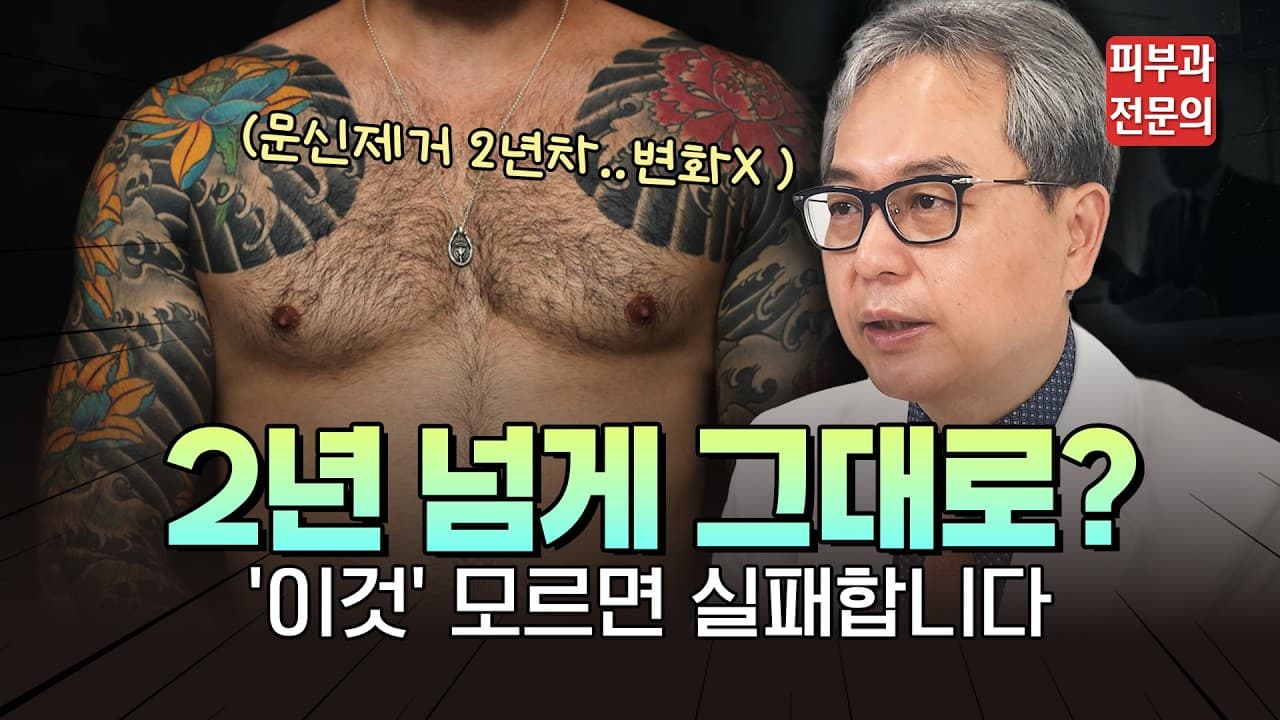
Hello. I am Dr. Lee Sang-ju, a dermatologist.
Many people are frustrated that their Irezumi tattoo removal, which they started with great determination, seems to be stuck after more than two years. It's easy to think it's simply because of the large size or dark color, but a more complex process is at work within our bodies. Here are five reasons why it takes so long.
1. It doesn't end with breaking down the pigment
While tattooing involves injecting dye into the skin, the removal process is different. When pigment is broken down by a laser, our body's macrophages (immune cells) must transport that pigment and excrete it out of the body through the lymphatic vessels.
It takes time not only to break down the "waste" but also to transport and excrete it. Irezumi tattoos have a large amount of pigment, so it cannot all be moved at once, making the process longer.
2. Different colors react to different lasers
Brown and black absorb most light and respond well to various wavelengths. However, colors like red, green, yellow, and white only react to specific laser wavelengths.
- If multiple colors are mixed, lasers must be used alternately.
- The degree of reaction varies by color, which can multiply the number of treatment sessions.
3. The reason for receiving treatment according to the cycle
It takes time for broken pigment to be expelled from the body. Since the skin's regeneration cycle is about 4 weeks, laser treatments are usually performed at intervals of 4 to 8 weeks. Rushing the process by ignoring the cycle can only increase the burden on the skin.
4. Irezumi tattoos have deep and abundant pigment
Most Irezumi tattoos are applied by professional tattoo artists who inject pigment deeply, uniformly, and repeatedly. Pigment located deep within the skin is difficult for laser light to reach.
Even if the surface of the skin lightens, the deeper pigment may remain longer, and since Irezumi tattoos inherently contain a large amount of dye, it takes even more time.
5. The goal is to safely fade it
Tattoo removal can sometimes result in the skin returning close to its original state, but not always, so individual results may vary. The realistic goal in the consultation room is to significantly fade the tattoo while minimizing skin damage.
To shorten the duration, the following care is necessary:
- Avoid alcohol as much as possible after the procedure.
- Consistently use sunscreen.
- Pay attention to regenerative care.
Conclusion
Irezumi tattoo removal is a long battle with the skin and a battle against time. The key is to remove it safely while minimizing skin damage, even if it takes time.
This has been Dr. Lee Sang-ju, a dermatologist. Since results may vary depending on individual skin conditions, please consult a dermatologist for an accurate diagnosis.