
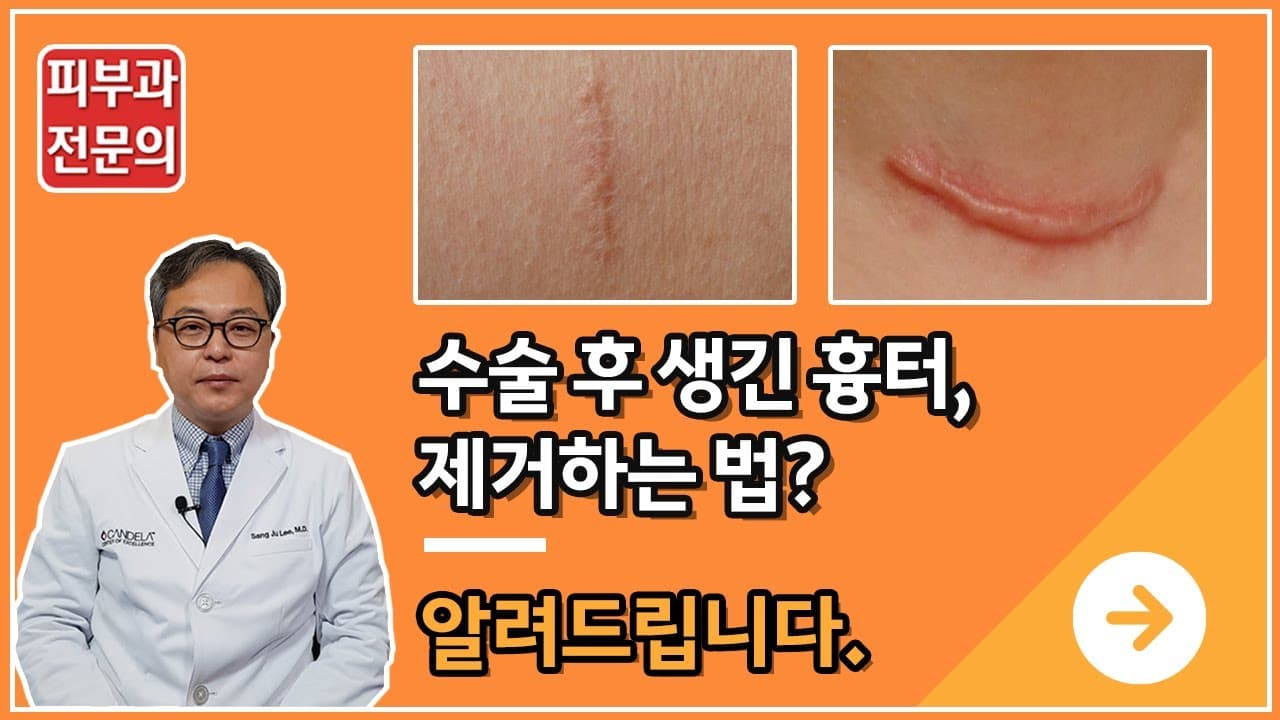
Hello. I am Lee Sang-ju, a dermatologist. Last time, we discussed treatment methods for early red scars. Today, we will take a closer look at scars remaining after surgery. After undergoing surgery for disease treatment or cosmetic purposes, most people are left with surgical scars.
Generally, if only the epidermal layer of the skin is damaged, no scars are left, but if the dermis or deeper layers are damaged, scars are inevitable. Since surgery affects all layers of the skin, all surgical sites can lead to scars during the healing process.
Types of Surgical Scars
Surgical scars typically appear as straight lines, but they can remain in various shapes depending on an individual's constitution or the affected area.
- Linear Scars: Sometimes they appear as fine lines, but they often have a white color, making them visually noticeable. They mainly appear after facial plastic surgery.
- Widened Scars: In joint areas, especially the shoulder or knee after orthopedic procedures, scars can widen severely. Some patients complain that they look like caterpillars.
- Hypertrophic Scars: These are scars where a linear scar swells up and appears reddish. A typical example is when the area after breast surgery becomes red and swollen.
- Keloid Scars: This refers to cases where, due to an individual's constitution, a scar swells significantly beyond its original area of damage. Since it is influenced by constitution, it can occur anywhere.
- Uneven or Depressed Scars: Many people are concerned about surgical sites that are uneven or sunken.
What are the treatment options for surgical scars?
Treatment methods for surgical scars can be broadly divided into two categories.
Reoperation
While it has the advantage of reducing scar size, in individuals prone to scarring, the scar often becomes larger or remains unchanged.
Laser Treatment
Laser treatment can be thought of as a method to appropriately refine the scar area based on its shape, color, and size. It has the advantage of relatively few side effects and expected efficacy, but the disadvantage is that multiple sessions are required.
Customized Laser Treatment Methods by Scar Type
Scars have various characteristics such as shape, size, depth, and color, making it difficult to satisfy all needs with a single laser treatment. It is important to use the appropriate laser according to the scar's characteristics.
- Dark Scars: Q-switched lasers or PicoWay Laser used for whitening are utilized to lighten the color.
- Red Scars: Vascular lasers are used to reduce the redness of the scar and flatten its height.
- Uneven or Depressed Scars:
- Using Pinhole Technique or other fractional lasers can stimulate new collagen and skin to fill the scar area, making it resemble normal skin.
- Ablative lasers can even out uneven, raised, or depressed areas of the scar.
Other procedures to consider besides lasers
Dermatology clinics also frequently use simple procedural methods, short of surgery.
- Direct injection into the scar area
- For depressed scar areas, procedures such as Subcision or Suture-Free Punch to release the underlying tissue.
For successful surgical scar treatment
As such, surgical scars vary greatly in shape, size, color, and depth. Therefore, it is important to receive appropriate treatment tailored to the individual's scar characteristics. Especially since various laser treatments are needed and much experience is required, it is advisable to consult a specialized clinic for treatment. We hope today's video was helpful.