
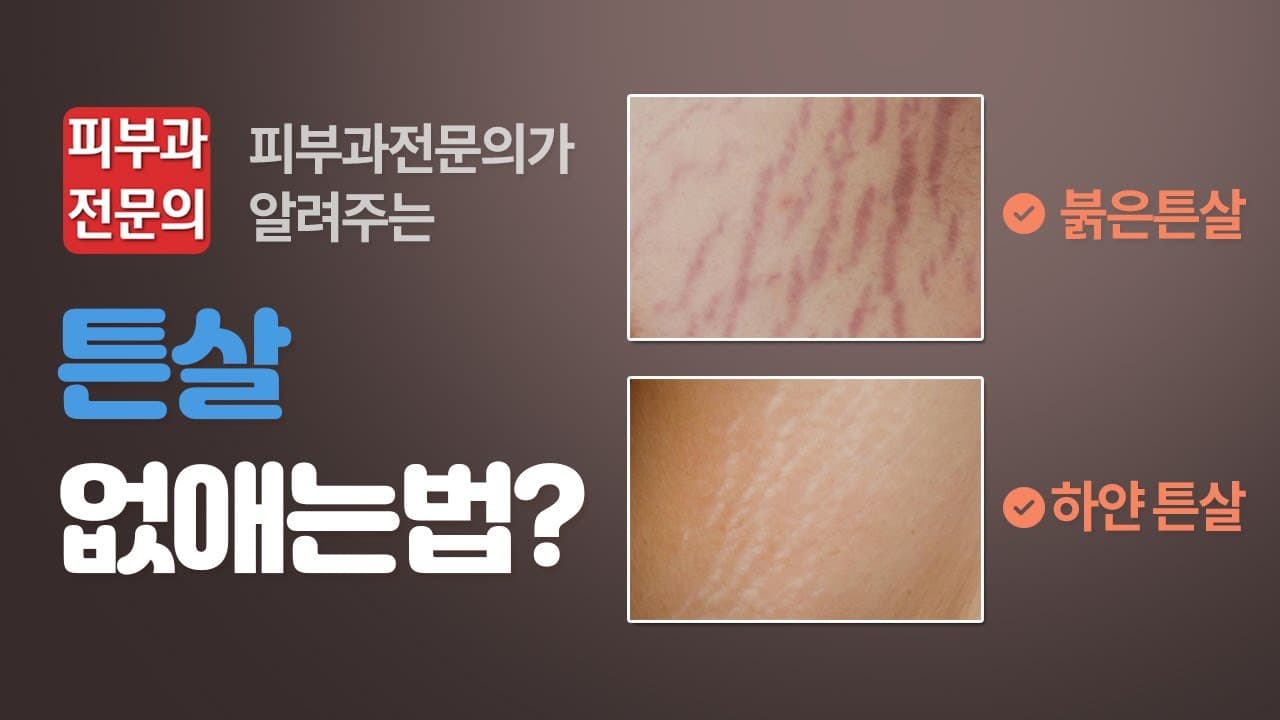
Hello, I am Lee Sang-ju, a dermatologist. Today, I would like to talk about 'stretch marks,' a concern for many people. Stretch marks, which appear on various parts of the body such as the calves or thighs during rapid growth in puberty, the abdomen during pregnancy, or the chest during a sudden increase in muscle mass, are medically called 'striae distensae.'
Why do stretch marks occur?
Stretch marks are traces that occur when the skin tears because it cannot keep up with the rapid growth rate. They commonly appear on the calves or thighs during puberty when height increases, and on the abdomen after pregnancy and childbirth. In men, they can also appear on the chest or back when muscle mass suddenly increases due to bodybuilding, etc.
Medically, changes in body hormones or an increase in steroid hormones are known to affect the occurrence of stretch marks. In particular, if steroid ointments are used for a long time, or if steroid drugs are taken for autoimmune diseases, etc., stretch marks may appear all over the body.
What is the difference between red stretch marks and white stretch marks?
Stretch marks can be broadly divided into red stretch marks and white stretch marks according to their color.
- Red stretch marks appear in the early stages when stretch marks begin to form, and are characterized by a slightly pinkish color.
- White stretch marks are a state where red stretch marks have turned white over time. They are generally known to be more difficult to treat than red stretch marks.
Can stretch marks be prevented?
Unfortunately, there is currently no reported method to 100% prevent stretch marks. However, the following efforts may help reduce the occurrence of stretch marks.
- Cause Management: If stretch marks are caused by steroid ointments or medication, you should consult with medical staff to consider reducing the dosage or replacing it with other medications.
- Moisturizing Care: For stretch marks caused by growth or weight gain, consistently applying moisturizers or stretch mark creams may help reduce the occurrence of stretch marks, even if only slightly.
The most important thing is early treatment. If red stretch marks appear and treatment is started quickly, it may be possible to prevent the stretch marks from getting larger or to expect them to return to their previous state, so early detection and treatment are very important.
What are the treatment methods for stretch marks?
Various methods have been attempted to treat stretch marks, and recently, they can be broadly divided into three methods.
1. Topical Ointment Treatment
There is a method of applying vitamin A-based ointments. However, the treatment effect is limited, and side effects such as itching or stinging may occur, so it is used cautiously.
2. Microneedle Treatment (MTS, CIT, PIC, etc.)
This method uses fine needles or pins to stimulate the skin to induce new collagen production. In the past, it was widely attempted in dermatology clinics, but due to severe pain and side effects such as bleeding after the procedure, its use is decreasing recently. It is sometimes used in Korean medicine clinics, etc.
3. Laser Treatment
It is considered one of the most effective treatments, and different lasers are used depending on the type of stretch mark.
- Red stretch marks: For early red stretch marks, vascular lasers are used. This method is also widely used for treating red scars, and it can help prevent stretch marks from progressing further and return them to their previous state.
- White stretch marks: For white stretch marks, Fractional collagen regeneration is mainly used. Fractional lasers are largely divided into non-ablative and ablative, and ablative fractional lasers are known to be more effective. In particular, powerful lasers such as Ultrapulse Encore can treat not only fine stretch marks on the calves but also thick stretch marks on the abdomen that occurred after pregnancy, and numerous papers report good treatment effects.
Can old white stretch marks also be treated?
Many people think that old white stretch marks are difficult to treat. This may be because in the past, it was difficult to achieve satisfactory results with methods such as vitamin A ointments, microneedles, or peeling.
However, recently, with advanced fractional lasers such as Ultrapulse Encore, even old white stretch marks can be improved.
Ultrapulse Encore treats stretch marks by inducing new collagen formation, making them resemble the surrounding skin.
This has been dermatologist Lee Sang-ju. If my video today was helpful, please like or subscribe, and if you have any questions, please contact us via comments or KakaoTalk. Thank you.