
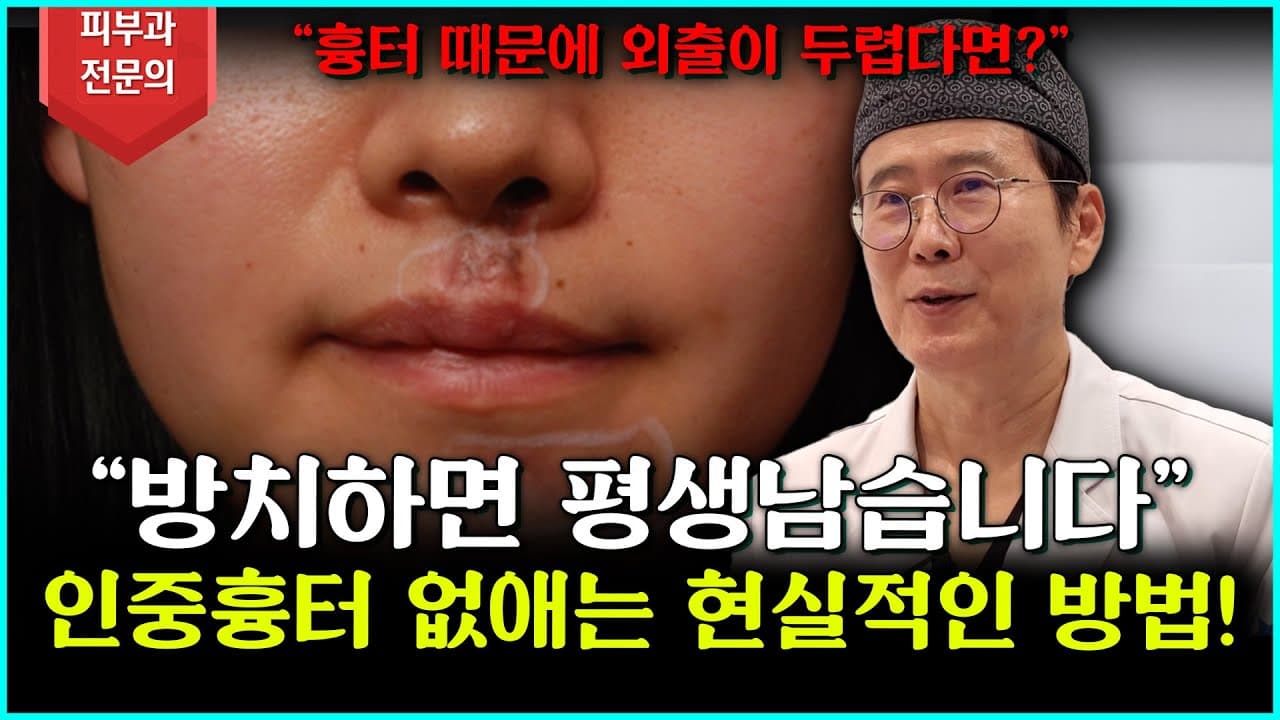
The philtrum is located in the center of the face, making even small scars easily noticeable, which causes many people distress. From acne and shaving cuts to plastic surgery and unforeseen accidents, philtrum scars can result from various causes. Today, we will address your questions about the causes and treatment of philtrum scars.
Why do philtrum scars occur?
The causes of philtrum scars are very diverse. Most commonly, severe acne or injuries during shaving can leave scars. Recently, scars occurring after nasal plastic surgery are also not uncommon. Additionally, philtrum scars can result from falls, and there are often cases where women develop scars due to accidents after drinking.
Do scars inevitably remain after surgery?
Scars will 100% form after surgery. However, the important question here is whether a noticeable scar will form that interferes with daily life. Not all post-surgical scars are severe enough to affect social life.
According to the experience of plastic surgeons, when treating about 100 patients, approximately 90 patients are left with scars that are not very noticeable. However, among the remaining 10 patients, scars may remain that are unsightly to others, and about half of these, 5 patients, may develop quite severe scars. We can help these 10% of individuals who have developed noticeably unsightly scars.
Can we predict if a scar will worsen?
It is difficult to accurately predict how a scar will progress after surgery. However, by observing the progress for about one week to one month after suture removal, a general pattern can be identified.
- Good sign: If the redness quickly diminishes and the scar does not protrude after about a month, the likelihood of developing a severe scar is low.
- Warning sign: Conversely, if the redness persists or worsens, and the scar area protrudes, it can be inferred that the scar may not disappear easily and could progressively worsen.
How often should philtrum scar treatment be received?
The frequency of scar treatment can vary depending on the doctor's experience. I usually recommend a cycle of about one month. The reasons are as follows:
- Too short a cycle: It can put a strain on the skin and is not advisable.
- Too long a cycle: The overall treatment period can become extended, which may be burdensome for the patient.
If there are no particular issues, receiving treatment at intervals of about one month is generally considered appropriate.
It is advisable to avoid hair removal during scar treatment
It is generally recommended to undergo hair removal only after scar treatment is completely finished. This is because hair removal lasers typically have quite strong energy intensity.
- Strong laser energy burns the hair follicles in the skin to achieve hair removal.
- If such strong energy stimulates the scar treatment area too intensely, there is a possibility of burns or other undesirable outcomes.
Therefore, it is safer to avoid hair removal in the affected area during scar treatment and to proceed with it after all treatments are completed.
Reasons why philtrum scar treatment is challenging
Several important factors influence the success of scar treatment. The cause of the scar, the patient's individual constitution, and the location of the scar are typical examples.
The scar location is particularly important.
Generally, scars on facial areas with good skin regeneration tend to respond relatively well to treatment. Conversely, treatment tends to be more difficult as one moves towards the hands and feet, where regenerative capacity is lower. Among facial areas, the nose, in particular, is known to have insufficient blood supply and reduced regenerative capacity, making scar treatment challenging. The philtrum area also shares similar characteristics of reduced regenerative capacity, making scar treatment potentially difficult.