
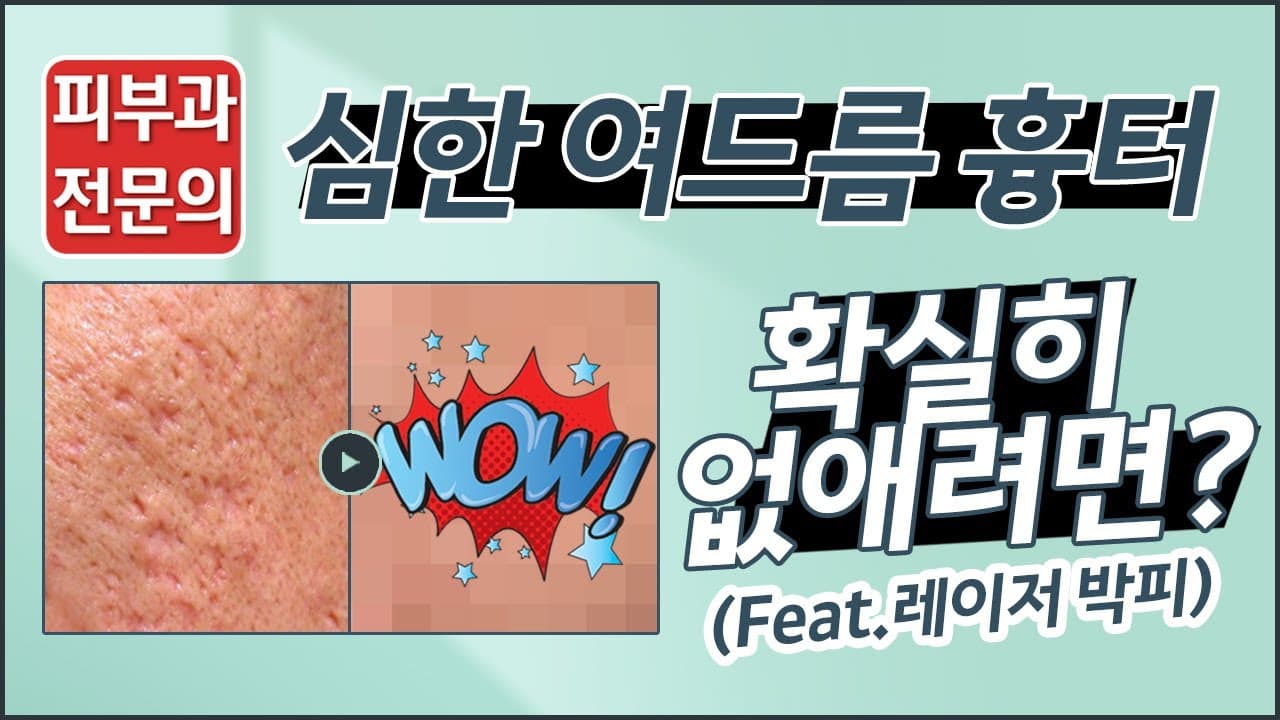
Hello. I am Lee Sang-ju, a dermatologist. Following our previous discussion on acne scars in general, this time we will delve into laser dermabrasion, one of the treatments for acne scars. Laser dermabrasion is known as a powerful and effective method for treating acne scars.
Why are acne scars difficult to treat?
Scar treatment is more challenging than other dermatological treatments. In particular, deeply pitted acne scars often yield unsatisfactory treatment results. There are three main reasons for this:
- Depth of the scar: Although they may appear shallow, acne forms when the skin deep below the surface becomes inflamed, so the scars can be deeper than they seem.
- Individual differences in regeneration speed: While lasers are used for scar regeneration, skin regeneration speed varies greatly from person to person.
- Diverse scar types: Acne scars vary widely in shape, size, and depth, making it difficult to achieve effective results without selecting the appropriate treatment method.
For these reasons, acne scars are known as a condition that is not easy to treat.
What is 'dermabrasion'?
Dermabrasion is, as the name suggests, a treatment that involves gently peeling off a layer of skin. By removing the skin, it naturally stimulates the creation of new skin, and in this process, you can expect a filling effect.
Various types of dermabrasion
There are several types of dermabrasion, with three main methods:
- Chemical peeling: This method involves applying an acid that corrodes the skin to stimulate it. In the past, it was widely used due to its low cost, but it has many side effects and the disadvantage of being difficult to precisely control the degree of peeling.
- Mechanical dermabrasion: This method involves rubbing the skin with a tool similar to sandpaper to peel it off. This also makes it difficult to precisely control the skin depth and causes severe side effects and bleeding, so while it was used 20-30 years ago, it is rarely used today.
- Laser dermabrasion: This is a much more advanced method than mechanical dermabrasion. It can precisely peel off the skin in minute increments, allowing for accurate treatment of specific depths and points. This means it is a treatment method that can reduce side effects while still providing powerful results.
Strengths and features of laser dermabrasion
A major feature of laser dermabrasion is that the laser can precisely peel off the skin. It can precisely ablate the skin in 5 micrometer (μm) units, allowing for very accurate treatment of deep scars deeply and shallow scars superficially.
Furthermore, recently, hybrid devices have been developed that not only have peeling capabilities but also penetrate laser energy deep into the skin to powerfully induce collagen regeneration and skin recovery. Using such devices, energy reaches deep into the skin without bleeding, promoting collagen regeneration and aiding skin recovery. This is a powerful effect that is difficult to achieve with mechanical dermabrasion and can be very effective for treating deep and severe acne scars.
While fractional lasers are commonly used nowadays, laser dermabrasion can be expected to have at least 5 to 10 times more powerful treatment effects compared to these lasers. The advantage is that satisfactory results can be achieved with just one treatment session.
Who can consider laser dermabrasion?
Laser dermabrasion can offer powerful treatment effects, but it requires a recovery period of about a week, during which a regenerative tape must be applied to the skin. Therefore, if you are someone who can tolerate some disruption to your studies or daily life, especially if you have very severe acne scars, laser dermabrasion is one of the treatment options you can consider.
Since acne scars vary in shape, depth, and size, accurate diagnosis and the selection of an appropriate treatment method are paramount. Therefore, it is advisable to consult sufficiently with an experienced dermatologist before the procedure to establish a personalized treatment plan.