
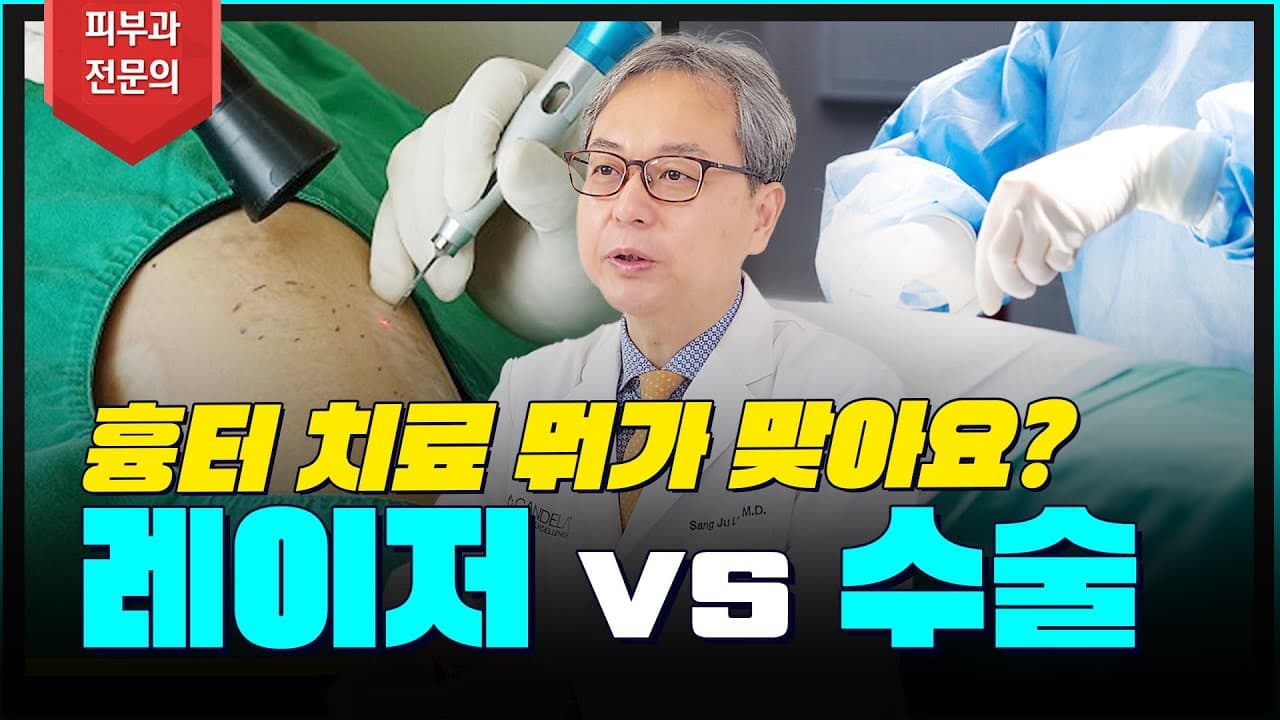
Scar treatment offers significant advantages, including excellent cosmetic improvement and a reduced risk of leaving new scars. However, many individuals considering scar treatment often wonder whether laser treatment at a dermatology clinic or surgical treatment at a plastic surgery clinic would be more effective. Today, we will directly compare and explain these two treatment methods for those considering scar treatment.
Scar Treatment: Broadly Two Methods
Scar treatment methods can be broadly divided into surgery and laser. The suitability of each method may vary depending on the type, size, and location of the scar.
Characteristics of Surgical Scar Treatment
Surgical methods are primarily used when a scar is too large, involving cutting out and suturing the affected area, or performing skin grafting.
Which scars are suitable for surgery?
- Large Scars: When the scar is very large.
- Scars on Joint Areas: If functional problems, such as difficulty extending a joint, are present, surgical treatment is primarily considered.
Advantages and Limitations of Surgery
Surgery is generally performed as a single treatment. However, it may have the following limitations:
A disadvantage of surgery is that it can leave another scar due to suturing the area, and since it is excised larger than the original size, the initial scar may become longer. Additionally, if skin grafting is required, the grafted skin may not be identical to the surrounding skin, leaving a scar that resembles a patched garment.
Characteristics of Laser Scar Treatment
Laser treatment for scars is performed in various ways.
Various Laser Treatment Methods
- Laser Dermabrasion or Mechanical Dermabrasion: A method that shaves off the surface of the scar with a laser.
- Piole: A method that creates microscopic holes in the skin to aid skin regeneration and treat scars.
Advantages and Limitations of Laser Treatment
Laser treatment offers excellent cosmetic results and is less burdensome as it does not leave new scars. It also carries a lower risk of side effects such as infection, which can occur during surgery, and has the advantage of improving the color or texture of scars, making it possible to treat scars that were difficult to address with traditional surgery.
However, it may be difficult to achieve completely satisfactory results with a single laser treatment. It should be understood that gradual improvement is accumulated through multiple repeated treatments, progressively building up the results. It is similar to a method that alleviates the skin by sanding it.
How to Approach Scars After Plastic Surgery?
Some individuals are dissatisfied with scars remaining after plastic surgery and consider revision surgery. However, scars often form easily depending on an individual's constitution, so those with such a constitution may develop undesirable scars in the same area even after another surgery.
Especially in cases where individuals repeatedly undergo revision surgery for unsatisfactory double eyelid scars, those with a constitutional tendency to scar easily often find that the scars worsen with repeated manipulation, requiring caution. If the scar resulted from plastic surgery, considering laser treatment rather than surgery may be more effective.
Which Scar Treatment Method is Right for Me?
Depending on their shape and size, some scars are suitable for surgery, while others are better suited for laser treatment. If there are no joint problems and the scar requires improvement in skin color, texture, or thickness, considering laser treatment rather than surgery may be more effective.
It is important to consult sufficiently with medical professionals to find the treatment method appropriate for you.