
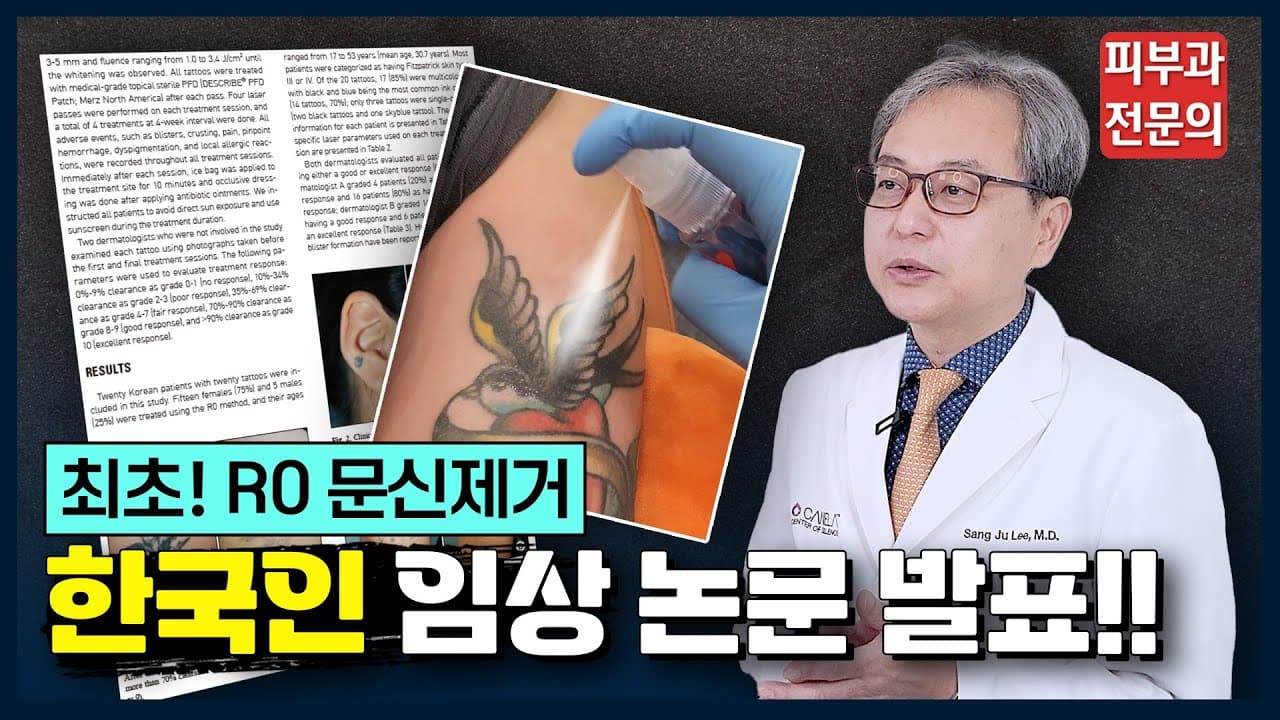
Hello. I am Director Lee Sang-ju of Yonsei Star Dermatology Sinchon. The R0 Technique, one of the tattoo removal methods performed at our clinic, was first introduced in the United States in 2013. It allows for up to four repeated treatments in a single session, gaining significant attention in Korea for its fast tattoo removal effects. Recently, my research team and I received considerable attention for being the first to publish R-Zero Pico-Frectat Tattoo Removal clinical results for Koreans in the Journal of the Korean Society for Laser Medicine and Surgery, a prestigious academic journal in the Korean medical community. Today, I will provide detailed information on whether R-Zero Pico-Frectat Tattoo Removal is effective and safe for Koreans, based on the clinical trial results.
Why did traditional tattoo removal take so long?
The basic principle of tattoo removal is that when tattoo pigments are broken down by a laser, macrophages, which are the body's cleaning cells, consume them and expel them from the body. However, when a laser is applied, the pigments in the skin break down, creating white bubbles. These bubbles obstruct laser penetration, reducing the effectiveness of subsequent laser treatments. For this reason, complete tattoo removal typically requires 5 to over 20 sessions, taking a long time, from as short as 6 months to several years, which has been cited as the biggest drawback.
R-Zero Technique, what is the secret to fast tattoo removal?
In 2013, a tattoo removal method was reported in the United States that involved applying a special drug called Perfluorodecalin (PFD) to help these bubbles disappear quickly. This drug absorbs the bubbles, allowing the laser to be applied repeatedly up to four times in a single session. This is the core principle of the R-Zero Technique used at Yonsei Star Dermatology Sinchon.
Why was the R-Zero Tattoo Removal clinical study on Koreans important?
Unfortunately, the Perfluorodecalin (PFD) special drug, which is central to the R-Zero Technique, is not easily obtainable in Korea. As a result, despite its known effectiveness, very few places offer tattoo removal using this method. Consequently, there has been almost no clinical research on R-Zero Tattoo Removal in Koreans. Therefore, my research team and I decided to conduct a clinical trial to prove the efficacy and safety of the R-Zero Technique for Koreans.
What was the R-Zero clinical research process at Yonsei Star Dermatology Sinchon?
This clinical trial involved 20 Korean individuals with tattoos. Tattoos were removed using a PicoWay Laser with a total of four wavelengths that break down tattoo pigments into finer particles at one-trillionth of a second. A total of four treatments were performed at 4-week intervals. After the treatments were completed, two dermatologists unrelated to this study evaluated the before-and-after photographs.
Is the R-Zero Technique effective for Koreans?
The clinical results are as follows:
- In 30% of all patients, over 90% of the tattoo was removed with just four treatments.
- In the remaining 70% of patients, 70% to 90% of the tattoo was significantly removed with only four treatments.
This suggests that the R-Zero Technique can be effective for fast tattoo removal in Koreans.
Are there any safety concerns?
Positive results were also observed in terms of safety. Although temporary blisters or pigmentation sometimes occurred immediately after the procedure, long-term side effects such as scarring did not occur.
Some people ask if performing multiple treatments in one session, like with the R-Zero Technique, could damage the skin or cause scars. In response to this, I would say:
Scarring during tattoo removal can occur due to excessive laser intensity or constitutional factors, rather than the number of treatment sessions. Therefore, if the practitioner uses an overly strong laser intensity, even for a single shot, there is a possibility of scarring.
The beginning of customized tattoo removal research for Koreans
So far, we have reviewed the R-Zero Tattoo Removal clinical paper for Koreans in which I participated. This clinical trial has proven that the R-Zero Technique is an effective and safe tattoo removal method for Koreans. Given the previous lack of domestic research on R-Zero Tattoo Removal, we hope that this clinical paper will serve as a catalyst for continuous research on R-Zero Tattoo Removal focused on Koreans, and we also plan to continue our research. If you have any questions, please contact Yonsei Star Dermatology via KakaoTalk channel. Thank you.