
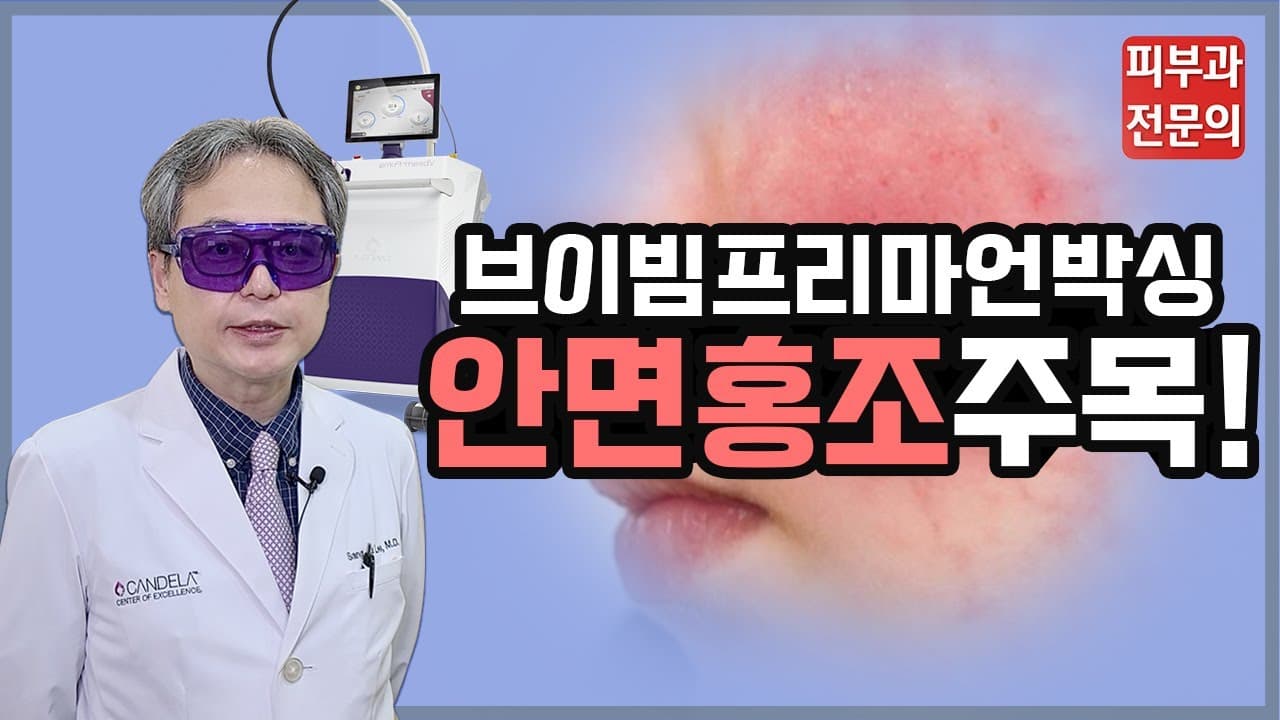
Facial redness is a concern for many, especially as it's known to be one of the more challenging conditions to treat. Recently, the newly developed Vbeam Prima laser has garnered attention for treating facial redness and various vascular conditions.
What kind of device is Vbeam Prima?
Vbeam Prima is the latest Vbeam laser device, newly introduced by Candela, a specialized laser company, after 15 years. It inherits the advantages of the existing Vbeam laser while significantly upgrading treatment efficacy and safety.
Wider Treatment Range with Two Wavelengths
One of the most significant features of Vbeam Prima is its ability to use two wavelengths simultaneously: 595 nm and 1064 nm. This means that not only red vessels but also blue vessels can be treated with a single device. It is known that devices equipped with both wavelengths are rare.
Thanks to this feature, it can also be used to improve blue vessels, thick vessels, and dark circles. Furthermore, with a special tip, it can be applied to treat brown spots on the face. While existing brown spot treatment devices had the potential for side effects like post-inflammatory hyperpigmentation after treatment, Vbeam Prima can help reduce the likelihood of such side effects by selectively treating blood vessels.
Advantages of Increased Spot Size and Higher Energy
Vbeam Prima boasts a larger spot size (12mm → 15mm) and increased energy compared to the existing V-Beam Perfecta. A larger spot size allows the laser light to penetrate deeper, and higher energy enables more effective targeting of the desired vessels.
These changes contribute to shortening treatment time for conditions like facial redness and can be applied to treat deep vessels that did not respond to previous Vbeam lasers. It can be understood as an upgrade from a 2000cc car to a large car of 3000cc or more.
Enhanced Cooling System for Safety
As energy increases, the potential for side effects can also rise. However, Vbeam Prima has mitigated these concerns through an enhanced cooling system. Thanks to a sufficient cooling system, even when treating deep areas with high energy, it can help lower the possibility of skin damage or side effects.
Like an airbag in a car, the enhanced cooling system plays a crucial role in protecting the skin during treatment.
Conditions Treatable with Vbeam Prima
Vbeam Prima can be applied to various vascular conditions. The main treatable conditions are as follows:
- Facial redness
- Erythema remaining red after acne
- Warts with thickened blood vessels
- Red keratosis pilaris (chicken skin)
- Blue vessels, thick vessels, dark circles, etc.
- Brown spots (when using a special tip)
'Erythema-Induced Prima Treatment' for Refractory Facial Redness
Facial redness is known as a challenging condition to treat. In particular, there are cases where the face is not red just before the procedure, making laser irradiation difficult. Our clinic implements 'Erythema-Induced Prima Treatment' to solve this problem.
This treatment involves applying a special medication to the face to intentionally make it redder, and then irradiating it with the Vbeam Prima laser in that state to treat facial redness more effectively.
What are the precautions after the procedure?
Since the Vbeam laser is also a light-based procedure, it is advisable to follow a few precautions after treatment.
- It is recommended to avoid sun exposure after the procedure.
- It is advisable to avoid alcohol and smoking on the day of the procedure.
- Slight redness or swelling may appear immediately after the procedure, but this often subsides naturally over time. Cold compresses or packs may be helpful if needed.
For some conditions like thick vessels or rosacea, effects can be seen immediately after the procedure, but for conditions like facial redness where vessels are not clearly visible, an improvement in redness can be experienced about a week after the procedure.
Our medical team strives to contribute to the improvement of patients' conditions and quality of life by applying the Vbeam Prima laser to conditions that have shown little or no response to existing treatments.