
Hello. I am Dr. Lee Sang-ju, a dermatologist.
If facial sagging due to aging is not severe, improvement can be expected with device treatments such as Ulthera Prime or Thermage FLX. However, if the sagging is very severe, there is no choice but to opt for facelift surgery, which involves incising around the ears to pull and fix the sagging skin and muscles. Facelift surgery has a not-insignificant chance of leaving scars, so many people visit dermatology clinics every year for facelift scars. Today, I would like to explain in detail the characteristics of facelift scars and effective management and treatment methods.
Why do scars remain after facelift surgery?
Since facelift surgery involves pulling up the skin, tension is inevitably applied to the surgical area. If this tension is excessive, many scars can form in that area.
Where and how do facelift scars form?
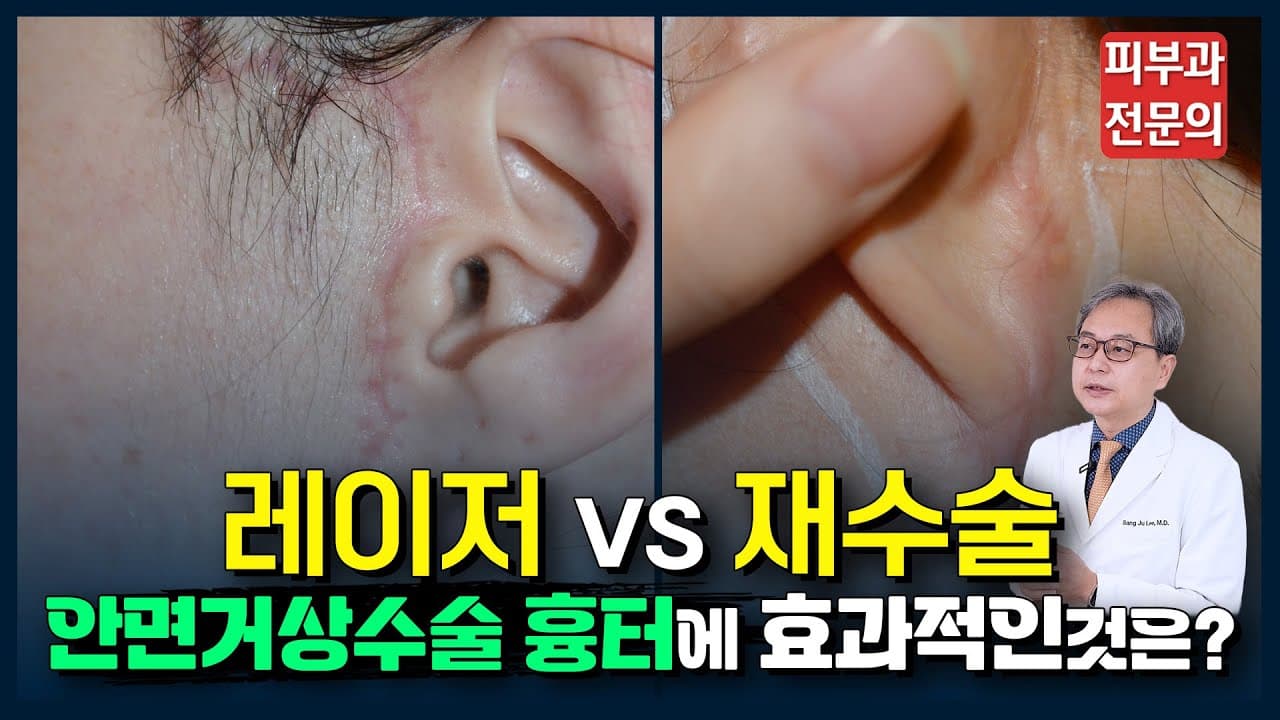
Facelift surgery proceeds from the front of the ear, around to the back of the ear. Scars in the area above the ear can be hidden under the hair, but the skin in front of the ear is inevitably exposed. Therefore, facelift scars typically form in front of and behind the ear.
Various appearances of scars
Facelift scars may initially appear as a red line. However, depending on one's constitution, if many scars remain, the area may swell, or over time, it may turn white and remain as a line. In particular, for those who are constitutionally prone to scarring, it is not uncommon for the scar area to widen or appear uneven.
Facelift Scar Treatment: Reoperation vs. Laser
There are two main ways to treat facelift scars. The first is reoperation, and the second is to refine the scar area with laser.
Reasons to carefully consider reoperation
Those who develop facelift scars tend to be constitutionally prone to scarring. Therefore, even with reoperation, there is a possibility of scars recurring, so plastic surgeons tend to approach reoperation cautiously.
Advantages and process of laser treatment
Laser treatment can be considered when facelift scars are uneven, raised, or have color issues. Unlike surgery, laser treatment does not completely eliminate scars with a single treatment, but good effects can be expected through repeated procedures. Multiple laser treatments may be necessary depending on the extent and color of the scar.
- If the scar is not severe: Approximately 3-5 treatments may be needed.
- If the scar is severe: 5-10 or more treatments may be needed.
How can facelift scars be prevented?
There are three main reasons why scars form after a facelift. Knowing and managing these causes in advance can help reduce scar formation.
- Constitutional predisposition: If you have a keloid constitution prone to scarring, there is a high possibility of scars forming after surgery. If you have such a constitution, it is recommended to receive scar prevention treatment early after surgery.
- Excessive tension: If excessive tension is applied to the surgical area, many scars can remain. Therefore, it is important to apply tape to the area or consistently use scar-reducing ointment to prevent tension in the early stages.
- Negligent wound care: If wound care is improper and inflammation occurs, many scars can also remain. Thorough disinfection and, if necessary, antibiotic intake are important.
We have discussed the causes of scars after a facelift and effective treatment methods. Please consult with a dermatologist for detailed guidance on any questions you may have. Thank you.