
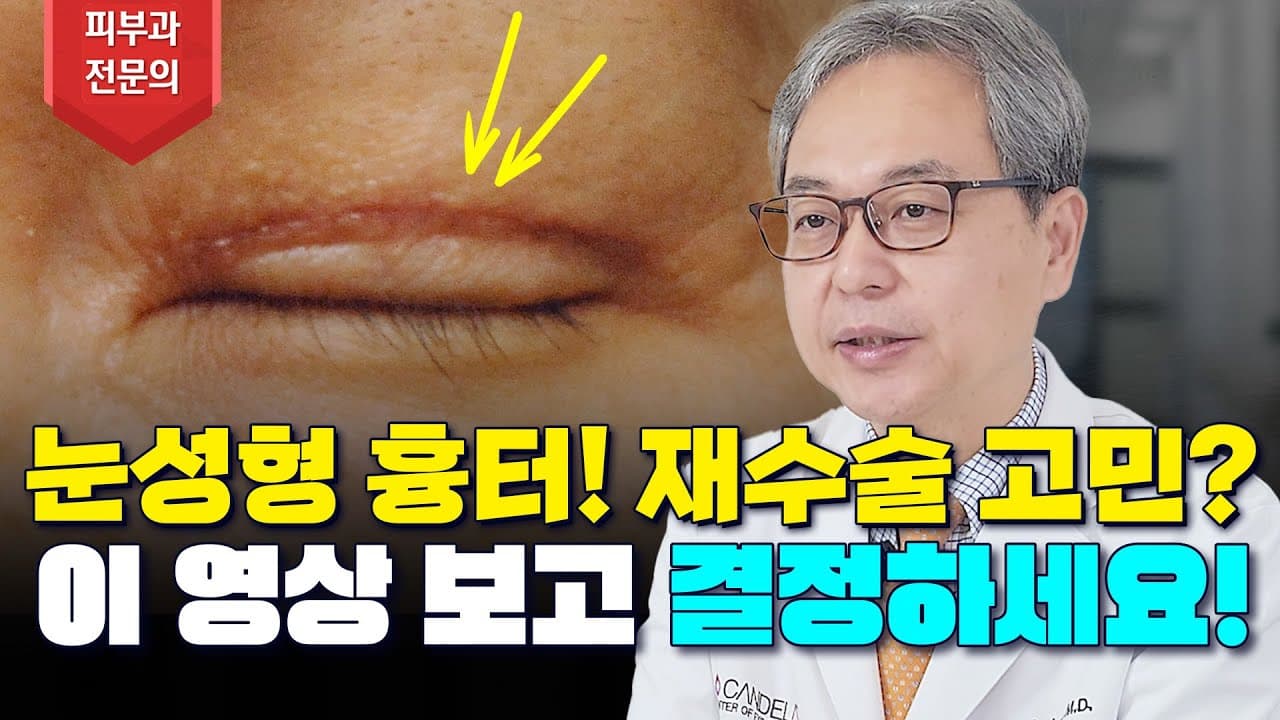
Eye Surgery Scars: Laser vs. Revision Surgery? A Guide to Your Concerns
Hello, I am Dr. Sang-ju Lee, a board-certified dermatologist. The eyes, which determine a person's impression, are so important that eye surgeries like double eyelid surgery or epicanthoplasty have become common and easily accessible. However, like all surgeries, many people are concerned about linear scars, red raised scars, or sunken scars that remain after eye surgery. Today, I would like to address your questions about these eye surgery scars.
When is the best time to treat eye surgery scars?
After eye surgery, an ointment that keeps the wound moist can help with recovery. Various scar ointments, such as silicone ointments, are available on the market, but due to the proximity to the eyes, they are often difficult to apply. In such cases, it is advisable to use an antibiotic ointment or petroleum jelly that can be used around the eyes.
Scar treatment starting within 1-2 weeks after the wound has healed has a positive impact on the treatment outcome. If you start treatment immediately 1-2 weeks after removing the stitches from eye surgery, it can also help prevent scars. If you miss this period and are left with a white scar, you can receive treatment whenever you wish.
For scars, treatment within 1-2 weeks after the wound has healed yields better results. If you want to prevent scars, it is recommended to start treatment immediately 1-2 weeks after removing the stitches from eye surgery.
Eye Surgery Scars: Laser vs. Revision Surgery, which treatment is suitable?
It is difficult to definitively say that one of laser treatment or revision surgery is unconditionally better. The preferred treatment method differs depending on the shape and nature of the scar.
- Considering revision surgery: If the double eyelid line is completely crooked or asymmetrical, surgical methods may be more suitable than laser.
- When laser treatment is effective:
- If the double eyelid scar is sunken
- If the scar line appears too thick
- If the scar is raised
- If your body type is prone to scarring (keloids, hypertrophic scars), it is advisable to consider laser treatment first rather than surgery.
Laser can be an effective method for refining and improving scars.
Various Eye Surgery Scars, Customized Treatment?
Eye surgery scars appear in various forms, and customized treatment is required accordingly.
- Dark parallel line scars: Especially when scars along the line are too dark, lasers can be used to lighten the color of the scar.
- Depressed scars: For scars that appear as partially depressed forms, a method of irradiating with a laser to gradually fill the depressed area is used.
- Red and thickening keloids/hypertrophic scars: In cases of keloid scars or hypertrophic scars where the area becomes too thick and red due to body type, injection treatment is performed in conjunction to loosen the scar.
- Partially thickened scar tissue: For scar tissue that is slightly thickened in certain areas, improvement can be expected by applying laser or injection treatment only to that area.
- Hyperpigmented scars: If the scar area has darkened in color, treatments such as whitening lasers may be helpful.
Daily life after eye surgery scar treatment?
The area around the eyes is one of the fastest-recovering parts of our body. Therefore, most daily activities such as washing your face or showering are possible immediately after scar treatment. However, please note that fine exfoliation may occur for about 4-5 days after treatment.
Various treatment methods can be applied to eye surgery scars depending on the individual's scar type and body type. It is important to establish the most suitable treatment plan for you through consultation with a medical professional. If you have any further questions, please feel free to inquire.