
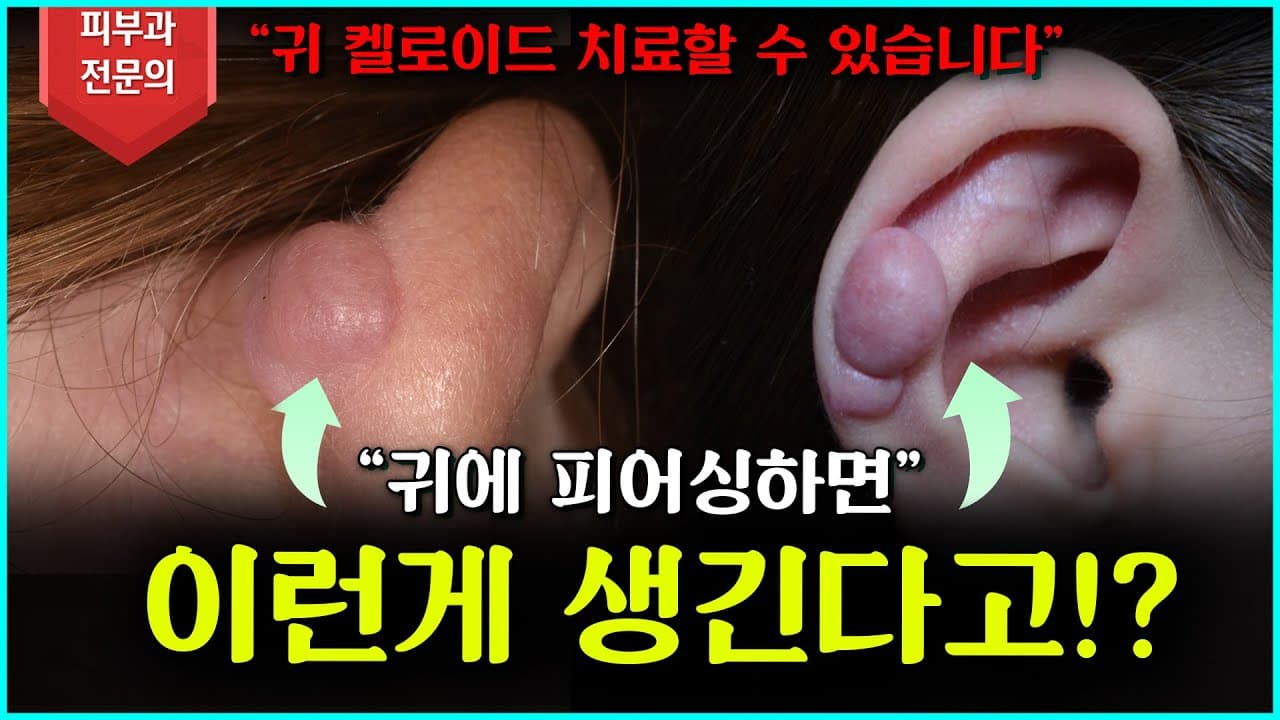
Hello, I am Director Lee Sang-ju of Yonsei Star Dermatology, a skin concern counseling center. Today, I would like to talk about a topic that many people have experienced or are interested in: ear keloids related to piercings.
What is a keloid?
Keloids are abnormal scars that swell due to excessive scar tissue formation during the skin healing process after an injury. This is different from general scars that simply form as a wound heals.
- Wearing earrings
- Piercings
- Surgery
- Trauma
The phenomenon of scars swelling due to various causes such as those listed above is called a keloid.
Why do keloids often form on the ear?
Keloids are more likely to appear in skin types that are constitutionally prone to scarring. However, in addition to constitutional factors, they tend to occur more frequently in specific areas.
In particular, the ear is known as a common site for keloids. This is because we often get piercings or pierce our ears for wearing earrings. In addition, the jawline, chest, and upper shoulders are also areas where keloids frequently occur.
Why do ear keloids keep growing?
The clear reason why keloids on the ear continue to grow has not yet been elucidated. Generally, keloids on the chest or back are known to grow larger due to skin tension, but the ear is not an area where much tension is applied.
Although the exact cause is unknown, we believe that keloids continue to grow due to irritation, chronic inflammation, hormonal changes, and various other changes in the body.
Effective Treatment for Ear Keloids
There are various methods for treating ear keloids.
- Surgical excision: A method of directly cutting out the keloid tissue.
- Cryotherapy: A method of freezing and destroying keloid tissue.
- Injection therapy: A method of directly injecting medication into the keloid lesion.
- Laser treatment: Methods using various lasers such as Ultrapulse Encore and Vbeam Prima.
Recently, combination therapy combining laser and injection treatment has been gaining attention, and it is reported that sufficient treatment is possible through such combination therapy.
Can ear keloids be prevented?
There is no known method to 100% prevent keloids from forming on the ear. However, if chronic inflammation occurs due to neglecting care after piercing, the probability of ear keloid development may increase.
Therefore, after piercing, it is important to regularly disinfect and thoroughly manage the area to prevent inflammation and infection.
If a keloid is suspected, early treatment is crucial!
If a keloid forms on the ear, and what initially felt like a lump gradually grows larger, it is highly likely to be a keloid. In such cases, it is very important to visit a dermatologist immediately for an accurate diagnosis and to start treatment early. Early treatment helps prevent the keloid from growing larger and enhances treatment effectiveness.