
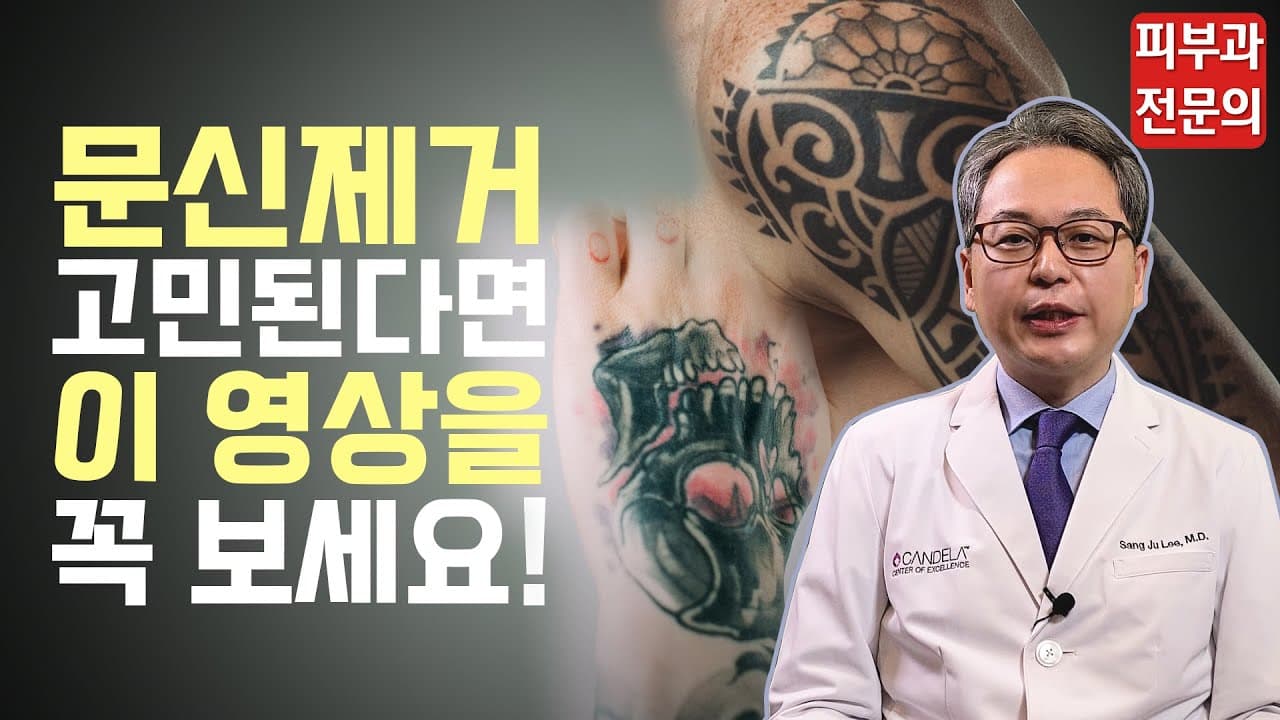
Hello, I am Lee Sang-ju, a dermatologist. Last time, we looked at tattoo removal methods and precautions before and after treatment. Today, I have prepared information that may be helpful for those who wish to remove tattoos.
Why Laser Equipment is Important for Tattoo Removal
Laser equipment is very important for tattoo removal. Whether it's a large or small tattoo, the principle of tattoo removal is the same, but it's good to remember two main things:
- Various Wavelengths: For tattoo removal, the appropriate wavelength is crucial depending on the color. For black and blue tattoos, a 1064nm wavelength is important, and since other colored tattoos each have their suitable wavelengths, a laser that supports various wavelengths is necessary.
- Short Pulse Width: The shorter the pulse width, the better the effect. In the past, Q-switched lasers were used, but recently, picosecond lasers (pico lasers) have emerged. The difference between Q-switched and pico is that the pulse duration is much shorter. This is because a shorter pulse width allows for finer and smoother tattoo removal. The intensity of laser energy is a bit difficult for the general public to understand.
In conclusion, you can think of picosecond lasers with short pulse widths and lasers that support various wavelengths as important. Especially for black tattoos, which absorb all colors, both 1064nm and 755nm wavelengths are possible, and they are not significantly affected by the wavelength.
Tattoo Removal Treatment Interval: What Should It Be?
When you are not satisfied with a tattoo and want to remove it, some clinics may treat it after a month, while others treat it immediately. If you are not satisfied, treating it quickly is much more effective for removal.
Generally, as those who have had many tattoos know, tattoos start to shed 3-4 days after the procedure. Therefore, I can say that breaking down the tattoo with a laser beforehand makes it easier to remove more of the tattoo. Some clinics advise waiting a month, which is to perform tattoo removal after the epidermis and wound have healed. The problem is that while the epidermis heals, the effectiveness of removing the tattoo inside is reduced.
In the past, with Q-switched lasers or early PicoWay Laser, treatment at intervals of 1-2 months was recommended. This is because even if the tattoo is pulverized, it takes time for it to be removed and for the skin surface to heal. However, with the recent advent of PicoWay Laser and rapid tattoo treatment, tattoo treatment is possible at intervals of 1-4 weeks. If you have the technology to shorten the interval, you can treat the tattoo faster.
Large Tattoos vs. Small Tattoos, Black & White Tattoos vs. Color Tattoos
The principle of tattoo removal is the same for both large and small tattoos. However, the wider the area, the relatively higher the cost and longer the treatment time. In reality, the amount of pigment in the tattoo has more influence on the overall treatment outcome than the size of the tattoo.
Color tattoos are more difficult than black and white tattoos. For black and white tattoos, one wavelength of laser is used with only intensity adjustment, but for color tattoos, appropriate wavelengths must be mixed according to each color, making it much more difficult. Also, since the pulse width varies depending on the wavelength, multiple types of lasers must be used, and it takes more time to see improvement. It is advisable to consider that the treatment cost increases with each wavelength and color.
How Many Sessions Are Needed for Tattoo Removal?
The number of tattoo removal sessions varies depending on whether it is an amateur or professional tattoo. Amateur tattoos generally require fewer sessions, while professional tattoos require more. Also, even for professional tattoos, the number of treatment sessions varies depending on the amount of pigment injected at once.
Generally, it is advisable to consider that the number of tattoo removal treatment sessions is around 10, according to published papers. However, it is important to remember that there may be differences depending on the amount of tattoo and individual skin reactions.
Pain Management and Side Effect Response During Tattoo Removal
During tattoo removal, the tattoo pigment particles burst, causing pain. Therefore, general anesthesia involves applying anesthetic cream before proceeding with tattoo treatment. For those sensitive to pain or with small areas, there is also a method of injecting anesthetic. Our clinic's low-pain tattoo removal treatment involves applying anesthetic cream and using other devices to minimize pain during the procedure, and there are also methods that can be treated without injections.
Generally, after tattoo removal, especially after PicoWay Laser treatment with a large amount of tattoo pigment particles or strong energy, blisters may occasionally form. This should be considered part of the tattoo treatment process, but if blisters do occur, it is advisable to visit the clinic quickly for appropriate treatment.
Criteria for Choosing a Clinic for Successful Tattoo Removal
Tattoo removal generally requires a long treatment period and is an expensive procedure. Therefore, it is important to consider the following three points when choosing a clinic:
- Treatment Experience: Treatment experience is most important in tattoo removal, as various side effects can occur.
- Excellent Equipment: No matter how good the technique, if the equipment cannot keep up with the technique, it is difficult to achieve sufficient treatment effects. Therefore, a clinic that has a PicoWay Laser, and among PicoWay Laser, one that has various wavelengths, is more effective.
- Ability to Handle Side Effects: All laser procedures can have side effects. Bruising, bleeding, wounds, and in severe cases, scars can occur. Choosing a clinic with extensive experience in appropriately treating these side effects is important for selecting a clinic that performs tattoo treatment well.
Dangers of Illegal Procedures
Removing a tattoo is much more difficult than getting one. In illegal establishments, various solutions or lasers are sometimes used to remove tattoos, which is likely to result in secondary scarring rather than tattoo removal.
In fact, many people visit our clinic with scars after tattoo removal. Scars are more difficult to treat than tattoos, so it is most important to receive professional treatment at a clinic.
Today, we looked at helpful information regarding tattoo removal. If you have any questions, please feel free to ask in the comments or via KakaoTalk. This has been dermatologist Lee Sang-ju. Thank you.