
Conquering Acne: A Comprehensive Guide from Types to Treatments
Hello, I am Dr. Sang-ju Lee, a board-certified dermatologist. Acne frequently occurs on parts of the body with relatively more oil, such as the face or chest. It is a common skin condition that appears in a wide age range, from teenagers to, more recently, people in their 20s to 40s. In the past, it was medically referred to as acne vulgaris, but recently, the term "acne" is generally used.
Why Does Acne Occur?
Acne begins with hyperkeratinization of the pores, leading to clogged pores. Sebum accumulates in these blocked pores, and if a secondary bacterial infection occurs, inflammation worsens, forming pustules. This condition is acne.
The Many Faces of Acne: Non-Inflammatory Acne
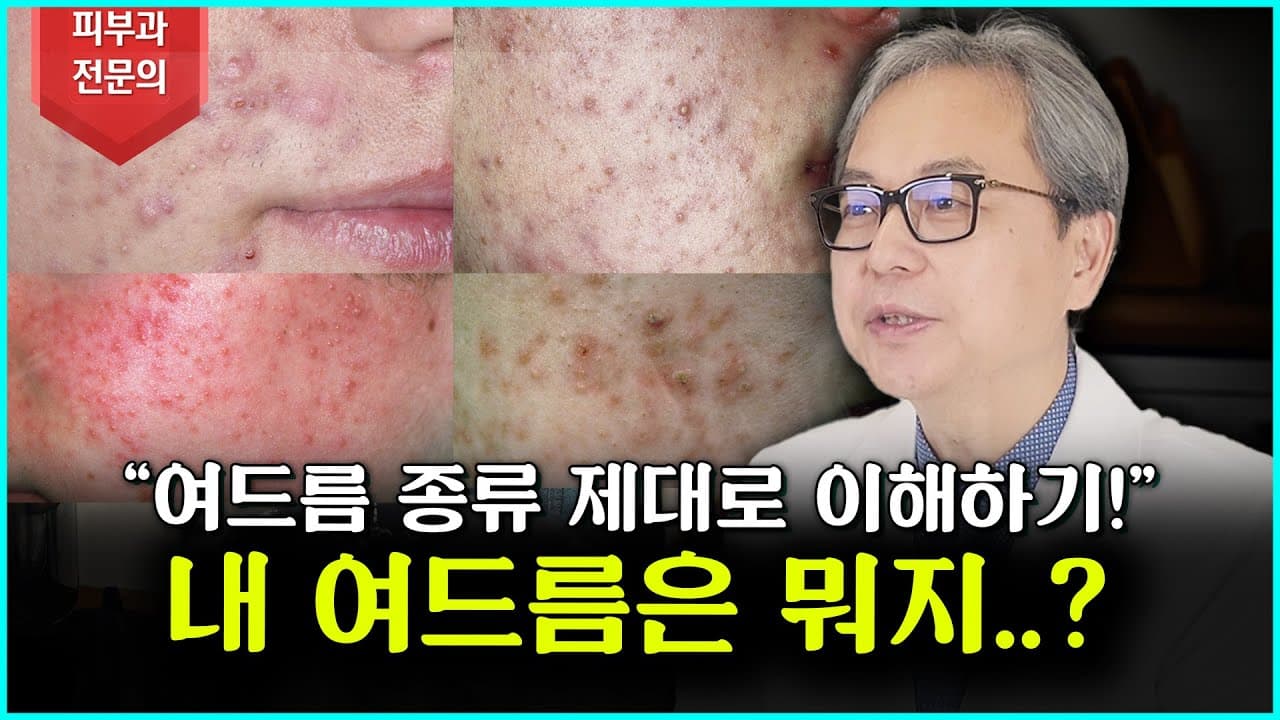
Acne can be broadly divided into non-inflammatory acne and inflammatory acne based on its form. Non-inflammatory acne refers to acne without accompanying inflammation, primarily categorized into open comedones and closed comedones.
Open Comedones (Blackheads)
This form has an open pore, and the outer part oxidizes, generally appearing black. What is commonly called blackheads are precisely open comedones.
Closed Comedones (Whiteheads, Milia-like Acne)
The pore is closed, containing only sebum inside. This is referred to as whiteheads, and what is commonly called milia-like acne falls into this category of closed comedones.
What Types of Red and Yellow Inflammatory Acne Are There?
Inflammatory acne, due to inflammation, appears red or yellow, not skin-colored. As bacteria proliferate in the sebum inside, inflammation and pus form around that area, causing it to appear red or a different color. Inflammatory acne is divided into various forms based on its appearance.
- Papular Acne: This refers to a form where the skin turns red and bulges. It can be thought of as a state where the inflammatory response begins and bacteria proliferate, causing redness.
- Pustular Acne: This refers to cases where the tip of the acne becomes yellow and suppurates. Generally, this is a form where pus has developed in that area due to significant bacterial growth.
- Cystic Acne: This occurs when acne forms like a soft sac inside the skin.
- Nodular Acne: This refers to cases where acne is felt as a hard lump inside the skin.
- Conglobate Acne: This is a form where multiple nodular acne lesions are connected to each other.
Inflammatory acne often leaves more scars or other side effects compared to non-inflammatory acne, so active treatment may be necessary.
Acne Treatment: More Than Just Eliminating It!
The goal of acne treatment is not merely to reduce acne. It is very important to prevent further acne formation to maintain healthy skin and to prevent acne from leading to acne scars. While medication is fundamentally the basis of acne treatment, various methods can be utilized to achieve the desired outcome.
Non-Inflammatory Acne Management
In the case of early non-inflammatory comedonal acne, combining treatments like Scaling or light Peeling, which gently remove waste and sebum from within the pores, can help organize dead skin cells and prevent pore blockage.
Aggressive Treatment for Inflammatory Acne
For inflammatory acne that causes skin redness, more aggressive treatment is needed. Various treatment methods have been developed for inflammatory acne. For example, treatments like Gold PTT can be importantly utilized to address the fundamental cause of acne.
Gold PTT is a treatment that involves penetrating micro nano gold particles into the skin and then inducing a photothermal reaction to selectively destroy acne bacteria and sebaceous glands. It can help address the root cause of acne.
Managing Post-Acne Redness
After acne inflammation has improved, it is advisable to use vascular lasers to improve post-acne redness and prevent it from progressing to depressed scars.
Lifestyle Habits for Acne Prevention
While professional treatment is important, it is crucial to manage factors that can trigger acne, such as stress or hormonal changes, which are underlying causes of acne. Efforts are needed to reduce skin stress in daily life by getting enough sleep and maintaining healthy eating habits.