
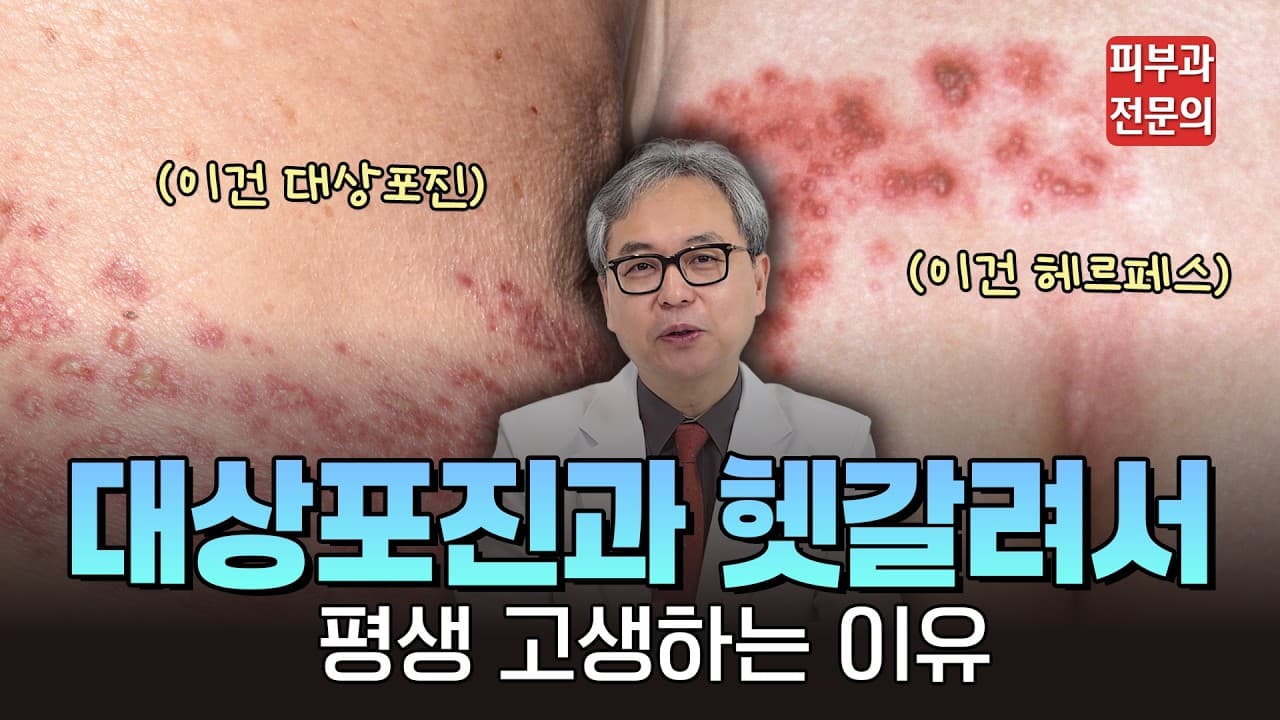
When small blisters appear around the mouth or on the skin, it's easy to confuse herpes simplex with herpes zoster. Both diseases involve clusters of blisters, but they are distinct conditions with different causes and courses. We've summarized how to distinguish between the two diseases and common questions patients ask, from the perspective of a dermatologist.
The names reveal the relationship between the two diseases
Herpes simplex is called Herpes Simplex, and herpes zoster is called Herpes Zoster. Herpes means "blister," so you can understand these two diseases as distant relatives. Both are similar in that they involve some pain and blisters.
The appearance and location differ
The key to distinguishing them is how the lesions spread.
- Herpes simplex: Blisters appear in dense clusters in one area, such as the mouth or skin.
- Herpes zoster: Appears as scattered, band-like lesions along one side of the body.
Herpes zoster can be distinguished by its band-like appearance on only one side of the body, never simultaneously on both sides.
Recurrence patterns also diverge
Herpes simplex tends to recur in the same spot when the body is fatigued.
In contrast, herpes zoster is a disease typically experienced once or twice in a lifetime, with different symptoms, appearance, and location. Herpes simplex recurs in specific areas like around the mouth, genitals, or buttocks, but it does not spread laterally from one spot.
Treatment and transmission: How to respond
Herpes simplex is caused by a virus, so antiviral medication is the first step. It's important to take enough medication; if oral intake is difficult, topical antiviral agents may be used. It can be transmitted through human contact, so extra caution is needed when blisters are present.
Be especially careful with babies
Recently, a tragic case was reported in the UK where a two-year-old child lost vision in one eye after being infected with the virus from a kiss on the face. Herpes type 1 typically causes lesions around the mouth, while type 2 primarily affects the genital area. If the eyes are infected, it can cause inflammation of the cornea, and repeated inflammation is known to lead to blindness. Babies with weaker immune systems can get infected just by contact, so it's safer to avoid kissing or close contact when blisters are present.
Lifestyle management to reduce recurrence
Herpes simplex recurs when the body is fatigued. Regular management is prevention.
- Avoid overwork through regular routines and condition management.
- If you feel unusual sensations just before a recurrence, take antiviral medication quickly.
- When blisters are present, be careful with contact with babies or others.
Even if the blisters look similar, the courses of the two diseases are completely different. If the location and appearance are ambiguous, it is safer to get a diagnosis from a doctor rather than self-diagnosing.