
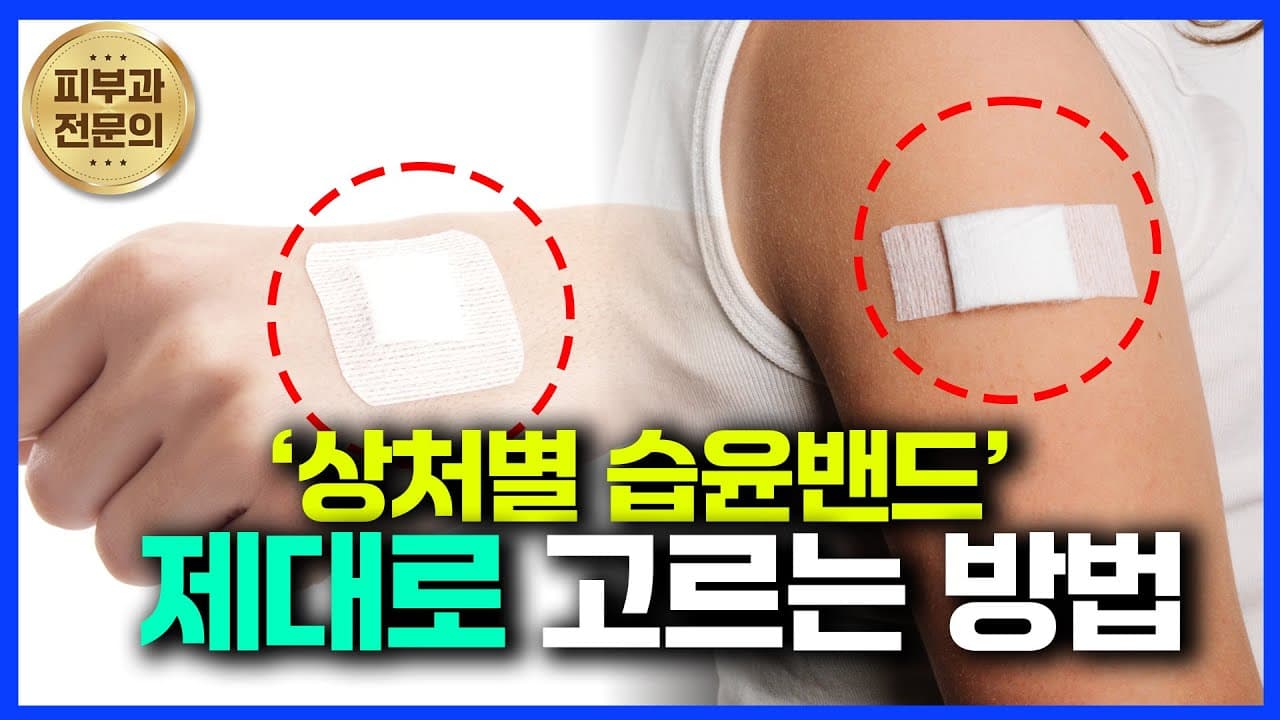
How to Choose the Right Hydrocolloid Dressing for Each Wound Type
Hello. This is Dr. Lee Sang, a dermatologist at the Skin Concern Counseling Center. Hydrocolloid dressings, easily available at pharmacies, are now familiar wound care products for many. But did you know that even the same product can have different uses and effects depending on the type and condition of the wound? Proper use is essential for faster wound healing and minimal scarring. Today, I will explain in detail how to choose the right hydrocolloid dressing for your wound condition and how to use it correctly.
The Basic Principle of Hydrocolloid Dressings: A Moist Environment is Key
Wounds refer to a state where the continuity of the skin is broken. The skin's defense line, which protects our body from external factors, has been compromised. For skin wounds to heal, surrounding cells must migrate to the damaged area. If the wound area is dry, cell migration may not be smooth. The basic principle of hydrocolloid dressings is to seal and protect the wound from the outside, while keeping the inside moist to promote cell migration.
In the past, it was common to dry out wounds to form scabs, but scabs can hinder the growth of surrounding cells, potentially leading to larger scars. Recently, the trend has shifted towards using hydrocolloid dressings to effectively treat wounds and minimize scarring.
Wound Treatment vs. Scar Prevention Hydrocolloid Dressings are Different
Many people confuse wound treatment with scar treatment, but these are distinctly different. A wound refers to a state where the continuity of the skin surface is broken, and once the epidermis is re-covered, the wound is considered healed. A scar, on the other hand, is a reaction that occurs in the underlying tissue after wound healing, determining whether many or few scars will form.
Hydrocolloid dressings can be broadly categorized into those for wound treatment and those for scar prevention. Dressings used when there is no exudate are primarily considered for scar prevention. Therefore, it is important to choose the appropriate dressing according to the current condition of the wound.
Guide to Choosing Hydrocolloid Dressings Based on Wound Condition
Various types of hydrocolloid dressings are available on the market. You should choose the appropriate dressing based on the wound's condition.
- Wounds with little exudate: Dressings that protect the skin and maintain slight moisture are suitable. These can primarily be used for scar prevention.
- Wounds with a lot of exudate: If exudate flows out, it can cause secondary bacterial infection, so it is advisable to use a dressing that can absorb the exudate appropriately.
- Wounds on joints: For joint areas with a lot of movement, elastic dressings can be helpful.
- Dressings with good absorbency but weak adhesion: Some products may have strong exudate absorption but weak adhesion. In such cases, it is common to apply another dressing over it to secure it.
Hydrocolloid Dressings Must Be Used Correctly to Be Effective
To achieve optimal results, hydrocolloid dressings must be used properly.
Replacement Cycle
- Small, shallow scars: If there is no exudate, it is acceptable to leave it on for more than a week.
- When there is a lot of exudate: If exudate builds up, the dressing in that area should be replaced.
Avoid Frequent Changes
Some people intentionally change the dressing every day, but due to the adhesion of hydrocolloid dressings, new skin may come off with the dressing as the wound heals. This is not desirable for wound healing, so it is best to avoid changing it too frequently.
Follow Expert Instructions
The appropriate usage may vary depending on the depth of the wound. Following the usage instructions provided by the hospital according to the wound condition can greatly aid in wound recovery.
Precautions When Using Hydrocolloid Dressings
Hydrocolloid dressings are effective for wound healing, but improper use can lead to side effects.
- Delayed wound healing: Wound healing may be slow, with some wounds that could heal in about 3 weeks lasting for more than a month.
- Secondary bacterial infection: If a hydrocolloid dressing is improperly applied to an infected wound, bacteria can multiply within the dressing, leading to secondary infection.
- Allergic reactions: Although very rare, allergic reactions to hydrocolloid dressings can occur. The skin may become red, small blisters may form, and itching may accompany these symptoms, following the shape of the applied dressing. If these symptoms appear, discontinue use immediately and visit a dermatologist for appropriate treatment.
Today, we learned about hydrocolloid dressings. If you have any questions, please feel free to ask. Thank you.