
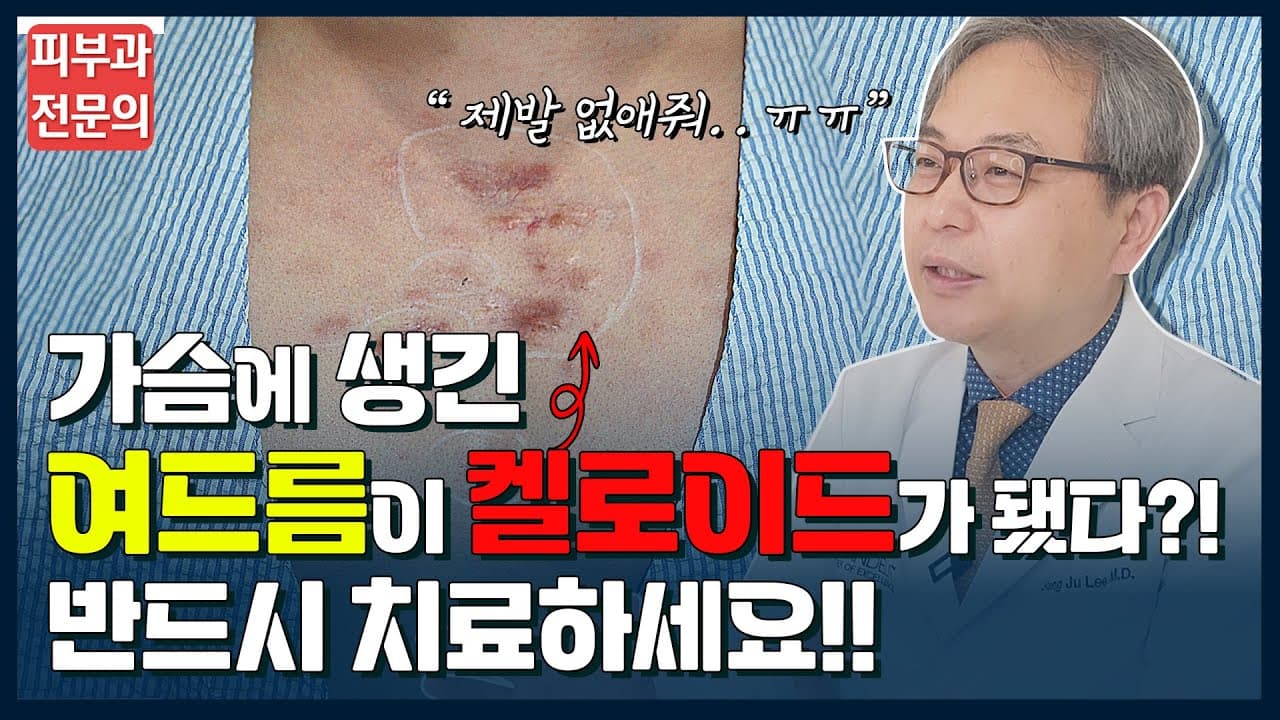
Hello, I am Dr. Sang-ju Lee, a dermatologist. Keloid scars, which appear as red or white raised areas on the skin, tend to form easily in specific areas. Let's take a closer look at keloids that occur specifically on the chest.
What exactly are keloids?
Keloids refer to the phenomenon where scars continuously form unnaturally after a skin injury heals.
Why do chest keloids occur?
The main causes of chest keloid scars are as follows:
- Acne: If skin is injured by acne, and this injury heals and swells, chest keloids may occur.
- Epidermoid cyst surgery: In many cases, keloids form in the area after surgery for something like an epidermoid cyst on the body.
- Chest surgery: It is not uncommon for scars to form as wounds heal after surgery on the chest area.
What are the characteristics of chest keloids?
Keloids tend to form easily in specific areas such as the ears, shoulders, chest, and back. In particular, keloids on the chest are often harder than those in other areas and are frequently accompanied by symptoms such as pain and itching.
A distinctive feature is that keloids often form in the middle of the chest, spreading thinly towards the hair follicles, resembling a crab extending its legs.
The term keloid itself is derived from 'crab'.
If chest acne and keloids are present together, how should they be treated?
If chest acne (chest pimples) and keloids are present together, it is advisable to treat both simultaneously or to start acne treatment first. This is because acne is a primary cause of chest keloids. It is important to treat the acne that acts as the 'seed', and since keloids can worsen in pain or itching and grow larger if left untreated, simultaneous treatment is most effective. If you have to choose between the two, prioritizing acne treatment is preferable.
What are the treatment methods for keloids?
Keloid treatment can be broadly divided into three methods:
- Surgical treatment: This method directly removes keloid scars. However, the recurrence rate after treatment is high, and scars often become larger, so surgical treatment alone for chest keloids is rare. If surgery is performed, adjunctive radiation therapy may be considered, but it is not widely practiced in Korea due to the increased risk of cancer or ulcer development in the long term.
- Injection treatment: This method involves injecting directly into the keloid area, which helps reduce itching or pain. A disadvantage is that chest keloids are often large, requiring multiple treatments.
- Laser treatment: This method is effective in improving the height and color of keloids.
Each treatment method has its pros and cons, so applying multiple methods in combination is more effective.
Synergistic effect of combined injection + laser treatment
Combined treatment using both injections and lasers is more effective than a single treatment method. In particular, the redness remaining after injection treatment can be gradually lightened by repeated treatments with vascular lasers such as Vbeam Prima.
Post-treatment care and recurrence prevention
- If itching occurs: If new keloid scars appear, or if treated scars start to grow again, or if itching occurs, it is advisable to visit the clinic early for treatment. Early treatment can lead to easier improvement.
- Chest exercises: Chest exercises that stretch the skin may not be good for keloids. It is advisable to avoid chest exercises, especially during the initial active treatment phase.
- Reduced recurrence rate: The recurrence rate can be lowered by sufficiently treating the keloid until even the small 'seeds' are completely flattened, and by improving the color.