
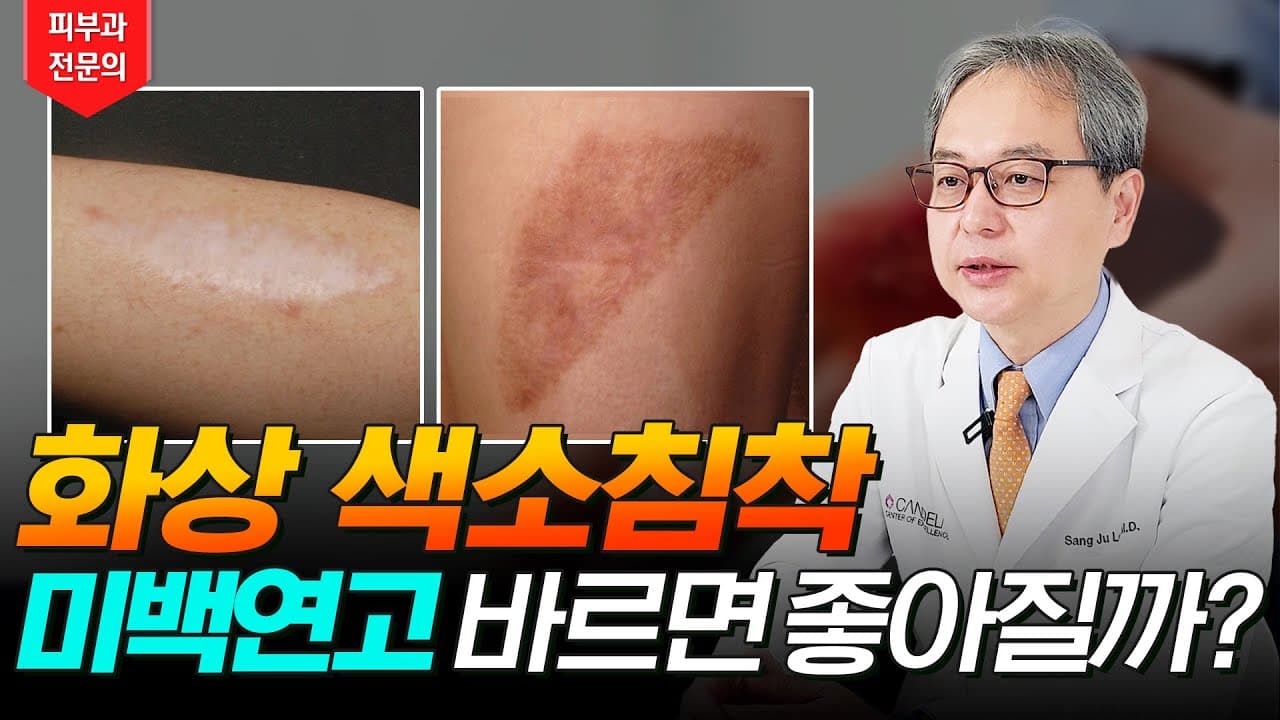
Hello. I am Dr. Sang-ju Lee, a dermatologist. Many people are concerned when a reddened area after a burn or scalding gradually turns brown, or conversely, becomes whiter than the surrounding skin. These symptoms are called post-burn hyperpigmentation or hypopigmentation. Let's take a closer look at why post-burn pigmentation, which is common in daily life, occurs and how it can be treated.
Why does skin color change after a burn?
Burns are a process that injures the skin. Various inflammatory substances are secreted to heal the wound, and if some of these substances stimulate melanocytes to produce excessive melanin, the affected area turns dark, resulting in hyperpigmentation. Conversely, if the melanin cells that produce color are completely destroyed by the burn, hypopigmentation, where the skin becomes whiter than the surrounding skin, may remain. You can experience post-burn color changes in various situations, such as forehead burns from using a curling iron, low-temperature burns from continuous exposure to low temperatures, or pigmentation after tanning due to strong summer sunlight.
Post-burn Hyperpigmentation (When the skin turns dark)
How can hyperpigmentation be treated?
For brown hyperpigmentation remaining after a burn, several treatment methods can be considered.
- Whitening Cream: One of the simplest methods is to use a whitening cream. However, its effectiveness may be somewhat lower compared to other treatments, and long-term treatment may be required. Also, it often does not respond to deep skin pigmentation.
- Laser Treatment: Treatment using laser toning or Fractional laser can be effective. Treatment is usually performed 5 to 10 times at intervals of 2 to 4 weeks, and with repeated treatments, you may experience the post-burn hyperpigmentation gradually fading.
Post-burn Hypopigmentation (When the skin turns white)
What are the treatment options for hypopigmentation?
If post-burn hypopigmentation, where the skin turns white, occurs, several treatment methods can be attempted.
- Laser Treatment: If melanocytes are not completely destroyed but are dormant, or if there are deeply remaining melanocytes around the hair, laser stimulation can induce these cells to awaken and produce pigment again. However, if melanocytes are completely gone, it may be difficult for the pigment to return.
- Medication Treatment: Other medication treatments can also be attempted, but the disadvantage is that the treatment effect may be somewhat lower.
- Epidermal Graft: If melanocytes are completely dead and hypopigmentation remains permanently in the affected area, treatment is possible through methods such as epidermal graft, which involves transplanting melanocytes from another area.
Will post-burn pigmentation get better on its own over time?
If the pigmentation remaining after a burn is minor, it often fades naturally over time. For example, even if the skin turns dark from a sunburn in the summer, it often fades significantly by winter.
However, if the pigmentation is relatively deep or dark, it often remains as is even after time passes. In such cases, it is advisable to consider active treatment.
If you are concerned about post-burn pigmentation, it is important to consult with a dermatologist to establish an appropriate treatment plan.