
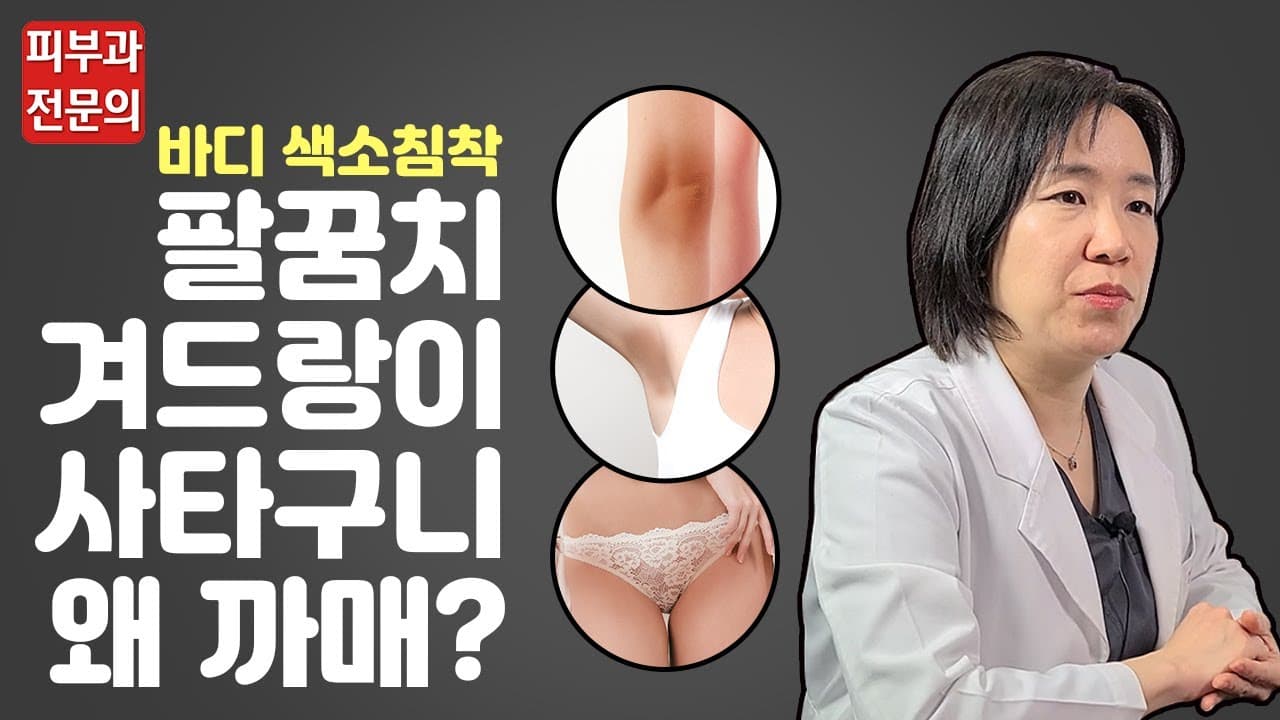
Body skin, often neglected compared to facial skin, also requires care. In particular, many people are concerned about body hyperpigmentation in areas such as the groin, armpits, knees, and elbows. Today, we will delve into why this body hyperpigmentation occurs and how it can be managed and treated.
Why is body hyperpigmentation more common?
Body hyperpigmentation is more common in individuals with darker skin tones, such as Latin Americans, Arabs, Indians, and Black people, rather than Koreans. This is not because they have more melanocytes, but because their ability to produce melanin is stronger.
In addition, if dermatitis occurs due to folliculitis, fungal infections, or deodorants used in the groin and armpits, hyperpigmentation often appears as a sequela.
Acanthosis Nigricans: A sign of obesity and diabetes?
Acanthosis Nigricans is a condition where the skin in areas like the armpits, nape of the neck, and groin becomes dark, rough, or thick like velvet. This phenomenon is often associated with conditions such as obesity and diabetes, and it is commonly seen in the nape of the neck of larger adolescents.
Dryness and friction can also cause hyperpigmentation
Hyperpigmentation on the elbows or knees, or a darker area around the mouth compared to other parts, is also common. While this can be purely due to melanin pigmentation, it often occurs because the dry stratum corneum does not shed properly, making the skin thick and rough. The collagen in the deep dermis does not reflect light beautifully but rather scatters it, making the skin appear dark.
Furthermore, joint areas that experience frequent friction and pressure can develop thickened skin. This can be seen as a necessary structure for the skin to cope with the characteristics of joints that require flexion and extension. Care should be taken as excessive exfoliation can cause discomfort and pain.
Is there a special reason for groin hyperpigmentation?
The groin normally has more melanocytes compared to other areas, excluding the scalp and forearms. At birth, there is not much difference from other areas, but after puberty, melanocyte activity becomes vigorous due to sex hormones. While the number of cells in other areas tends to decrease with age, this area tends to maintain a certain level throughout life.
Moreover, the skin in the groin area is thin and absorbs external substances readily. When various medications or sanitary pads come into contact with this area, contact dermatitis often occurs, leading to hyperpigmentation. Conditions like hidradenitis suppurativa, where boils frequently appear only in the groin area, can also cause color changes. In all these cases, a fertile ground for hyperpigmentation is created.
Home care: What about lemon juice?
Vitamin C, found in lemons, is known to have a whitening effect by inhibiting melanin synthesis through enzyme action. However, simply rubbing lemon juice on the surface is unlikely to show immediate results. This is because it stops the process of melanin production, so it takes time to be reflected.
Also, vitamin C is water-soluble and not well absorbed through the skin. Vitamin C derivatives, which are liposome-treated or chemically modified to facilitate epidermal penetration, are added to cosmetics or ampoules, or are available in oral forms.
Pure lemon juice has a very strong acidity, with a pH of about 2. Applying such low pH lemon juice directly to the skin can cause stinging, and it can cause pain, especially when it comes into contact with dry and cracked areas like the elbows. Even if it is diluted appropriately to a pH of about 4, discomfort can be significantly reduced. Some suggest that if it is well absorbed in this state and balances the skin's pH, it can help restore the skin barrier and reduce skin inflammation. However, it is more likely that the temporary brightening effect is due to the exfoliation of the stratum corneum by the acid, rather than a true whitening effect.
Manage body hyperpigmentation this way
- Address underlying conditions: If Acanthosis Nigricans is accompanied by obesity, diabetes, etc., efforts to resolve the underlying condition, such as weight loss, are important.
- Minimize irritation: It is advisable to reduce the use of products that can cause skin problems, such as sanitary pads containing organic compounds, deodorants with fragrances, and detergents used for clothes, and to rinse clothes thoroughly.
- Early treatment of infections: Early treatment of groin fungal infections (tinea cruris) can prevent hyperpigmentation from spreading or worsening.
- Sufficient moisturizing: Before using whitening cosmetics or medicinal ingredients, it is important to first restore a strong skin barrier through sufficient moisturizing.
- Gentle exfoliation: For elbows or knees, gentle physical exfoliation, such as an oatmeal scrub, can be helpful, as long as it is not excessive.
- Caution when using whitening ingredients: Arbutin, niacinamide, retinoids, and hydroquinone are known whitening ingredients. When using hydroquinone, it is advisable to use it for a short period, as its carcinogenic potential has been raised in animal studies, and it is not recommended to overuse it for too long.
When professional treatment is needed
Hospitals can apply various treatment methods depending on the cause of hyperpigmentation and the individual's skin condition. If the stratum corneum is thick, chemical peels and other drug treatments may be performed along with whitening treatments. Pigmentation-improving drugs such as retinoids or mild corticosteroids can also be prescribed for topical application. These drugs are prescription medications.
In addition, procedures such as laser toning, which destroys pigment using body-specific lasers suitable for body pigmentation, may be considered. This is known as a method that provides good treatment effects and minimizes side effects.
Unlike facial skin, body skin has slow regenerative power, making it difficult to see treatment effects in a short period. Therefore, it is advisable to consult sufficiently with a dermatologist specializing in hyperpigmentation treatment, taking into account the treatment situation, side effects, and sequelae. It is important to provide treatment tailored to each individual's degree and skin type, and please remember that incorrect management, overuse of whitening products, or excessively strong care can actually worsen hyperpigmentation.