
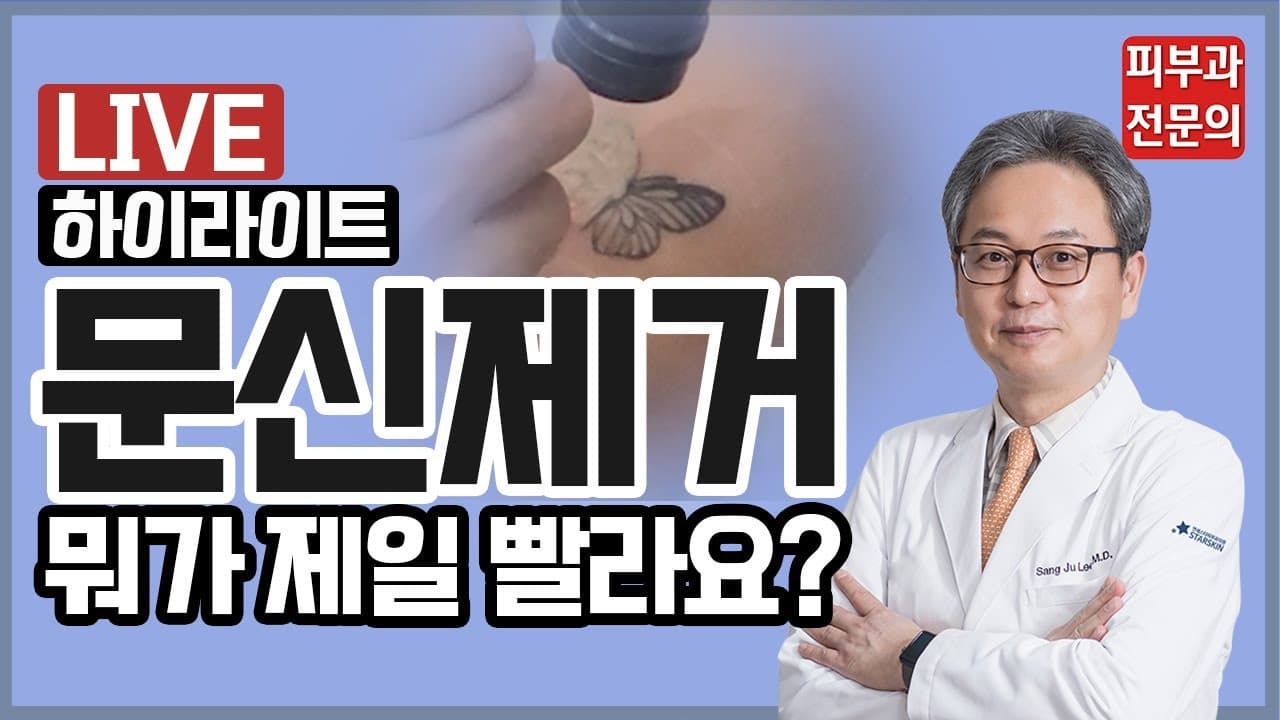
Tattoo Removal: Why Is It So Difficult?
Once a tattoo is etched, it's not easily erased, causing many people concern. Traditional laser tattoo removal, in particular, requires multiple sessions, and many questions arise during the process. Today, we'll delve into the principles of how tattoos remain on our bodies, the latest effective tattoo removal methods, and post-treatment care.
Why Do Tattoos Remain on Our Bodies?
Our bodies contain cells that clear foreign substances. These cells can move small tattoo ink particles, causing them to disappear. However, when tattoos are applied, ink particles larger than these clearing cells (approximately 10 micrometers in size) are injected.
"The cells in our body are unable to clear (large ink particles)."
This is why tattoo ink remains in the skin, settling permanently.
Limitations of Traditional Laser Tattoo Removal: Why Only One Pass?
When laser energy shatters tattoo ink, the ink fragments scatter, creating a cloudy 'bubble' effect, much like fog. This bubble then scatters subsequent laser light, preventing further laser penetration into the skin.
"When tattoo ink shatters and creates bubbles, the laser cannot penetrate further. The light is scattered, preventing the desired effect."
Therefore, in typical laser tattoo removal, further laser passes after the first are meaningless, making it difficult to perform multiple treatments in one session. Consequently, for tattoos with a large amount of ink, such as lettering tattoos, an average of 8-10 sessions are reported in studies, and in practice, it takes more than 4-5 sessions to notice fading.
Fast and Effective Tattoo Removal: R-Zero Technique
R-Zero Technique was developed to overcome the limitations of traditional laser tattoo removal. After a laser pass, a special medication is applied to the resulting bubbles to absorb them. This allows for immediate re-treatment with the laser without waiting.
- Reduced Treatment Sessions: Multiple laser passes (average 3-4 times) are possible in a single visit, reducing the overall number of treatment sessions. For lettering tattoos, it is reported that fading can be noticed after one or two treatments.
- Reduced Scar Risk: As a clinic renowned for scar treatment, we implement various safety measures to minimize the possibility of scar formation.
- Pain Management: We utilize various methods to minimize patient discomfort, helping patients receive treatment with less pain, even without topical anesthetic cream.
- Scope of Application: It can also be applied to eyebrow or semi-permanent tattoo removal. However, it is generally not used for areas like eyeliner where there is a risk of medication entering the eyes.
- Cost: Since multiple laser passes are performed in one session, the cost may be higher than standard procedures, but the clinic applies fees similar to other specialized clinics.
Fractat Technique: For Deep Ink in the Skin
Fractat Technique is a method that enhances tattoo removal by creating micro-holes on the skin surface. First proposed in 2013, this method originated from the concept of removing the upper layer of skin to eliminate deep-seated tattoo ink.
Fractat first uses a Fractional Laser to create micro-holes in the skin, followed by a conventional (full-beam) laser pass. The principle is that these micro-holes reduce the bubbles generated during laser irradiation, thereby enhancing the tattoo removal effect. Approximately 1.2 times the effect of a standard procedure can be expected.
- Pico Fractat: This refers to using a Pico Laser with the Fractat Technique. Pico Laser is known to be more effective for tattoo treatment than traditional Q-switched lasers, so even better results can be expected.
- Treatment Interval: Typically, treatments are performed at one to two-month intervals until the tattoo is removed.
- Skin Damage: If excessively strong energy is not used, the procedure can be performed without major issues.
R-Zero vs. Fractat: What's the Difference?
Both methods aim to enhance tattoo removal by reducing the bubbles generated after laser treatment.
- R-Zero: Uses medication to absorb bubbles, allowing multiple laser passes (e.g., 4 times) in a single visit. In terms of the number of laser passes, it is significantly more effective than traditional methods.
- Fractat: Involves pre-drilling micro-holes to allow bubbles to rise. This method combines one session of conventional laser treatment with a Fractional Laser, expecting approximately 1.2 times the effect of traditional methods.
Therefore, based on the number of laser passes, R-Zero can be considered more effective than Fractat.
Considerations for Tattoo Removal
Tattoo removal involves more than just laser irradiation; several factors must be considered.
- When Fast Removal is Needed: If you are facing a physical examination for a police officer exam or similar, it is advisable to choose treatment methods like R-Zero or Fractat that allow for multiple repetitions in a single session. Additionally, using a Pico Second Laser, which is effective for tattoo removal with minimal skin damage, is currently considered the fastest way to remove tattoos.
- Color Tattoo Removal: For color tattoos, the laser wavelength that reacts to each color varies. Black and blue colors break down relatively well, while red responds well to 532nm wavelength, and blue to 700-range wavelengths. Therefore, it is effective to receive treatment at a clinic equipped with laser devices that can use various wavelengths. Recently, devices that emit 2-4 wavelengths simultaneously are also available, which is advantageous for color tattoo removal.
- Precautions When Choosing a Clinic:
- Good Equipment: Pico Laser equipment is more effective than Q-switched lasers. It is advisable to choose a clinic equipped with machines capable of treating various wavelengths such as 532nm, 1064nm, 737nm, and 785nm.
- Practitioner's Experience: It is crucial to receive treatment from experienced medical staff who can minimize and effectively treat potential side effects such as blisters, burns, or scars, in addition to tattoo removal itself.
- Scar Treatment Capability: It is also wise to check if the clinic has extensive experience in treating scars that may occur in rare cases.
Post-Tattoo Removal Care
Proper care after tattoo removal treatment is important.
- Cold Compress: For about a day after the procedure, the treated area may feel hot, similar to a sunburn. Applying a cold compress can help.
- Pain Management: If the pain is severe, pain relievers can be taken.
- Blister Management: Small blisters are generally not a major concern, but if large blisters form, it is advisable to visit the clinic for disinfection or treatment to drain them.
- Persistent Pain: If pain continues for 2-3 days, it is advisable to contact the clinic for consultation.
Tattoo removal results can vary depending on individual skin condition and tattoo type, so it is important to choose the optimal method for you through thorough consultation with medical staff.