
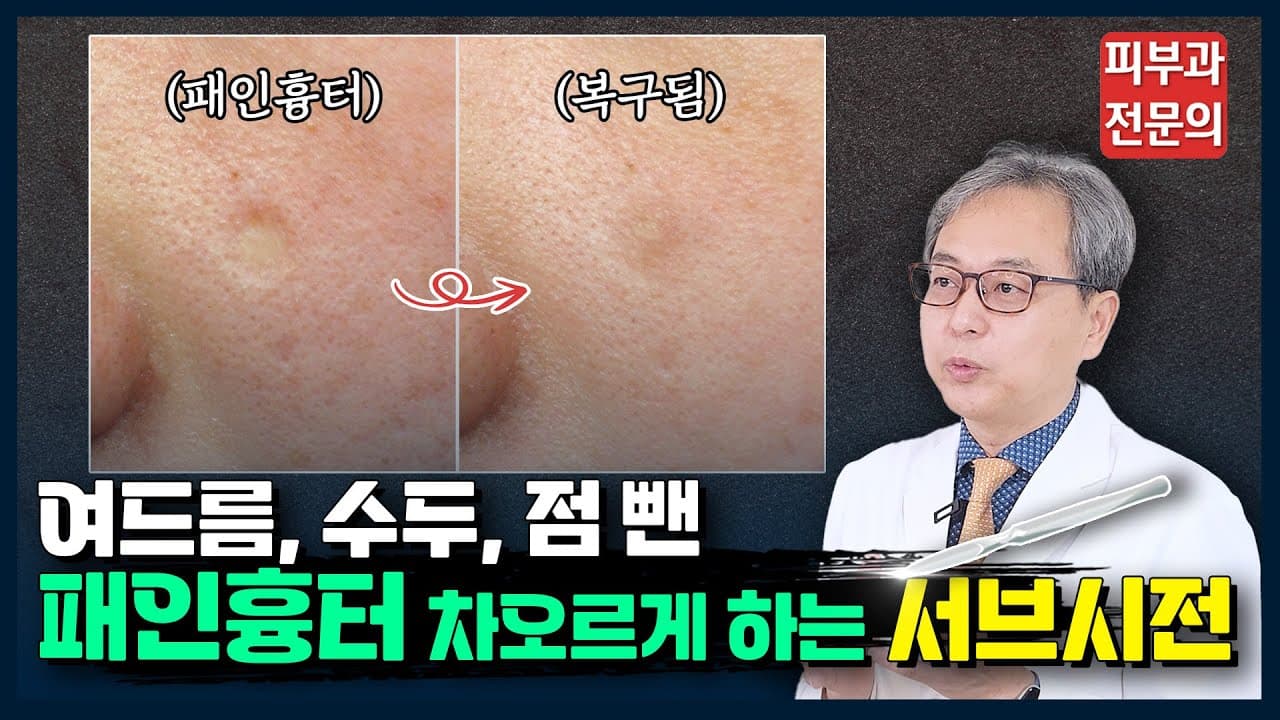
Depressed Scars: If Lasers Aren't Enough, Everything About Subcision
Hello. As a dermatologist specializing in scar treatment, I frequently meet patients concerned about depressed scars caused by acne, chickenpox, fingernails, and more. Depressed scars are typically treated by stimulating skin cells in the scar area with lasers to induce powerful skin regeneration. However, there are times when lasers alone are not enough to sufficiently fill in the depressed areas. In such cases, combining surgical treatments like Subcision, Suture-Free Punch, or Dot Peeling can enhance the effect. Among these, let's learn more about Subcision, the most commonly used procedure for improving depressed scars.
What is Subcision?
Subcision is a compound word of 'Sub (below)' and 'Cision (to cut)'. When a scar occurs, the affected area can harden or be pulled down from beneath the skin, creating a depressed scar. Subcision is a procedure that uses a needle to sever the scar tissue beneath the skin, encouraging the skin to rise.
Subcision involves inserting a needle to cut the scar tissue in that area, which can result in the skin rising.
Which Scars Are Effective for Subcision?
Subcision is particularly effective for specific types of depressed scars.
- Rolling Scars: It can show good results for scars that are broadly depressed.
- Tethered Scars: It can be expected to be effective for scars that appear to be pulled down like a string from beneath the skin.
Conversely, for narrow and deep scars like ice pick scars, other procedures that fill the skin or narrow the scar may be more suitable. Broadly depressed scars on the nose can be treated with Subcision.
Subcision Procedure and Effects?
Subcision can show effects even with a single treatment. However, unlike surgery, scar treatment tends to show better results with multiple cumulative treatments rather than being completed in one session.
After the procedure, a hematoma (collection of blood) may form under the skin, which will be absorbed in about a week. During this process, you might temporarily feel the area sinking again. However, as the hematoma disappears, new collagen is generated, so you can feel significant improvement after about a month. As this process is repeated, semi-permanent treatment effects can be expected.
Why the Operator's Experience is Important for Subcision
Subcision is a procedure that involves cutting beneath the skin with a needle, so it is performed in an area that the operator cannot directly see with the naked eye. Therefore, it is crucial for the operator to perform the procedure accurately at an appropriate depth, depending on their experience and skill. At our clinic, through research on Subcision, we can perform precise level-by-level treatments in 3 to 5 stages, and we also apply different post-treatment care to achieve more effective results.
Is Bruising After Subcision Okay?
Bruising can generally occur after Subcision. However, at our clinic, there are various methods to treat the patient's scar tissue without bruising, or to intentionally cause bruising.
Generally, bruising occurs under the skin, so its color is usually not as dark as bruises in other areas. Most bruises disappear within about a week, but depending on the shape of the scar, there are methods to intentionally create more bruising, in which case it may last for 2-3 weeks or more.
What is the Difference Between Fractional Laser and Subcision?
Both Fractional Laser and Subcision are used for scar treatment, but they target different types of scars.
- Fractional Laser: Effective for smoothing scar areas or improving uneven skin texture.
- Subcision: Effective for deeply depressed scars that are shaped like a pit.
Therefore, these two procedures are applied to different scar types, and in terms of seeing effects with a single treatment, Subcision may show more prominent results.