
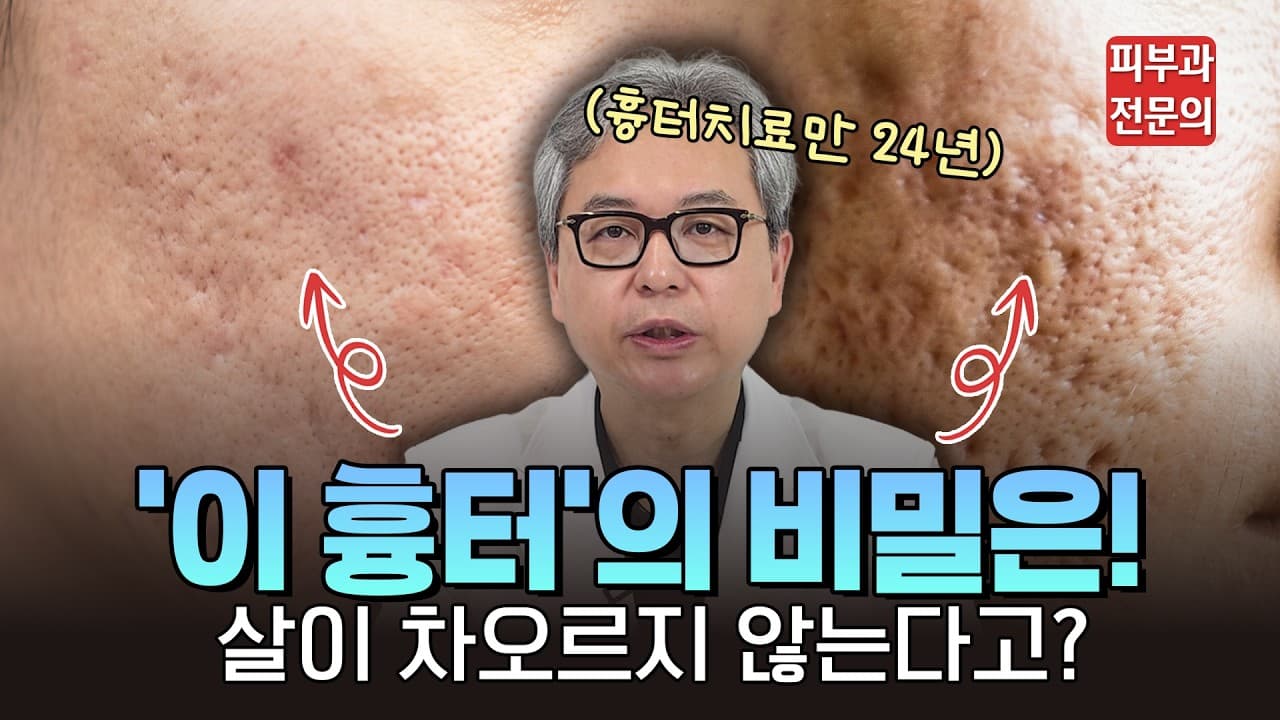
Acne is a concern for many people, from adolescence to adulthood. Severe inflammatory acne can leave depressed scars even after treatment, causing long-term stress. If your acne scars remain despite receiving good treatment, something pulling the scar from beneath the skin might be the cause. Today, we will learn more about the types of acne scars and their treatments, especially Subcision, a procedure that severs adhesions beneath the skin.
Acne Scars: Why Do They Form, and What Types Are There?
Acne scars primarily occur when the dermis is damaged by squeezing pimples or when inflammatory acne repeatedly destroys surrounding collagen tissue. The more severe the inflammation, the deeper and more severe the scars tend to be.
Although the cause of acne scars is a single factor—acne—their appearance varies greatly. Generally, depressed scars are common, but they can also appear as keloid scars on the chin or bumpy papular scars on the nose.
Three Representative Types of Acne Scars
Acne scars, which primarily appear as depressed forms, can be broadly divided into three types based on their shape:
- Icepick Scars (Ice Pick Scars, Pore Scars)
- These are narrow, deep scars, usually 1-2mm or less at the opening. They resemble marks made by an ice pick and often look similar to enlarged pores.
- Boxcar Scars
- These are depressed scars with distinct, square-shaped borders, typically 2mm or more in diameter. They are named for their resemblance to the rectangular compartments of a boxcar.
- Rolling Scars
- These are broad, shallow, wave-like depressions with smooth edges. They often occur when inflammation is severe and deep.
Do Acne Scars Disappear Naturally?
These types of acne scars generally do not improve naturally. They tend to persist over time, often requiring active treatment.
Various Acne Scar Treatments: Why Combination Therapy Is Needed
Depressed acne scars require different treatments depending on their type, and the methods are highly diverse. Broadly, they can be divided into methods using lasers or radiofrequency, and procedural methods like Subcision or Suture-Free Punch.
However, because acne scars vary in shape and size, it is difficult to treat them perfectly with a single method. Just as a sculptor uses various carving tools, it is necessary to choose the appropriate method according to the scar's shape, so combination therapy is usually required.
Furthermore, rather than attempting to eliminate scars all at once, a gradual, repetitive approach is often the safest and most effective method.
What Is Subcision?
Let's delve into Subcision, one of the representative methods used for acne scar treatment.
"Sub-" refers to beneath the skin, and "incision" means to cut. Thus, Subcision refers to a procedure that incises beneath the skin.
Depressed scars are caused by hardened or tethered scar tissue pulling the skin downwards. Subcision uses a special needle to sever this adherent scar tissue, helping the skin to rise.
Especially for broad and deeply depressed scars, the scar tissue is often deep and pulls from above. For example, in broad, saucer-like scars such as chickenpox scars, Subcision can cut the underlying scar tissue and soften it, causing the scar to spring up as if a stretched rubber band has been released.
After the procedure, a void forms between the severed tissues, into which surrounding blood collects. This blood acts like a natural, absorbable filler in the body, and as it is absorbed, it fills the area with new collagen, pushing the scar upwards. Therefore, two effects can be expected from a single procedure.
Which Scars Are Effective for Subcision?
Subcision is particularly effective for the following types of scars:
- Round, depressed rolling scars
- Scars that appear to be pulled down by a cord-like structure underneath
Depressed scars on the nose can also be treated with Subcision. However, for icepick scars, where the pulling area underneath is narrow, other procedures that fill or narrow the scar might be more suitable.
Expected Process and Effects After Subcision
Subcision can show effects with a single treatment, but scar treatment can achieve cumulative effects with repeated treatments.
Hematoma (blood clot), which may occur after the procedure, is absorbed in about a week. During this process, you might temporarily feel the area sinking again. However, as the hematoma beneath disappears, new collagen is generated, so you may notice an improvement after about a month. As this process is repeated, semi-permanent treatment effects can be expected.
At our clinic, we can perform the procedure to cause bruising or to avoid it. Various treatment methods are available to match the patient's scar tissue characteristics. Generally, bruising occurs beneath the skin, so its color is not as dark as typical bruises, and it usually disappears in about a week. However, depending on the scar's shape, methods that intentionally create more bruising might be used, in which case the bruising could last for 2-3 weeks or more.
Subcision: Why the Operator's Experience Is Important
Subcision is a procedure that uses a needle to sever adherent tissue beneath the skin, and the treatment area is not visible to the naked eye. Therefore, the operator's experience is crucial, and the procedure must be performed accurately at the appropriate depth.
At our clinic, through research on Subcision, we can perform precise 3-5 stage procedures, and post-procedure care is also applied differently to achieve more effective results. Based on the know-how directly taught by Dr. Goodman, an authority in acne scar treatment in Australia, we can precisely treat scars according to their shape, expecting excellent results even with a single procedure.
Fraxel vs. Subcision: What's the Difference?
Fractional laser is effective for smoothing uneven scar areas or improving rough skin texture. In contrast, Subcision is effective for deeply depressed, crater-like scars. Therefore, their targets are somewhat different. However, in terms of effectiveness as a single procedure, Subcision may be more effective.