
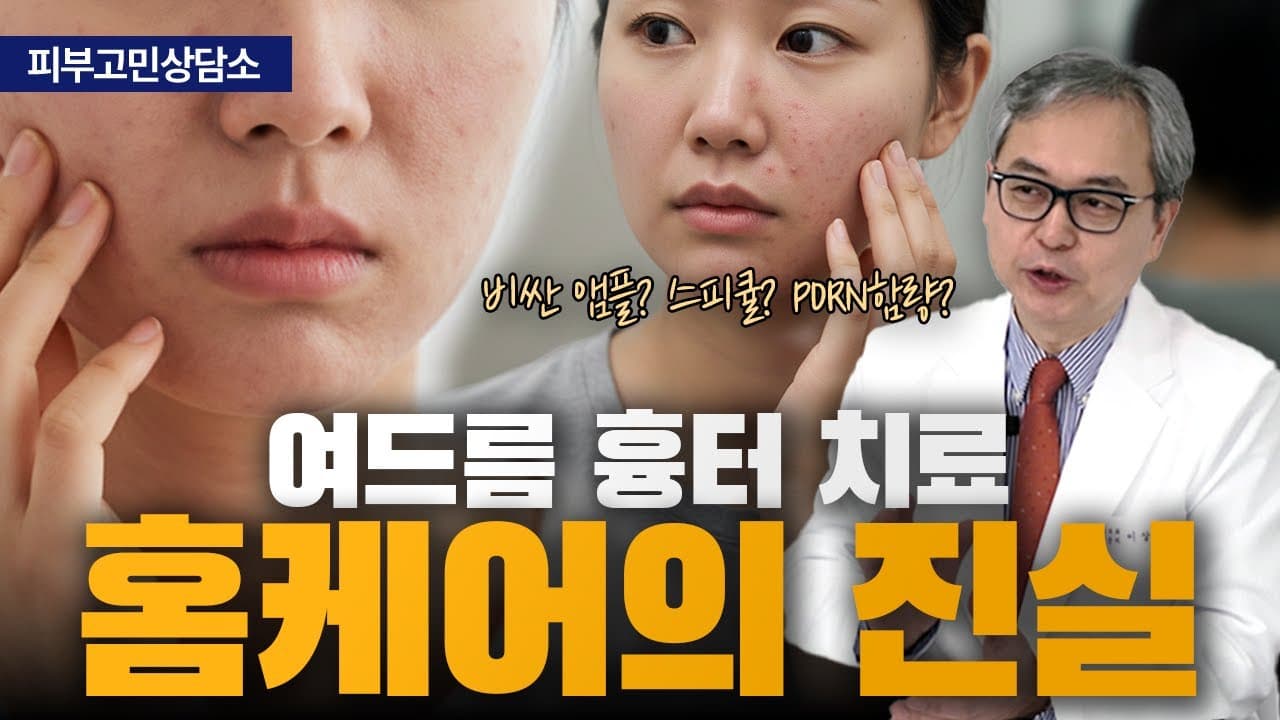
If applying an entire bottle of a good ampoule doesn't fill the pitted holes on your face, it's not your fault; it's because you're addressing the wrong issue. Acne scars are like collapsed ground that cosmetics cannot reach. Acne is a chronic inflammatory disease involving a complex interplay of hormones, sebum, dead skin cells, and acne bacteria. Acne scars are structural defects where skin structures have melted away and fibrosis has progressed after that inflammation has swept through.
Acne and Scars Are Different Problems
If acne is a war of inflammation occurring within the skin, acne scars are the sunken ground after that war has ended. It's not simply pitted skin, but a structural defect where tissues are entangled and hardened, making it difficult to restore with surface management alone.
Understanding Why Home Care Isn't Enough
Ingredients that open up pathways for sebum, like spicules, can be helpful for early-stage comedonal acne. However, recurrent inflammatory acne in the same spot is difficult to resolve with home care alone. Since the root cause, the sebaceous glands, are enlarged and produce excessive oil, merely treating the surface can lead to easy recurrence.
- First, prevent recurrence by reducing the sebaceous glands that produce sebum with Gold PTT-type treatments.
- Second, address the redness of inflammation with vascular lasers.
- Treating blood vessels when red marks are present can help block the path to deep, pitted scars later on.
Existing Scars Require Internal Structure Remodeling
Once acne scars have formed, it's difficult to expect noticeable improvement with cosmetics or ointments. This is because fibrosis progresses beneath the skin, and entangled lumps or rope-like tissues pull on the surface, leaving pitted scars.
There's no use applying good products to the surface if these rope-like tissues aren't severed.
Therefore, the core of treatment is not about shaving or managing the surface, but about remodeling the internal structure by severing the internal ropes and rebuilding a firm structure.
Three Checklists to Review During Consultation
Acne scars vary in shape, making it difficult to expect significant results with a single laser treatment. Checking the following three points during your consultation can be helpful:
- First, can deep scars be physically lifted? For icepick scars, where lasers have difficulty reaching the bottom, check if Suture-Free Punch, which lifts the sunken skin with a punch device, is possible.
- Second, can the rope-like tissues within the skin be severed and filled? If the fibrotic bands beneath round scars are not severed with Subcision, there are limits to how much the skin can fill in.
- Third, can even hard, stubborn scars be treated? For scars as hard as stone, check if advanced procedures like Pinhole Technique, which creates microscopic holes to flexibly loosen the tissue, are possible.
Based on Principles Proven by Research
Dr. Lee Sang-joo's paper, published in a European dermatology journal, states that thick, entangled collagen masses and abnormal fibrous cords that hold scars can be selectively severed. Yonsei Star Dermatology uses this proven principle to sever entangled fibrosis and fill the empty spaces with skin boosters, inducing collagen regeneration to occur naturally.
Tissue biopsy results also confirmed that the tightly clumped, hardened scar tissue before treatment became a more flexible tissue with loosened collagen bundles after Pinhole Technique treatment. True acne scar treatment means not just shaving the surface, but loosening the entangled internal structure itself.
Results may vary individually, and accurate diagnosis and treatment are determined after consultation.
Written by Lee Sang-joo (Yonsei Star Dermatology) · Medical Staff Introduction · Last reviewed 2026-06-04