
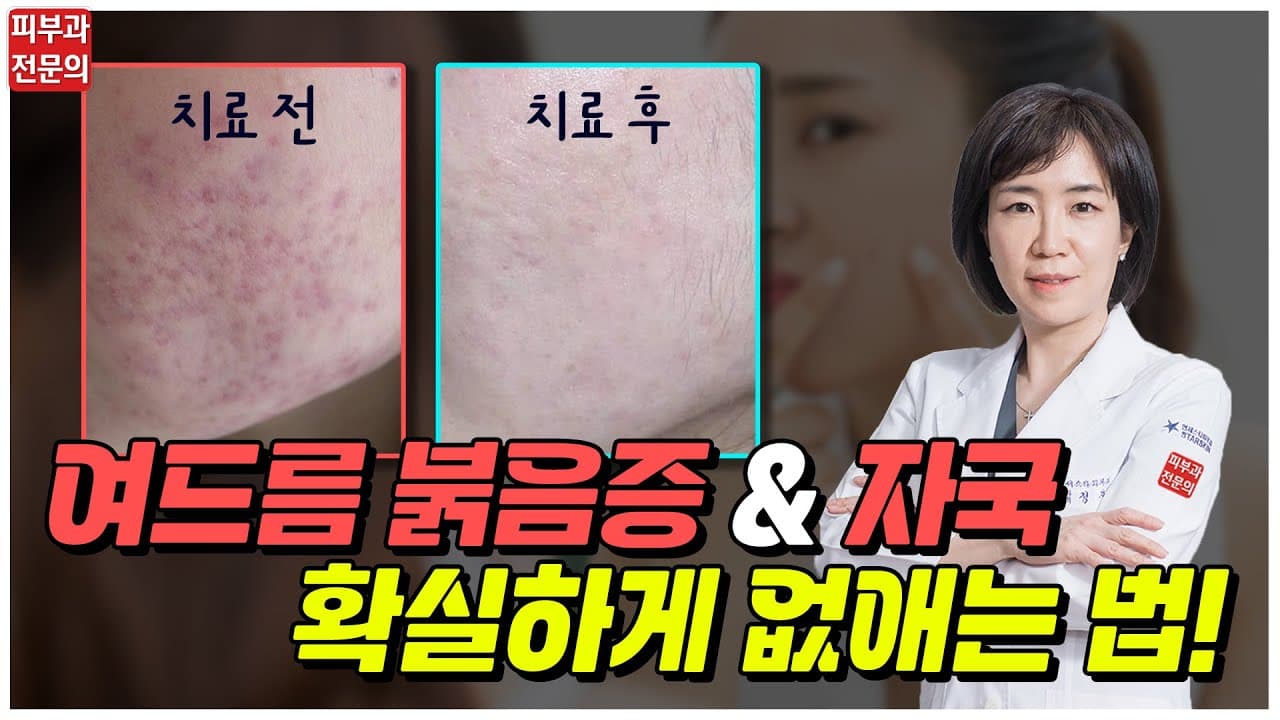
Hello, I am Dr. Ji-in Jung, a board-certified dermatologist. During the hot summer, acne often worsens as pores become clogged due to sweat and secretions. Acne itself is a concern, but many people also experience social anxiety due to accompanying redness, or brown/dark red hyperpigmentation. Today, we will delve into the causes of acne redness and marks, and effective prevention and management methods.
Why do acne redness and hyperpigmentation occur?
Acne redness or dark red hyperpigmentation is caused by inflammation. When acne develops, sebum in the hair follicles continuously causes inflammation. If this inflammation damages the skin, our body generates many blood vessels around the inflammation to protect and heal the skin. This leads to the red symptoms appearing in the acne area.
Most redness returns to normal after sufficient time for recovery, but if the inflammation is severe or prolonged, or if keloid scars form, it is likely to leave brown or dark red acne marks.
Do acne marks necessarily need to be treated at a dermatology clinic?
If someone were to ask me, a board-certified dermatologist, 'Do acne marks necessarily need to be treated at a dermatology clinic?', I would honestly answer, 'You don't necessarily have to treat them at a dermatology clinic.'
This is because most acne marks naturally fade over time, even without treatment.
However, it is impossible to know when these marks will disappear, and depending on the individual, they may disappear in a few months or remain for several years. Therefore, if you wish to improve acne marks more quickly and cleanly, you may consider professional treatment.
Time-specific preventive treatment for acne redness and marks
To achieve good results in treating acne redness or acne marks, it is crucial to remember that time-specific preventive treatment to prevent progression to the next stage is very important.
Comedonal acne stage
When there is white comedonal acne, it is advisable to prevent it from progressing to inflammatory or pustular acne. For this, you can consider the following methods:
- Oral medication prescription
- Sebum-reducing treatments such as Gold PTT
Pustular acne stage
If it has already progressed to pustular acne, it is advisable to reduce inflammation by prescribing antibiotics and remove the sebum causing the inflammation through extraction.
Caution: If you extract at home by yourself, incorrect methods can damage the skin or make inflammation spread more easily inwards, which can cause hyperpigmentation and scars. We recommend professional extraction at a dermatology clinic if possible.
Redness stage
To prevent acne redness from leading to marks, treatment that removes the microvessels causing the redness is effective.
- You can expect satisfactory results through the latest vascular laser treatments such as Vbeam Prima.
How to manage existing acne marks?
Acne marks usually fade naturally over time, even without treatment. However, it is impossible to know when the marks will disappear, and depending on the severity, some people see them disappear in a few months, while others have them for several years. Therefore, if you want to improve acne marks more quickly and cleanly, you can consider laser toning procedures.
Can old acne marks also be effectively treated?
Surprisingly, many people are concerned about acne marks that remain after several years. In such cases, they often wonder, 'Is laser toning useless for old acne marks?'
If the marks are very old, they are often accompanied by other problems such as depressed scars or changes in skin texture rather than just hyperpigmentation. For these cases, it is more desirable to combine basic scar treatments such as Subcision or filler with laser toning.
Old marks can be somewhat challenging to treat, but you can definitely see improvement. Don't worry too much, and consult with a board-certified dermatologist to create a treatment plan that suits you.
So far, we have discussed the causes of acne redness and marks, and effective management methods. We hope today's content was helpful, and if you have any further questions, please feel free to consult with a board-certified dermatologist.